
Essay
v1.0
The Economics of Coordination
The larger business case is not production cost. It is coordination cost, decision latency, variance and learning rate.

A note from the author
Most of the economic discussion around AI starts with productivity. How many hours can we save? How much work can one person now produce? Which tasks can be automated? Those questions matter, but they increasingly feel like the first-order effect. Building Revenue Labs has made me much more interested in the work surrounding the work: reconstruction, reporting, meetings, handoffs, management inspection and all the other mechanisms companies use to make fragmented activity cohere. If AI changes that layer, the economics become much larger than task automation. This essay explores a question I think deserves more attention: what happens to the shape of the firm when the cost of coordination itself starts to fall?
A salesperson needs to prepare for a meeting. AI can research the account, summarise previous conversations and generate a briefing in seconds. The obvious productivity gain is easy to see.
Work that previously took thirty minutes now takes three. Apply the same logic across prospecting, follow-up, reporting, analysis, customer research and administration and the economic argument for AI appears straightforward.
The cost of producing knowledge work falls. This matters. But I think it captures only the first-order effect. Companies do not only pay people to produce work. They pay an enormous, mostly invisible cost to make the work of many people cohere.
People search for information. Reconstruct context. Ask colleagues what changed. Prepare others for decisions. Reconcile conflicting interpretations. Attend meetings. Produce reports. Escalate exceptions. Manage handovers. Translate objectives into activity. Check whether work happened. Correct inconsistent execution.
Much of this does not create the final commercial output. It makes coordinated action possible. As AI moves from helping individuals produce work toward maintaining State, applying organisational Memory, executing Skills and coordinating capabilities, it begins affecting this second cost. The cost of coordination. That may prove to be the larger economic change.
The productivity frame is too narrow
Most technology waves are initially understood through the work they visibly replace. Spreadsheets made calculation faster. Email made communication faster. CRM made customer information easier to store and retrieve.
AI writes faster. Researches faster. Summarises faster. Analyses faster. This framing naturally leads to productivity calculations. If an employee spends five hours per week on tasks AI can perform twice as quickly, how much capacity is released?
These calculations are useful. But they assume the surrounding organisation remains broadly unchanged. The same roles. The same management structure. The same review cycles. The same information flows. The same decision processes. Only the tasks inside them become cheaper.
That is roughly what happens when AI is added to an existing operating model. An AI-native operating model raises a different question. What if some of the organisational mechanisms surrounding the work were themselves responses to previous technological constraints?
Then AI does not only make existing work faster.
It changes how much of that work needs to exist.
Companies pay to reconstruct context
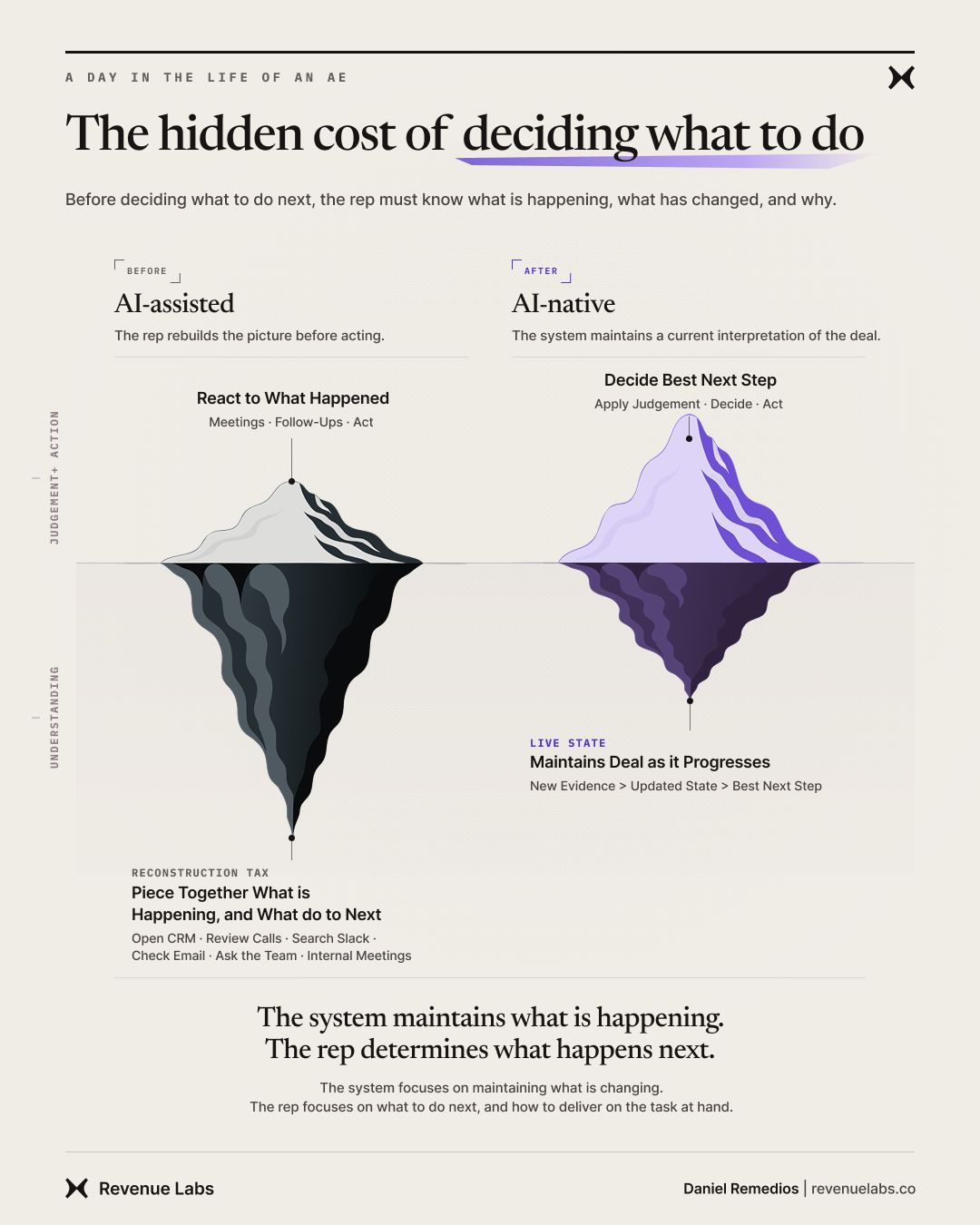
Start with reconstruction. A manager preparing for pipeline review needs to understand what changed across twenty opportunities. An AE preparing for a meeting needs to reconstruct the account. A CSM preparing for a renewal needs to reconstruct the customer. A CRO preparing for forecast needs to reconstruct the pipeline through layers of reports and management interpretation.
None of this reconstruction is the final decision. It is the cost of getting into a position where a good decision can be made.
We rarely measure it separately. The calendar simply contains a two-hour pipeline review. The salesperson simply blocks thirty minutes before the call. RevOps simply spends Monday preparing the report. But economically, these activities matter.
Suppose ten people independently reconstruct overlapping parts of the same commercial reality. The company pays for the same context repeatedly. This is partly what fragmented software does. Each application stores evidence. Each person assembles the subset they need.
A maintained Live State changes the economics. The organisation pays more of the reconstruction cost once, at the system level, rather than repeatedly at the individual level.
That does not make reconstruction free. The system still has to ingest evidence, interpret it and maintain state. But software can reuse the result.
Humans cannot easily share the context in their heads at zero marginal cost.
Persistent state can.
Reusable context has different economics
This is an important property of software. Once a system has established something useful, the marginal cost of making that understanding available elsewhere can be very low.
Suppose the system determines that champion strength on a deal has declined. That state can inform: Meeting Preparation. Deal Assessment. Pipeline Review. Forecasting. Coaching. An executive briefing.
The organisation does not need five independent reconstructions of champion strength. The interpretation becomes reusable infrastructure. The same is true of Memory. Define the ICP once and multiple prospecting capabilities can inherit it. Improve the definition of a champion and multiple sales capabilities can use it. Update positioning and research, preparation and follow-up can all change.
The same is true of Skills. Improve Account Research once and several capabilities can benefit. This is where the economics begin to move beyond individual task automation.
The organisation creates reusable context, judgement and methods. Each improvement can propagate through multiple pieces of work. That is leverage.
Coordination cost rises with complexity
This becomes more important as organisations grow. A ten-person company can coordinate largely through conversation. People share context naturally. The founder knows most customers. Information travels quickly.
As the organisation expands, the number of potential relationships between people, teams, systems and decisions increases. Coordination becomes harder. The company responds by adding structure.
Managers. Processes. Meetings. Reporting. Operations. Specialised systems. These mechanisms are not bureaucratic accidents. They are responses to complexity. But they carry cost.
A sales manager coordinates several reps. A director coordinates several managers. RevOps coordinates processes and systems. Executives coordinate functions. The hierarchy helps compress information and distribute decisions. In that sense, organisational structure is partly a technology for managing coordination cost.
AI changes some of the underlying constraints. If more state can be maintained automatically, more organisational logic can be shared and more recurring capabilities can execute consistently, the amount of human coordination required for a given level of complexity can change.
That does not imply a company without hierarchy.
It implies that the efficient shape of the hierarchy may move.
Management bandwidth is an economic constraint
Consider a sales manager. They have finite attention. They can deeply inspect perhaps a small number of deals in a day. They can listen to a subset of calls. They can coach a subset of behaviours.
They rely on scheduled reviews and employee escalation to discover where their judgement is needed. As team size increases, management quality tends to degrade unless another manager is added. This creates a familiar relationship between headcount and management overhead.
AI-native systems can alter that relationship. If the system maintains deal state, identifies meaningful changes, assesses routine situations and surfaces exceptions, the manager no longer needs to inspect every opportunity to discover which ones deserve attention.
Their scarce resource moves from observation toward judgement. That can increase management span without requiring every manager to work more hours. The same manager may be able to support more commercial activity because the system absorbs more of the monitoring and reconstruction burden.
This is not simply manager productivity. It changes the production function of management.
Attention is the scarce input
This points to a broader economic idea. Information used to be scarce. Then information became abundant. AI makes analysis and generated work increasingly abundant too.
Human attention does not scale in the same way. A CRO still has twenty-four hours in a day. A manager can still only think deeply about a limited number of situations. A salesperson can still only have so many meaningful customer conversations.
As machine production becomes cheaper, the relative value of attention increases. The operating system therefore creates value partly by deciding what does not require human attention.
A healthy deal with no meaningful change may not need review. A low-value account with no buying signal may not deserve research. A customer whose state remains stable may not require intervention. The system absorbs routine observation. It escalates meaningful change.
Human attention moves toward: uncertainty, novelty, high consequence, relationships, creative judgement, and exceptions.
The economic objective is not to maximise automation. It is to allocate scarce human cognition where its marginal value is highest.
Decision latency has economic value
There is another cost that traditional productivity analysis misses. Time between a change in reality and an organisational response.
A customer begins disengaging. Nobody notices until the monthly review. A strategic account hires a new CRO. The SDR discovers it six weeks later. A deal loses momentum. The manager identifies the problem during Friday’s pipeline review. The organisation eventually makes the right decision.
But it makes it late.
This is decision latency. We can think of the sequence as: Event → detection → interpretation → decision → action. Every interval creates delay.
Traditional software has improved detection dramatically. AI can compress interpretation. Live State can reduce the need to reconstruct context. Capabilities can reduce the delay between interpretation and action. Agents can execute immediately where autonomy is appropriate.
The result is not merely lower labour cost. The company reacts to the world faster. That has direct commercial value.
A risk identified earlier provides more time to intervene. A buying signal recognised earlier creates a better chance of engagement. A pricing issue discovered before a renewal conversation is more useful than one discovered afterwards.
In many markets, the value of a correct decision decays with time. Reducing decision latency therefore has economic value even when the decision itself does not change.
Variance is expensive
Companies also pay for inconsistent execution. Two reps research accounts differently. Two managers qualify similar opportunities differently. Two CSMs respond differently to the same customer-risk pattern.
Some variation reflects legitimate judgement. Some reflects uneven access to organisational knowledge and methods. The economic consequences appear as: missed opportunities, poor forecasting, unnecessary escalation, longer onboarding, inconsistent customer experience, and dependence on a small number of exceptional people.
Traditional process tries to reduce this variance. Training. Playbooks. Templates. CRM requirements. Management. Quality assurance.
Executable Memory and Skills create another mechanism. The organisation can make more of its current judgement and methods available directly inside the work.
The goal is not identical behaviour. It is reducing variance caused by people operating from different versions of what the company already knows. That distinction matters.
Healthy variation comes from judgement applied to different situations. Wasteful variation comes from rediscovering the same operating logic independently. AI-native systems should reduce the second without eliminating the first.
Expertise becomes more scalable
This changes the economics of exceptional people. Imagine a company has one extraordinary sales manager. Today, the manager’s judgement scales primarily through direct interaction. They coach people. Review deals. Create playbooks. Train other managers.
Their expertise has high value but limited bandwidth. If more of their method can become Memory and Skills, their judgement can influence work they never personally inspect. The manager’s expertise moves from a purely labour-based asset toward an input into organisational infrastructure.
The same applies to founders. Top salespeople. Customer experts. Industry specialists. The organisation can increasingly separate some portion of expertise from the immediate presence of the expert.
This does not make experts less valuable. It may make the best ones more leveraged. A strong operator can improve the system through which hundreds of other decisions occur. The unit of impact changes.
Onboarding is partly a coordination cost
Consider a new salesperson. The company pays their salary from day one. Full productivity may take months. Why? They need product knowledge. Market understanding. Process. Tools. Messaging. Examples. Judgement.
They need to reconstruct enough of the company’s operating model inside themselves to perform effectively. During this period, managers and peers also spend time transferring knowledge. Onboarding is therefore partly a knowledge-transfer and coordination problem.
Executable Memory and Skills can change its shape. The employee still needs to learn. But they can operate inside a system that already contains more of the company’s knowledge and methods.
The system can bring the relevant context into the work. The new rep does not need to perfectly remember the ICP to conduct Account Research. They do not need years of company experience before every known deal pattern becomes available to them.
The economic effect is not simply cheaper training. It is potentially a shorter distance between joining the organisation and contributing with organisational context.
The cost of change can fall
Companies also pay heavily to change how they operate. Suppose leadership changes the ICP. Today that decision may require: new documentation, new training, new lists, new CRM logic, new sequences, manager communication, reporting changes, and repeated reinforcement.
Different parts of the organisation adopt the new logic at different speeds. For a period, the company runs multiple versions of itself. This is expensive.
An AI-native system cannot eliminate change management. People still need to understand important strategic changes. But executable Memory and Skills can reduce the propagation cost.
Change the relevant organisational logic. Capabilities using that logic can inherit the upgrade. The next Account Prioritisation decision uses the new ICP. The next Meeting Preparation uses the new positioning. The next Deal Assessment uses the updated qualification definition.
This creates a different economic property: the marginal cost of propagating organisational judgement falls. That may allow companies to adapt more frequently without creating equivalent increases in coordination burden.
AI changes the minimum efficient scale of some functions
This leads to a more structural consequence. Companies have historically required certain amounts of organisational infrastructure at certain scales. Enough sellers require managers. Enough tools require operations. Enough customers require specialised success infrastructure. Enough reporting complexity requires analysts.
These relationships will not disappear. But their ratios can change. A small GTM team with a strong operating layer may be able to perform work that previously required a larger operational structure.
A manager may support a broader span. RevOps may govern more capabilities without manually configuring every workflow. A smaller team may maintain more sophisticated prospecting or customer intelligence. This can change the minimum efficient scale of parts of the organisation.
The important economic question therefore becomes less: “How many jobs does AI replace?” and more: “What organisational output can a given amount of human coordination now support?” That is a more useful way to think about leverage.
Software spending may move too
There is another economic effect. Companies currently pay for a large number of applications partly because each application packages a particular set of workflows and intelligence. As capabilities begin operating across systems, some of that value may migrate.
The organisation may continue paying for systems of record and specialised infrastructure. But the operating layer increasingly owns: context, judgement, orchestration, cross-system capabilities, and user attention.
This changes the basis on which software value is measured. Seat count becomes less natural when machine actors perform a growing share of the work. Application usage becomes less meaningful when capabilities appear across multiple surfaces.
The economic unit may move toward: records understood, decisions made, capabilities run, actions performed, commercial value managed, or outcomes influenced. Pricing architecture will have to follow operating architecture.
The SaaS seat was economically coherent because the human user was the primary unit of software consumption. AI-native systems complicate that assumption.
But lower costs do not automatically become higher margins
There is an important counterargument. Every technological reduction in production cost does not simply flow to company profit. Competition matters.
If every company can produce outbound at one-tenth the cost, markets receive more outbound. Attention becomes scarcer. If every company can create content instantly, content itself becomes less differentiated. If every sales team can research every account, research ceases to be an advantage. The gains can be competed away.
This is why simple “AI saves X hours” economics are incomplete. When production becomes cheap, value migrates toward things that remain scarce.
Proprietary context. Judgement. Relationships. Distribution. Attention. Trust. Speed of learning. AI-native architecture matters because it can strengthen some of these less commoditised assets.
The objective is not merely to generate more work for less money. It is to build an organisation that learns and coordinates better than competitors using access to similar intelligence.
The important metric may be decisions per unit of coordination
This suggests a different way of thinking about organisational productivity. Traditional productivity often measures output per worker. Revenue per employee. Calls per rep. Tickets per support agent.
AI will make many activity metrics increasingly strange. If agents perform thousands of actions, action volume tells us little about organisational quality. A more interesting metric might be something like: useful decisions per unit of human coordination.
How much commercial complexity can the organisation manage without proportionally increasing meetings, management, operations and reconstruction? How many accounts can it understand? How many opportunities can it govern? How many customers can it monitor? How quickly can it respond to change? How consistently can it apply judgement?
The exact metric will differ by company. The principle is that AI-native leverage appears not only in output volume, but in the ratio between organisational intelligence and the human coordination required to produce it.
Then there is the learning rate
So far, these effects make the organisation cheaper or faster. There is another effect that may ultimately matter more.
Suppose two companies begin with identical economics. Both adopt AI. Both reduce administrative work by 30%. Both increase management leverage. Both lower decision latency.
But one has Decision Traces connecting its actions to outcomes. It learns which State matters. Which Memory is wrong. Which Skills work. Where humans outperform agents. Where agents outperform humans. Its capabilities improve.
The other company receives the same productivity gain every year. The first company’s gain compounds. This introduces a different economic variable: learning rate.
How quickly does operating the company improve the system through which the company operates? A traditional process may improve quarterly. An AI-assisted process may execute faster but improve at roughly the same organisational cadence.
An AI-native capability can potentially generate evidence about itself every time it runs. That changes the shape of the advantage.
The value is not simply: cost saved per execution.
It is also: improvement generated per execution.
The compounding company
This is where the economics become more interesting. Imagine an Account Prioritisation capability. At first it performs reasonably well. It uses current ICP Memory, buying signals and account State.
People override some recommendations. Outcomes accumulate. The system identifies patterns. The ICP improves. The Skill improves. Prioritisation improves. Better accounts receive attention. The resulting outcomes create better evidence. The next version improves again.
The same can happen with Deal Assessment. Customer Risk. Meeting Preparation. Coaching. Each capability produces work. The work produces outcomes. The outcomes improve the capability.
The company is not simply consuming software. It is accumulating operational capability through use. That is a fundamentally different economic property from most SaaS.
Traditional software may create data network effects or workflow lock-in. An AI-native operating system can potentially create learning effects inside the customer organisation itself. The longer the system operates, the more company-specific it becomes.
This changes the nature of the asset
What exactly has the company accumulated after several years? Not simply data. Its Live State will continue changing. Not simply prompts. Models and techniques will evolve. It has accumulated: organisational Memory, Skills, Decision Traces, outcome history, evaluations, governance, and increasingly refined capabilities.
It has encoded more of how the company understands and operates its market. That is an asset. It may not appear neatly on the balance sheet. But neither do many of the capabilities that make one organisation outperform another. The difference is that more of this asset can now become persistent and executable.
A competitor can buy the same CRM. It can access the same foundation model. It can hire similar people. It cannot instantly reproduce years of company-specific judgement, traces and capability improvement. That is where the defensibility argument begins.
From labour leverage to organisational leverage
The first wave of AI economics is understandably focused on labour. How much work can one person now perform? How many tasks can be automated? How much headcount can be avoided? These questions matter.
But the operating-model view suggests a larger frame. How much complexity can the organisation manage? How quickly can it understand change? How consistently can it apply its judgement? How efficiently can it allocate scarce attention? How rapidly can improvements propagate? How quickly can the system learn from outcomes? These are properties of the organisation, not merely the individual worker.
AI therefore creates two forms of leverage. Labour leverage: more output per person. And organisational leverage: more coherent intelligence, decisions and action per unit of coordination.
The second may ultimately matter more. Because companies are not simply collections of productive individuals. They are systems for coordinating specialised people and resources toward shared objectives. Change the cost of that coordination and you change the economics of the firm itself.
The economic frontier
The SaaS era digitised workflows and created enormous productivity gains. The first phase of AI is making many of those workflows faster. But if AI remains only inside the existing architecture, the surrounding coordination system remains largely intact.
People still reconstruct. Managers still gather state. Operations still reconcile. Knowledge still propagates unevenly. Decisions still wait for scheduled reviews.
The larger opportunity appears when intelligence becomes part of the operating layer. State is maintained. Judgement becomes reusable. Methods become executable. Capabilities span applications. Attention is allocated by change. Decisions become traceable. Outcomes improve the system.
At that point, AI is no longer only reducing the cost of performing work. It is changing the amount of human coordination required to operate the company. And once that happens, the relevant economic question changes.
Not: How much faster can AI make the work we already do?
But: What kind of organisation becomes economically possible when the cost of understanding, deciding, coordinating and learning falls?
This essay is versioned. Where our thinking develops materially, we will update the version and explain why - the revision history is preserved, not polished away.