

A note from the author
Companies already have enormous amounts of knowledge. ICP documents. Messaging. Sales methodologies. Competitive notes. Customer frameworks. Leadership judgement. The problem is that most of it sits outside the work. People have to find it, remember it, interpret it and decide whether to apply it. AI can retrieve those documents faster, but that still leaves an important question: how does what the company knows become part of how the system operates? That is how we arrived at Memory. I increasingly think the important shift is from organisational knowledge as something people can read to organisational knowledge as something people and machines can reliably operate from.
Imagine two sales managers reviewing the same deal. They have access to the same CRM record, the same customer conversations and the same qualification framework.
One thinks the deal is healthy. The other is concerned.
The difference may not be information. One manager has seen this pattern before. The champion is enthusiastic but has not demonstrated the ability to mobilise the organisation. The economic buyer has technically been identified, but remains distant from the process. The customer keeps agreeing to next steps without creating internal momentum.
Nothing is obviously wrong. But the experienced manager has learned that this combination matters.
That judgement may have taken years to develop. It may have come from hundreds of customer conversations, dozens of slipped deals, mistakes, coaching from previous leaders and patterns the manager cannot completely articulate.
The company benefits from that knowledge whenever this particular manager is involved. The harder question is whether the organisation has learned it.
Usually, only partially.
This distinction between what people know and what the organisation knows becomes increasingly important as we build AI-native systems. Live State gives a system a maintained representation of what is happening.
But state alone cannot tell it what that reality means. To decide well, the system needs access to something companies have historically struggled to represent: their accumulated judgement.
Companies know more than their software does
Every mature company contains an enormous amount of knowledge. Some of it is explicit.
The ICP is documented. The sales process has stages. Messaging exists in Notion. Competitive battlecards describe alternatives. Customer success has a health framework. Pricing rules exist somewhere. New employees receive onboarding materials.
This is the visible knowledge of the organisation. There is another layer.
The founder knows that companies going through a particular transition make unusually good customers. The CRO knows that certain language from a buyer usually signals weak executive sponsorship. A strong AE knows that an enthusiastic contact is not necessarily a champion. An experienced CSM knows that falling executive engagement can matter before product usage declines. A sales manager knows that deals of a particular shape often slip even when the formal qualification fields look healthy.
This is organisational judgement.
Some of it can be written down. Much of it isn’t.
Even when it is, writing it down does not mean it will be applied consistently. A company can possess a detailed sales methodology and still have ten salespeople interpret it ten different ways. It can have an excellent positioning document while outbound messages bear little resemblance to it. It can have years of customer experience while each new CSM still has to develop intuition through their own exposure.
The company possesses knowledge. But the knowledge is distributed unevenly across people, documents, processes and software.
Documents solved a different problem
For most of organisational history, the primary mechanism for preserving knowledge has been documentation. Write down what we know so someone else can read it later.
This was an enormous improvement over knowledge existing only in people’s heads. Modern collaboration software made documentation easier to create, search and distribute. Companies can now maintain extensive internal wikis containing processes, strategies, product information, customer research and operating principles.
But documents have an important limitation. They are passive.
A sales playbook can describe what constitutes a qualified opportunity. It does not automatically appear inside every qualification decision.
A positioning document can explain how the company talks about a competitor. It does not guarantee that an SDR researching an account will apply that positioning correctly.
A customer success framework can describe risk indicators. It does not continuously inspect customer state and recognise when those indicators appear together.
The document waits for a person to find it, read it, interpret it and apply it.
That was appropriate because the person was the execution environment. We wrote knowledge for humans because humans were the things capable of using it.
AI changes that assumption. If software can increasingly interpret context, reason over knowledge and perform work, organisational knowledge can become something more than information stored for later retrieval.
It can become part of how the system operates.
Retrieval is only the first step
The obvious AI response to company knowledge has been retrieval. Connect the internal wiki. Index the documentation.
Give the model access to call transcripts, product information, process documents and previous conversations. Now an employee can ask a question and receive an answer grounded in company information.
This is useful. But it still treats organisational knowledge primarily as something to be retrieved.
The deeper opportunity is to make knowledge operational.
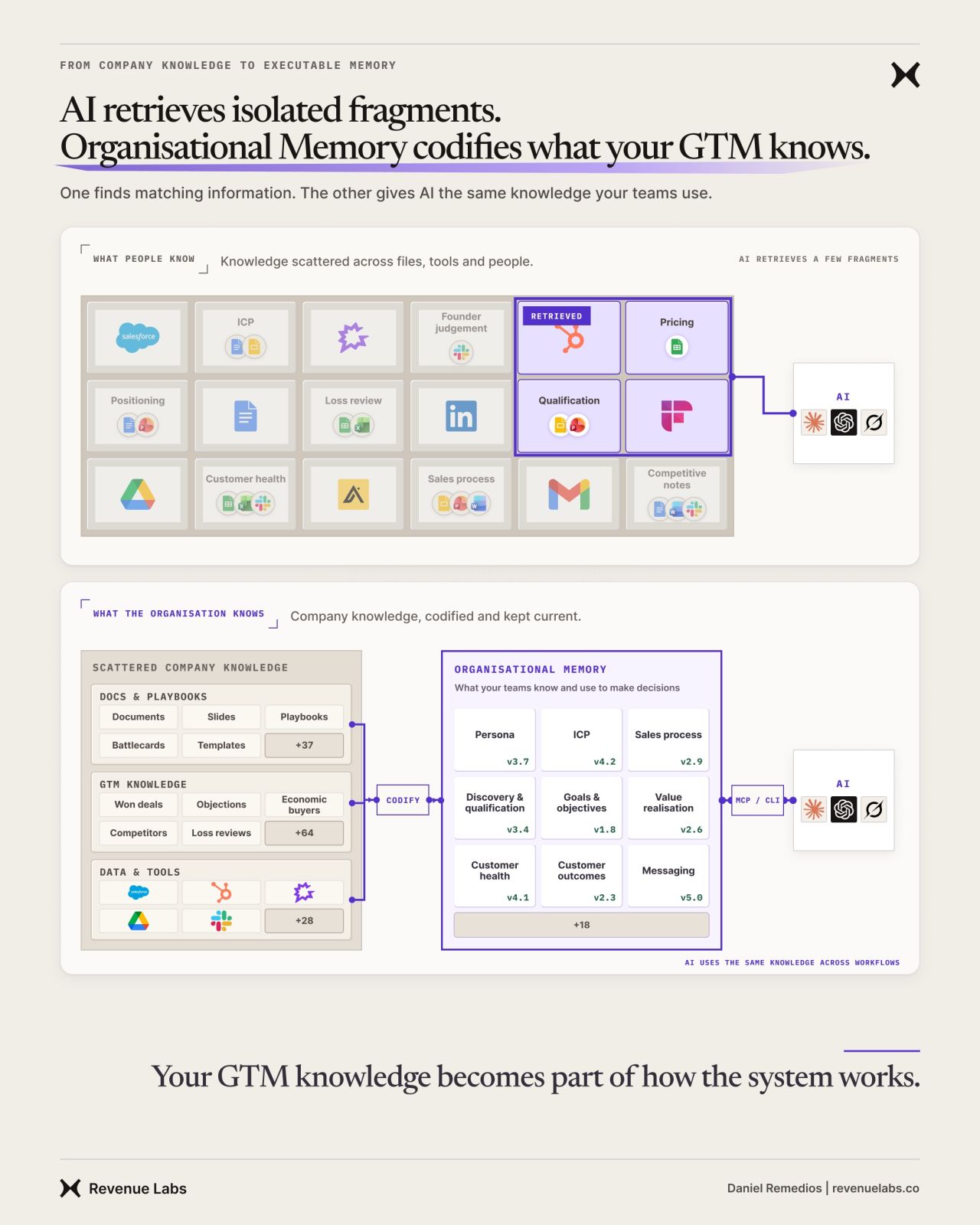
Suppose an organisation has documented its ICP. A retrieval system can answer: “What is our ICP?”
An AI-native operating system should be able to use that definition every time it evaluates an account.
A sales methodology document can answer: “What do we require before moving to Stage 3?”
Executable organisational knowledge can apply those requirements when assessing the current state of a deal.
A competitive battlecard can explain positioning. Executable knowledge can influence account research, meeting preparation, deal strategy and follow-up whenever that competitor becomes relevant.
The distinction is subtle but important. One system helps people find what the company knows. The other allows what the company knows to participate in the work.
That is what we mean by Memory.
Memory is more than stored information
The word memory is already used broadly in AI. A system remembers a previous conversation. An agent remembers a user preference. A model retrieves information from previous interactions.
These are useful forms of memory. Organisational Memory needs to go further.
It represents the knowledge, beliefs, definitions and judgement that should persist across the commercial system. An ICP is Memory. A definition of a qualified champion is Memory. Positioning is Memory. The sales process is Memory. Customer health principles are Memory. Competitive knowledge is Memory. A strategic decision about which markets the company will not pursue can be Memory.
Lessons learned from previous outcomes can eventually become Memory too. The important property is not simply persistence.
It is reusability in judgement and action.
The same Memory can inform multiple capabilities. ICP Memory can inform Account Sourcing, Account Research, Prioritisation and Territory Planning. Persona Memory can inform Contact Sourcing, Meeting Preparation and Messaging. Sales Process Memory can inform Deal Assessment, Pipeline Review, Forecasting and Coaching. Customer knowledge can inform Renewal Planning, Expansion and Risk.
This begins to create a shared operating logic across the organisation. Different capabilities can act differently while reasoning from the same underlying beliefs.
From tacit judgement to explicit logic
This raises a difficult question. How do we capture knowledge that the organisation itself has never fully articulated?
Companies often assume that because a process exists, its logic is known. Ask five managers what makes an account high priority and you may receive five different answers. Ask what constitutes a real champion and the differences become larger. Ask why one deal was lost and another won and the explanation may change depending on who tells the story.
This isn’t necessarily dysfunction. Some organisational knowledge is tacit because reality is complicated.
People develop heuristics through experience long before they can express those heuristics as formal rules.
AI creates an interesting possibility here. The system does not have to learn only from documents the organisation deliberately provides.
It can also observe how the organisation actually behaves. Which accounts do experienced reps prioritise? Which deals do strong managers challenge? Which recommendations do humans repeatedly override? Which messages receive positive responses? Which combinations of customer behaviour precede churn? Which exceptions recur often enough that they may no longer be exceptions?
The operating system can begin comparing stated logic with observed behaviour and actual outcomes.
That creates a much richer process for building organisational Memory. Instead of asking a company to perfectly document how it works before AI can become useful, the system can help the company discover how it works.
This is one of the places where the operating model begins to become reciprocal. The organisation teaches the system. The system helps the organisation understand itself.
Not all judgement should be encoded
There is an obvious danger here. If something can be observed, that does not mean it should immediately become a rule.
A top salesperson may succeed through behaviour that does not generalise. A historical pattern may reflect an old market condition. A manager may have a strong intuition based on a small sample. A successful outcome may have occurred despite the process rather than because of it.
AI-native organisations therefore need to distinguish between: what the organisation currently believes, what the evidence suggests, and what has been sufficiently validated to change the operating model.
This is why Memory should not become an automatically generated collection of correlations. It should be governed organisational logic.
Some changes may be proposed by the system. Some may require approval. Some may remain hypotheses until more evidence accumulates.
The more important the judgement, the more deliberate the governance should become.
This creates a useful distinction between learning and upgrading.
The system can continuously learn from outcomes. The organisation decides which learning should become part of how it operates.
At least initially, that boundary is likely to be deeply human.
Memory needs provenance
Once organisational judgement becomes executable, another requirement appears. Where did this belief come from?
A positioning statement may have been approved by the founder. A qualification definition may have been agreed by sales leadership. A customer risk rule may have emerged from analysis of hundreds of churned accounts. Another piece of guidance may have been written by an employee three years ago and never revisited.
Those should not necessarily have equal authority. Documents often flatten provenance.
The latest version sits in the wiki and the organisation assumes it is correct. Executable Memory needs a stronger model.
Who created this? What evidence supports it? When was it approved? Which capabilities use it? Has it changed? Why did it change? What outcomes suggest it should be reconsidered?
This makes Memory less like a knowledge base and more like version-controlled organisational logic.
That phrase matters. Software teams already understand why code requires version control.
Changes affect behaviour. They need owners. They need history. They need review. They sometimes need rollback.
If Memory increasingly affects how agents and capabilities behave, changes to organisational judgement deserve similar discipline.
A company can upgrade its judgement
Consider how commercial logic changes today. A company enters a new market. Its ICP changes. A sales leader discovers that a qualification criterion is producing false confidence. Messaging evolves. A new competitor emerges. Customer behaviour changes.
The organisation learns that an assumption it held six months ago is no longer useful. Today these changes propagate unevenly.
A document is updated. Managers are told. Training is run. A Slack message is sent.
Some people adopt the change immediately. Others continue operating from the old model.
Software workflows may remain unchanged for months. The organisation temporarily contains multiple versions of its own judgement.
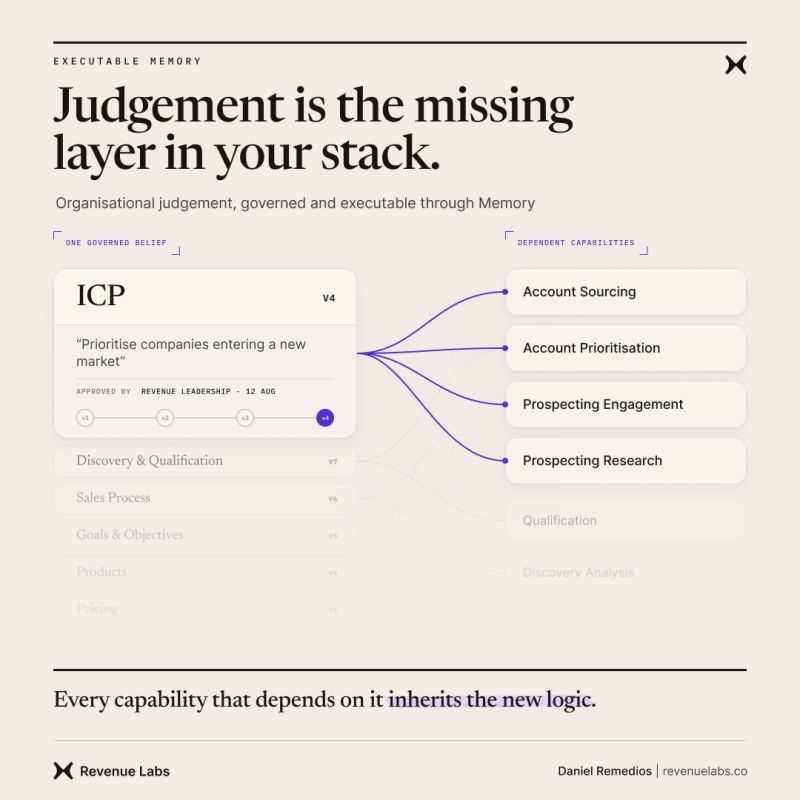
Executable Memory changes the propagation mechanism. Update the underlying Memory and every capability dependent on it can inherit the new logic.
A change to ICP can affect account prioritisation. A change to qualification can affect Deal Assessment and Pipeline Review. A positioning update can affect research, meeting preparation and follow-up.
The system does not merely store the new knowledge. It changes how the organisation performs work.
This is one of the reasons Memory becomes infrastructure. An upgrade to organisational judgement can propagate through the capability graph.
Memory and Skills are different
This distinction is worth making carefully. Memory represents what the organisation knows and believes. Skills represent how the organisation performs work.
A company’s definition of a strong champion is Memory. The method for assessing champion strength within a Deal Assessment is part of a Skill.
Its ICP is Memory. The process used to research and prioritise accounts is a Skill.
Its positioning is Memory. The method for constructing a relevant follow-up after a customer conversation is a Skill.
The two interact constantly. A Skill without organisational Memory becomes generic. Memory without Skills remains largely passive. Together they make company-specific judgement executable.
This is why simply giving an agent more context does not create an organisational capability. The system needs both the logic of the company and the method through which that logic should be applied.
Shared Memory reduces unnecessary variance
One consequence of distributed organisational knowledge is variance. Two SDRs interpret the ICP differently. Two AEs qualify similar deals differently. Two managers apply the same methodology differently. Two CSMs react differently to the same risk pattern.
Some variation is desirable. Commercial situations are not identical, and strong people should be able to exercise judgement.
But much of the variation inside companies is accidental. One employee received better coaching. One manager remembers a previous failure. One person found the relevant document. Another joined after the training happened. One team has developed a better local process that never propagated elsewhere.
Shared Memory can reduce this unnecessary variance. It gives different people and agents access to the same underlying organisational logic at the moment it becomes relevant.
The objective is not uniform behaviour. It is consistent access to what the organisation has already learned.
People can still disagree. Agents can still surface uncertainty. Exceptions can still be escalated.
But disagreement happens against a shared base of organisational knowledge rather than because important knowledge happened to reach one person and not another.
Memory changes onboarding
There is a simple way to see the economic value of this. Consider what happens when an experienced employee leaves.
They take more than their labour with them. They take accumulated context. Relationships. Patterns. Exceptions. Judgement.
The organisation replaces the person, but some of the operating knowledge has disappeared. The new employee then begins rebuilding it.
They read documentation. Shadow colleagues. Listen to calls. Ask questions. Make mistakes. Develop intuition.
Eventually they become effective. Companies call this onboarding.
Part of what is actually happening is reconstruction of organisational Memory inside another human.
Better documentation reduces that cost. Executable Memory can reduce it further.
A new salesperson does not need to perfectly remember every aspect of the ICP before researching an account if the Account Research capability already reasons from the company’s current ICP. They do not need to recall every competitive nuance before a meeting if the relevant knowledge appears in context.
The objective is not to stop people learning the business. It is to stop the organisation depending entirely on each individual rebuilding the same operating knowledge before they can contribute effectively.
Memory changes management
Management has historically been one of the primary distribution mechanisms for organisational judgement. A manager listens to a situation. Recognises a pattern. Explains how the company thinks about it. Corrects the employee. Over time, the employee internalises the judgement.
This remains valuable. But it is also difficult to scale.
The quality of organisational execution becomes dependent on the quality and consistency of management. Executable Memory gives managers another mechanism.
Instead of repeatedly teaching the same operating logic from scratch, managers can help define and improve the logic that the system makes available across the team.
When an employee disagrees with the system, that disagreement itself can become useful. Perhaps the employee is wrong. Perhaps the Memory is wrong. Perhaps the situation is genuinely exceptional.
Each case teaches us something different. The manager increasingly operates not only on the employee, but on the system through which employees work.
This is one of the reasons AI changes management even when no management role is automated.
Memory can become a commercial asset
Companies already think about intellectual property in certain domains. Patents. Code. Brands. Proprietary data. Processes.
But much of the knowledge responsible for commercial performance remains surprisingly intangible. Why does this company sell better than a competitor? Why does one sales organisation consistently identify good opportunities earlier? Why does one customer team recognise risk sooner? Why does one founder understand a market better than everyone else?
Part of the answer is accumulated judgement. Historically, that judgement has been difficult to separate from the people who possess it.
AI-native systems create the possibility of turning more of it into durable infrastructure. The organisation can increasingly retain: what it has learned about its market, how it interprets customers, which signals matter, how it makes recurring decisions, which approaches produce good outcomes, and how those beliefs have changed over time.
This does not eliminate tacit knowledge. There will always be things humans understand that are difficult or undesirable to encode.
But the boundary can move. And as it moves, the company’s operating knowledge becomes more persistent, reusable and scalable.
That begins to look less like documentation. It begins to look like an asset.
The system can help discover missing Memory
There is a further step. If capabilities operate from Memory and their decisions become observable, the system can begin identifying where its own knowledge is incomplete.
Imagine an Account Prioritisation capability repeatedly receives human overrides. Experienced reps consistently promote a particular type of company that the system ranks lower.
Why?
Perhaps the reps are acting on intuition unsupported by outcomes. Or perhaps they recognise a pattern the formal ICP does not contain.
The disagreement is evidence. The system can investigate.
What characteristics do the overridden accounts share? Do they convert differently? Is there an unmodelled buying trigger? Should the ICP change?
The same can happen in sales. Managers repeatedly reject the system’s assessment of champion strength.
Perhaps the Skill is weak. Perhaps relevant evidence is missing. Or perhaps the organisation has never explicitly encoded what its strongest managers mean when they say “champion”.
The system has identified a Memory gap.
This changes the role of AI from simply consuming organisational knowledge to helping create it. The company no longer needs to know everything it knows before the system can improve.
Its own behaviour can reveal where important judgement remains tacit.
From knowledge management to organisational learning
Knowledge management has traditionally asked: How do we capture and distribute what the company knows?
The AI-native question is larger. How does what the company knows become part of how the company operates?
And then: How does operating the company improve what it knows?
That creates a loop. The organisation defines its current judgement. Memory makes that judgement available to capabilities. Capabilities apply it to Live State. Agents and people act. Decision Traces preserve what happened. Outcomes reveal whether the judgement was useful. The system identifies where its knowledge may need to change. The organisation upgrades its Memory. Then the next decision starts from a better model.
This is no longer simply knowledge management. It is organisational learning becoming part of the software architecture.
When judgement becomes infrastructure
For most of the software era, companies digitised the outputs of judgement. A salesperson decided an opportunity was qualified and updated CRM. A manager decided a deal was risky and changed the forecast. A CSM decided a customer was unhealthy and updated a score.
The software stored the conclusion. The reasoning that produced it often disappeared.
AI-native systems allow us to move one layer deeper. The organisation can begin representing the knowledge and judgement that produce those conclusions.
What constitutes qualification. What evidence matters. How different signals should be interpreted. Which exceptions require attention. What the company has learned from previous outcomes.
That judgement can become shared. Executable. Version-controlled. Observable. And improvable.
This may prove to be one of the more important transitions in enterprise AI. The value of a company is not only in the data it has accumulated.
It is also in what the company has learned to believe about that data. For most of organisational history, that judgement lived primarily in people.
We are beginning to build systems in which more of it can belong to the organisation itself.
And once organisational judgement becomes executable, the next question is no longer only what the company knows. It is:
What can the company now reliably do?
That is where Skills and capabilities begin.
This essay is versioned. Where our thinking develops materially, we will update the version and explain why - the revision history is preserved, not polished away.