
Article
Deal State in an AI-Native GTM System
A CRO at a $239M ARR business had invested heavily in GTM and AI, but the same problem kept surfacing. It wasn't a data problem. It was a state problem.

Not a data problem. A state problem.
I recently spoke with a CRO at a $239M ARR business. They had invested heavily in GTM, and lots of AI. But the same problem kept coming up:
- pipeline was inconsistent
- rep performance varied
- deals slipped late
Their AI didn't really learn from the data over time. They didn't have a data problem. They had a state problem.
Data is what was captured
- call happened
- meeting scheduled
- stakeholder added
- stage moved
- close date changed
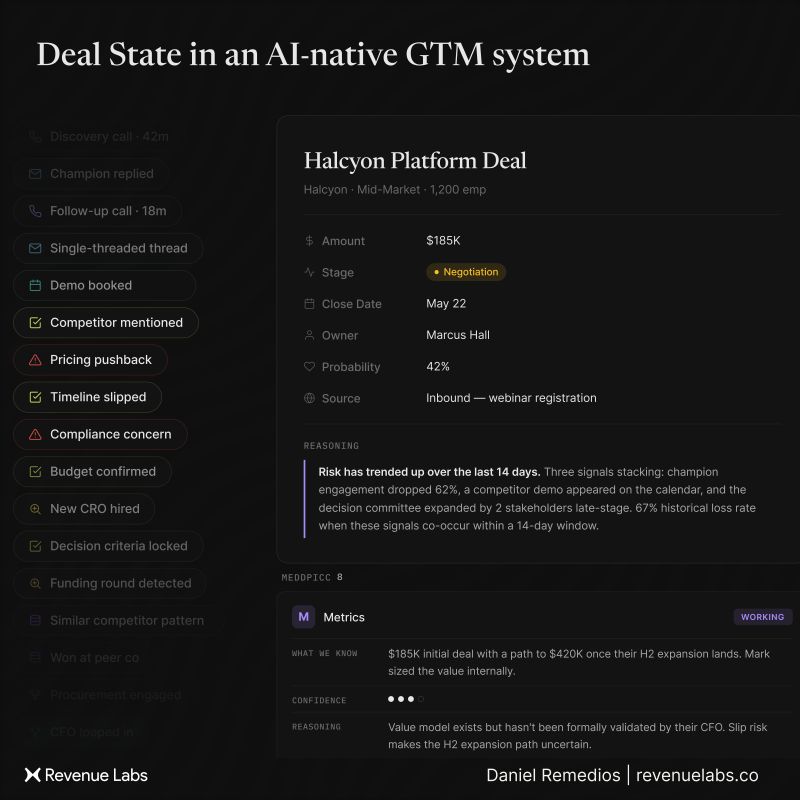
But teams and agents don't make good decisions from raw data. They need to understand the current reality of the deal. That's deal state. And it's the same for prospecting state and customer state.
The most important primitive
Deal state is the live, decision-ready understanding of an account, opportunity or customer, and it's the most important primitive for AI-native GTM. Teams trying to operate without it are manually reconstructing it before every meeting: prep the meeting, write the email, generate the document, summarise the call.
With the right primitives, every deal can teach the system:
- what is happening
- what changed
- why it changed
- what risk is emerging
- how confidence is shifting
- what should happen next
It's the shift that lets sales teams move from records to understanding. An AI-native GTM is bigger than localised productivity. It compounds.