
Essay
v1.0
The Decision Trace
As judgement moves into the system, we need a record of the decision — not just a log.

A note from the author
This idea started with a product question. If Revenue Labs makes a recommendation about a deal, how should someone understand why? The more we worked on it, the more interesting the problem became. CRM preserves the outcome of thousands of commercial decisions, but very little of the judgement that produced them. Once machines start participating in those decisions, that feels like a major omission. Decision Traces started as an observability primitive. I increasingly think they may become something much more important: a way for companies to build a persistent history of their own judgement and connect that judgement to what happened afterwards.
A sales manager downgrades a deal. Why? Perhaps the champion has become less engaged. Procurement entered earlier than expected. The implementation date has become uncertain. The customer missed a commitment.
The manager may be able to explain the decision. The CRM usually stores the result. Forecast category changed. Close date moved. Risk increased. The reasoning often disappears.
This has been acceptable because people carried much of the context in their heads. If someone wanted to understand the decision later, they asked the person who made it. AI changes that.
As systems increasingly interpret evidence, apply judgement and take action, an organisation needs a durable record of how those decisions were formed.
Not simply a log.
A Decision Trace.
Software has historically stored outcomes, not reasoning
Most enterprise systems are excellent at recording events. A field changed. A task completed. A meeting occurred. An opportunity moved stage. A customer renewed. A workflow fired. These records tell us what happened. They tell us much less about why.
Consider a forecast. CRM might show that an opportunity moved from Commit to Best Case on 14 August. That is useful.
But if the company wants to understand the judgement behind the change, the evidence may be distributed across a call, Slack discussion, email, manager notes and the memory of the people involved. The system stores the conclusion. The organisation reconstructs the reasoning.
This is another consequence of the architecture we inherited. Humans performed much of the interpretation, so software did not need to preserve it in a structured way. Once machines begin making more of those interpretations, that omission becomes much more consequential.
An audit log is not a Decision Trace
This distinction matters. An audit log might tell us: Agent 14 executed at 09:42. CRM field updated. Slack notification sent. That is operationally useful. It tells us that the system did something.
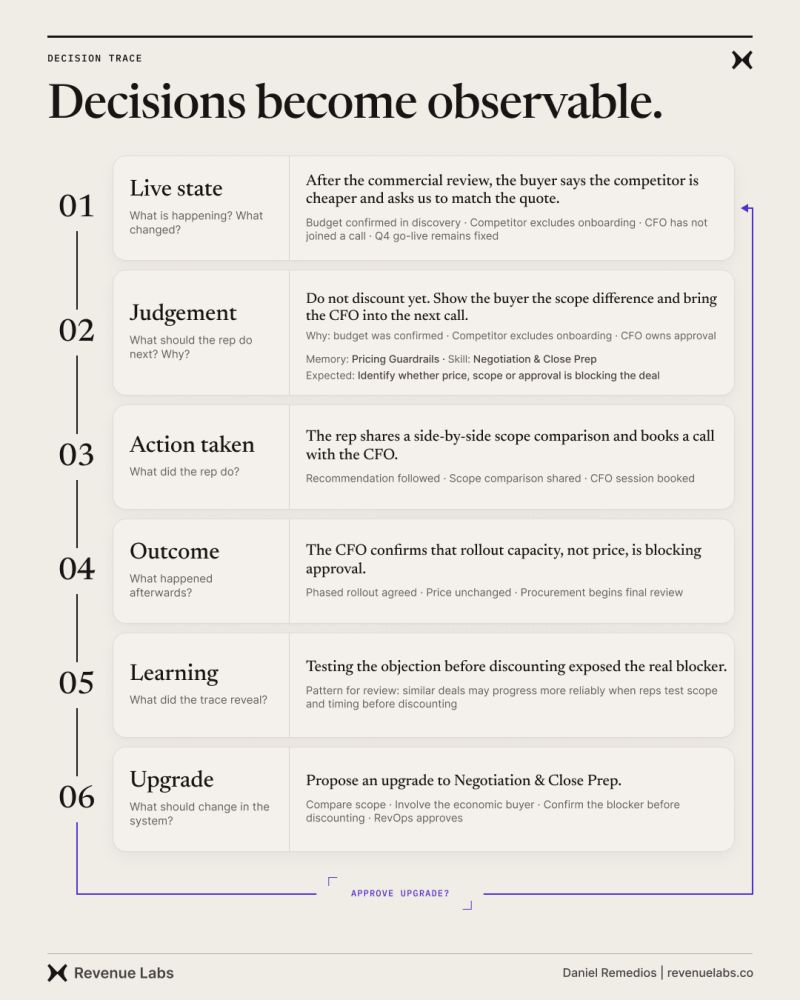
A Decision Trace should answer a different set of questions. What did the system believe at the time? Which evidence supported that belief? What organisational Memory did it apply? Which Skill or capability was used? What uncertainty existed? Why did the system choose one action over another? Did a human intervene? What happened afterwards?
The trace is therefore not merely about execution. It is about causality inside the operating model.
Decisions are temporal objects
A decision makes sense only in the context that existed when it was made. This sounds obvious, but most systems make historical reasoning surprisingly difficult.
Imagine reviewing a deal six weeks later. Today, the account has a different stakeholder map. New calls have occurred. The champion may have recovered. Security may have completed its review.
If we ask an AI system why it considered the deal risky six weeks ago, it cannot simply evaluate the deal using today’s State. It needs the state that existed then. The evidence available then. The Memory version in force then. The Skill version used then. The uncertainty present then.
A Decision Trace therefore preserves a snapshot of the reasoning environment at the moment of decision. This is crucial for evaluating judgement fairly.
A decision can be good even when the outcome is bad.
A decision can be bad even when the outcome is good.
Without historical context, organisations confuse luck with judgement.
Outcome is not the same as decision quality
Suppose a system recommends that a deal should be removed from Commit. The sales manager disagrees and keeps it in. The customer signs anyway. Was the system wrong? Maybe.
Or perhaps the recommendation was sensible given the evidence available, and the deal progressed because of an unexpected executive intervention. The reverse can happen too. A weak decision produces a good outcome by chance. If organisations train AI only from outcomes, they risk learning the wrong lessons.
This is where Decision Traces become important. They allow the company to inspect: what the system knew, what it inferred, what judgement it applied, and whether that reasoning was sensible given the information available.
The organisation can evaluate both decision quality and outcome quality. That distinction becomes essential if the system itself is going to learn.
Traces create organisational memory of judgement
Companies already accumulate histories of events. What they rarely accumulate systematically is a history of judgement.
Why did we pursue this market? Why did we stop prioritising this persona? Why did we change qualification? Why did the manager intervene in this deal? Why was this account escalated? Why did the organisation override the recommendation?
These decisions shape the company. But their reasoning often lives in meetings and memory. Then people leave. Context disappears. Six months later, the organisation may repeat the same debate without remembering why the original decision was made.
Decision Traces create the possibility of preserving that reasoning. Not every small action needs one. But consequential judgements can become durable objects inside the system.
That changes institutional memory. The company remembers not only what it decided. It can increasingly remember why it decided it.
This matters for governance
As AI systems become more capable, governance discussions often focus on permissions. Can the agent send an email? Can it change CRM? Can it approve a discount? Can it contact a customer?
Permissions are necessary.
They are not sufficient.
A well-governed system also needs to make judgement inspectable. Why was this account prioritised? Why was this customer considered at risk? Why did the agent decide to escalate? Which policy permitted the action? Was the confidence sufficient? Did the system use the latest company logic?
Decision Traces make governance more substantive. Instead of asking only: Was the agent allowed to act? the organisation can ask: Was the decision itself well-formed? That is a much higher standard.
Governance becomes continuous
Traditional governance often happens before deployment. Approve the workflow. Review the policy. Configure permissions. Then the system runs.
AI systems create a more dynamic problem. The same capability may behave differently depending on context. A Deal Assessment Skill may produce different conclusions across hundreds of opportunities. An agent may choose different tools. State changes. Memory changes. Skills are upgraded.
So governance cannot be only about approving the system once. It needs to include the ability to inspect how the system is behaving over time.
Which decisions are being made? Where is confidence low? Where are humans overriding the system? Which Skills generate the most disagreement? Where are exceptions increasing? Decision Traces turn governance from a static control exercise into an ongoing operating function.
Human intervention should be traced too
This is equally important. Suppose the system recommends that a deal is high risk. The manager overrides it. That human action should not disappear outside the learning loop.
Why did they disagree? Did they possess information the system lacked? Did they interpret the same evidence differently? Was there relationship context that had never been recorded? Did they simply make a better judgement? Or were they overly optimistic?
The override is itself a decision. It has context. It should have a trace.
This creates a healthier relationship between human and machine judgement. The system is not treated as the default truth and the human as an exception. Both are actors whose decisions can be evaluated.
The question becomes: Which judgement was better, under which conditions, and why? That is a much more useful learning problem.
Traces make disagreement valuable
A disagreement between human and machine is one of the richest signals in an AI-native operating system. If both reach the same conclusion, the organisation learns relatively little. If they disagree, there is something to investigate.
State may be incomplete. Memory may be wrong. A Skill may be weak. The human may have tacit knowledge. The model may have interpreted evidence poorly. The human may be biased. Repeated disagreement creates patterns.
Suppose managers repeatedly override the system when a particular type of procurement event occurs. That pattern may reveal a missing concept in the ontology. Or a weak rule in Memory. Or a Skill that does not account for the situation. The disagreement becomes a source of system improvement.
This is one reason Decision Traces matter beyond auditability. They create learning surfaces.
Traces connect capabilities to outcomes
We have argued that capabilities are a useful unit of AI-native work. But capabilities only become improvable if the organisation can connect their operation to what happens afterwards.
Consider Account Prioritisation. The capability ranks accounts. A rep acts. Some accounts respond. Some become opportunities. Some close. Without traces, the organisation sees the outcomes but may struggle to understand why the capability produced the original ranking.
With traces, it can ask: Which State influenced the decision? Which ICP Memory was applied? Which signals mattered? How confident was the system? Which Skill version ran? Were human overrides involved?
Now outcome analysis becomes richer. The company can begin to determine not only whether Account Prioritisation worked, but which parts of its judgement contributed to performance. That is the bridge between execution and learning.
The operating system needs causal memory
This suggests a useful distinction. Live State is the system’s working representation of commercial reality. Memory represents what the organisation knows and believes. Decision Traces preserve the causal history of how those representations produced action.
In other words: State tells us what was true. Memory tells us how the organisation thought about it. The Trace tells us what it decided and why. Outcome tells us what happened next.
Together they create the raw material for organisational learning. Without traces, the feedback loop is incomplete. The system can observe that something happened. It cannot reliably connect the outcome to the reasoning that produced it.
This is different from analytics
Traditional analytics asks questions such as: Which segments convert best? Which reps perform highest? Where do deals slip? Which customers churn? These questions remain useful.
Decision Traces enable another class of analysis. Which beliefs are associated with good decisions? Which Skill versions perform better? Where does human judgement outperform machine judgement? Where does machine judgement outperform humans? Which types of uncertainty predict poor outcomes? Which Memory changes improved capability performance? Which decisions consistently require escalation?
The unit of analysis moves from activity toward judgement. That is a significant change. Companies have historically measured what people do. AI-native systems can begin measuring how the organisation decides.
Decision latency becomes inspectable too
Traces can also reveal time. When did the relevant evidence first appear? When did State change? When was the change interpreted? When did a capability run? When was attention allocated? When did a human respond? When did action occur?
This lets the organisation inspect decision latency directly. Suppose a customer began showing risk signals on 1 June. The system updated the customer state on 2 June. No action occurred until the monthly review on 21 June.
The problem was not lack of data. It was a delay between understanding and action. Another organisation may act within hours. Over time, these differences matter.
Decision Traces make the operating rhythm visible. The company can identify where information, judgement or approvals create delays. This moves process improvement from anecdote toward evidence.
Traces can reveal hidden organisational policy
There is another interesting consequence. Companies often have an official operating model and an actual one. The sales methodology says one thing. Managers routinely do another.
Pricing policy says one thing. Exceptions reveal what the organisation actually tolerates. A customer-health framework defines risk formally. Experienced CSMs may react to entirely different signals.
Decision Traces create a record of actual judgement. Over time, the organisation can compare: stated logic with executed logic and outcomes.
That comparison can reveal where the formal operating model is incomplete or outdated. This is a deeper form of organisational observability. The company can begin to see not only whether people followed process, but whether the process itself represents how successful decisions are actually made.
Observability changes management
This affects the role of managers. Traditional management often relies on sampling. Listen to several calls. Inspect a handful of deals. Review selected accounts. Ask people to explain their reasoning. From those samples, the manager forms a view of how the team is operating.
Decision Traces can expand the observable surface. A manager may be able to see patterns across hundreds of decisions. Where are reps consistently overriding the system? Where does the team interpret qualification inconsistently? Which accounts received attention despite low priority? Which risk signals were repeatedly ignored? Which Skills create uncertainty?
The manager does not need to inspect everything manually. The system can help identify where judgement itself deserves inspection. This is another example of attention allocation. Management moves from discovering the pattern to deciding what to do about it.
RevOps becomes the steward of decision infrastructure
This also changes RevOps. If RevOps increasingly architects State, Memory, Skills and capabilities, Decision Traces give it a way to observe whether that architecture is functioning.
Which capabilities are being used? Where are they failing? Which Memory versions are producing inconsistent decisions? Where are humans rejecting the operating logic? Where are agents acting without sufficient confidence? Which changes improved outcomes?
RevOps becomes responsible not simply for system adoption, but for decision quality across the commercial system. That is a much more strategic operating role.
The objective shifts from: Are people using the process? to: Is the process producing good judgement, and is the system improving?
Traces make upgrades safer
We have also argued that AI-native systems can eventually begin upgrading themselves. That creates obvious risk. If a system proposes changing an ICP definition, Deal Assessment Skill or customer-risk rule, the organisation should understand why.
Which outcomes prompted the recommendation? Which traces revealed the weakness? How many decisions were affected? What evidence supports the change? Which capabilities will inherit it?
A self-upgrading system without traces would be difficult to govern responsibly. Decision Traces provide the lineage required to make upgrades inspectable.
The system can say, in effect: “These decisions repeatedly failed under these conditions. This part of the current Skill appears to be responsible. Here is the proposed change and the evidence behind it.”
That begins to resemble a software system debugging its own operating logic. Humans can review. Approve. Reject. Modify. The trace gives them something concrete to reason about.
Decision Traces become a new enterprise dataset
This may be one of the more important long-term consequences. Companies have accumulated enormous datasets around: customers, transactions, activities, conversations, usage, support, revenue.
They have accumulated much less structured data around: what they believed, why they made decisions, which judgement they applied, where uncertainty existed, how humans and machines disagreed, and whether the decision proved useful.
AI-native systems can start generating that dataset automatically. Every consequential decision can create a structured record linking: State → evidence → Memory → Skill → judgement → action → outcome.
Over time, this becomes an extraordinary asset. Not because every decision is correct. Because the company now has a corpus from which it can study and improve how it decides.
This is qualitatively different from more CRM activity. It is a dataset of organisational judgement.
The value compounds over time
Imagine two companies adopting the same frontier model today. They have similar tools. Similar data. Similar teams. One uses AI primarily to generate work. The other builds Decision Traces into its operating model.
Three years later, the second company has preserved the reasoning behind hundreds of thousands of commercial decisions. It can inspect which patterns consistently produce good outcomes.
Which Skills improved. Where humans added value. Where machine judgement became stronger. Which beliefs aged badly. How decision latency affected performance. Which exceptions became new operating logic.
The model providers may have improved dramatically during those three years. Both companies can access those improvements. Only one has accumulated three years of company-specific decision history. That is where compounding begins.
From explainability to learning
Decision Traces could easily be framed as an AI explainability feature. I think that would understate them. Explainability asks: Why did the model produce this output?
A Decision Trace asks something larger: What did the organisation understand? Which judgement did it apply? What did it decide? Who or what acted? What happened? What should change because of that outcome?
That is not merely model explainability. It is an infrastructure layer for governance, management and organisational learning.
The difference matters. The goal is not to make every model thought process visible. It is to preserve the parts of consequential organisational reasoning required to inspect, govern and improve the system.
A company that remembers how it decided
For most of organisational history, companies have been remarkably forgetful. They remember transactions. They remember customers. They remember documents. They remember outcomes.
But much of the reasoning that connected one state of the world to the next disappeared into meetings, messages and individual memory. That made sense when judgement lived primarily inside people. AI changes the requirement.
As more understanding, judgement and action move into the operating system, the causal chain needs to become part of the system too. What was true? What did we believe? Why did we decide? What did we do? What happened? What did we learn? A Decision Trace connects those questions.
And once the company can preserve that chain repeatedly, something important changes.
The organisation no longer only accumulates data from its operations.
It begins accumulating a memory of how it operates.
That is the foundation on which a system can learn to make better decisions.
This essay is versioned. Where our thinking develops materially, we will update the version and explain why - the revision history is preserved, not polished away.