
Essay
v1.0
RevOps Becomes the Architect
From administering applications to designing the commercial system itself.

A note from the author
RevOps has always seemed more strategically important to me than the way the role is often described. The function sits where data, process, technology and commercial judgement meet. But in the SaaS-native organisation, much of its time is consumed administering the consequences of fragmented applications. Our architecture led us toward a different version of the role. If someone needs to define State, codify Memory, govern Skills, compose capabilities and observe how the system is deciding, RevOps becomes much closer to an architect of the commercial operating model. That is a substantially bigger job than administering the stack, and I think it may become one of the defining roles of the AI-native company.
RevOps emerged because modern GTM became too complex to operate informally. Sales had CRM. Marketing had automation. Customer Success had its own systems. Data lived across warehouses, spreadsheets and dashboards. Processes crossed tools and teams. Someone had to make the whole thing cohere. That role became RevOps.
In many companies, RevOps still spends much of its time administering the consequences of fragmented software: configuring CRM, connecting applications, reconciling data, defining process, building reporting, managing workflows, enforcing hygiene, and translating leadership requirements into system configuration.
This work is important. It also reflects the architecture of the SaaS era. As AI-native systems begin to maintain State, apply organisational Memory, execute Skills and coordinate capabilities across applications, RevOps moves up an abstraction layer.
The role becomes less about operating software.
And more about designing how the commercial organisation itself operates.
RevOps was already an architectural response
RevOps is often described as a functional merger. Sales Operations. Marketing Operations. Customer Success Operations. Bring them together. Create one revenue process. That is true, but it misses the deeper reason the role became necessary.
Modern GTM fragmented. Different teams adopted different systems. Different systems created different data models. Different managers developed different processes. Different functions optimised locally. Someone had to build coherence across the commercial organisation.
RevOps became the connective tissue. The role was never only about software administration. It was already attempting to solve an architectural problem.
What is the commercial process? How should data move? Which system owns which record? How do teams hand work off? How should performance be measured? How should leadership see the business? The tools were SaaS-native. The responsibility was systemic. AI-native architecture makes that systemic responsibility much more explicit.
The old abstraction was the application
A RevOps leader in a SaaS-native organisation naturally thinks in applications. What should Salesforce contain? Which workflows should Outreach execute? How should Gong be configured? Where should this field live? Which system should own this process? How do we connect the stack? These are the right questions when applications are the main unit through which work is designed.
But if capabilities increasingly span applications, the starting point changes. Instead of asking: Which tool should own this workflow?
RevOps can ask: What does the organisation need to be capable of doing?
That is a much more powerful design question. The answer might be: Prioritise accounts. Prepare meetings. Assess deals. Review pipeline. Forecast. Detect customer risk. Plan renewals.
Then the architectural questions follow. What State does this capability require? Which organisational Memory should it use? Which Skills define the method? Which tools are needed? Which agents should act? Where should humans intervene? What should be traced? Which outcomes determine whether the capability is improving?
The application becomes one component of the design. Not the design itself.
RevOps starts with State
The first responsibility is representation. What does the organisation need to understand continuously? Accounts. People. Opportunities. Customers. Relationships. Signals. Commitments. Risk. Uncertainty. Changes over time.
Traditional RevOps has already done some of this work through CRM architecture and data modelling. AI-native RevOps goes further. It needs to distinguish between: observed state, derived state, uncertainty, and meaningful state transitions.
A stakeholder attending a meeting is observed state. Champion strength declining is derived state. The evidence supporting that interpretation matters. So does confidence. So does what changed since the previous state.
RevOps becomes responsible for deciding which parts of commercial reality the system should maintain. That is not simply data modelling. It is state architecture.
Ontology becomes operational
This leads directly to ontology. If a commercial system is going to reason about the organisation, it needs a coherent model of the concepts inside it. Account. Contact. Opportunity. Champion. Economic Buyer. Competitor. Renewal. Commitment. Risk. Signal. Capability.
These are not just fields. They are concepts with relationships. A Champion belongs to a deal. A deal belongs to an account. A stakeholder can move between companies. A customer can become an expansion opportunity. A competitor can appear inside a conversation. A commitment can remain unresolved across several interactions.
The ontology determines what the system is capable of representing and therefore what it is capable of understanding. This makes ontology a strategic operating concern. RevOps increasingly becomes one of the functions responsible for defining the commercial world the system can see.
RevOps becomes the steward of Memory
State tells the system what is happening. Memory tells it how the organisation interprets what is happening. This is where RevOps moves even further beyond administration. The company needs explicit representations of: ICP, persona, positioning, qualification, sales process, customer health, commercial principles, competitive knowledge, and lessons from previous outcomes.
Much of this already exists somewhere in the organisation. But not in a form that is consistently executable. RevOps can become responsible for making this operating logic coherent.
Which Memory is authoritative? Who owns it? Which version is current? Which capabilities depend on it? What evidence supports it? When should it change?
This is not the same as owning every commercial decision. Sales leadership still owns sales strategy. Marketing owns positioning. Customer Success owns customer logic. Leadership owns strategic direction.
RevOps becomes the system steward through which those decisions become executable across the commercial organisation. That distinction matters. RevOps should not become a central bureaucracy that decides everything. It should become the architecture through which company judgement propagates.
Skills make process programmable
RevOps has always worked on process. Define the sales stages. Create the handoff. Build the workflow. Set the required fields. Document the process.
AI-native systems change the medium. Instead of describing process only through documents and deterministic automation, RevOps can help define Skills. How should Meeting Preparation work? How should Deal Assessment work? How should Account Research work? Which inputs matter? Which methods should be applied? Where does judgement belong? Which exceptions require escalation? Which outputs are required?
This turns process into something executable. The work becomes more adaptable than a traditional workflow while remaining more governed than an unconstrained agent. RevOps therefore starts designing bounded machine judgement. That is a very different capability from building a workflow rule.
Governance moves into the operating model
Once agents can act, governance becomes inseparable from architecture. RevOps needs to help define: what an agent can access, what it can change, what it can send, what it can approve, what requires human review, and which actions must be traced.
The important question is not: Should this agent be autonomous?
It is: Autonomous to do what, under which conditions, with what confidence and what consequence?
Different capabilities deserve different boundaries. Account enrichment may be highly autonomous. A strategic pricing decision should not be. A low-risk follow-up may be automated. A major customer escalation may require human judgement.
RevOps becomes responsible for helping design those boundaries consistently across the organisation. That makes governance an operating-system function rather than an afterthought.
Decision Traces give RevOps a new control surface
Traditional RevOps monitors adoption and process compliance. Are CRM fields complete? Are reps following the sales stages? Is pipeline hygiene good? Are workflows working?
Decision Traces create a richer form of observability. Why are deals being classified as risky? Where are humans overriding the system? Which Skills produce inconsistent outcomes? Which Memory versions are driving poor decisions? Where is confidence low? Where are agents acting without enough evidence? Which capabilities are improving?
RevOps can begin inspecting not only whether the process is being followed, but whether the process itself is producing good judgement. That is a significant shift.
The question moves from: Are people using the system correctly?
to: Is the system helping the organisation decide correctly?
RevOps becomes responsible for learning loops
This may be the most important change. In a traditional GTM stack, RevOps improves the system periodically. A problem emerges. Someone investigates. A workflow changes. A field is added. A dashboard is rebuilt. Training occurs. The process improves.
AI-native systems create a tighter loop. Capabilities run. Decisions create traces. Outcomes occur. Patterns appear.
The system identifies where State, Memory or Skills may be weak. RevOps can review those patterns and improve the operating model. This makes RevOps the steward of a new question: How does the commercial system get better because it operated? That is a very different mandate.
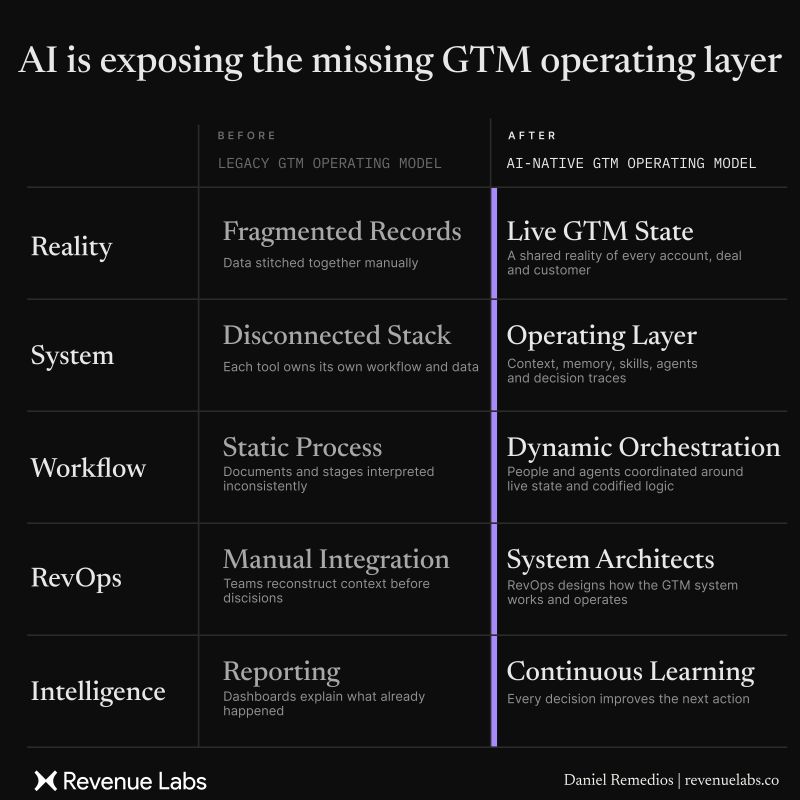
The role moves from configuration to architecture
You can see the shift clearly by comparing the work. SaaS-native RevOps asks: Which fields should exist? Which workflow should run? Which dashboard should show this? Which application owns the process?
AI-native RevOps asks: What State should be maintained? Which organisational Memory is authoritative? Which capabilities should exist? Which Skills define the method? Where should autonomy sit? Which decisions require traces? How should outcomes improve the system?
The first set is configuration. The second is architecture. This does not eliminate the first. Systems still need to be configured. Data still needs to be clean. Integrations still need to work. But the centre of gravity moves upward.
RevOps becomes closer to product
This also changes the relationship between RevOps and Product. A mature AI-native commercial system starts to look like an internal product. It has: users, capabilities, interfaces, permissions, data models, feedback, versions, and measurable outcomes.
RevOps therefore needs some of the same instincts as a product team. Which user has the problem? What outcome matters? Which capability solves it? What is the minimum useful system? How should it be evaluated? Which feedback matters? What should be improved next?
This does not mean RevOps becomes Product. It means the role becomes increasingly product-like. The commercial operating system has users. Someone has to design their experience.
RevOps becomes closer to engineering too
There is also an engineering dimension. Not because RevOps needs to write production code. Because the operating system has dependencies. State architecture. Versioning. Permissions. Reliability. Observability. Testing. Evaluation. Rollbacks.
Changes to Memory and Skills affect behaviour. Agents interact with systems. Failures propagate. This is closer to managing a software system than administering a set of SaaS tools.
RevOps therefore becomes a boundary role. Part commercial strategy. Part systems architecture. Part product. Part governance. That makes the role more demanding. It also makes it more important.
This may create a new professional identity
The title “Revenue Operations” reflects the job that emerged during the SaaS era. It may eventually feel too narrow. The future role is closer to: commercial systems architect, AI revenue architect, GTM systems lead, commercial operating architect.
The exact title matters less than the underlying shift. The person is responsible for translating how the company wants to operate into a system that can increasingly execute and improve that operating model.
This is not merely operations.
It is institutional design.
The best RevOps teams will codify judgement, not just process
The difference between average and exceptional RevOps may therefore change. Today, strong RevOps teams often excel at: clean data, good systems, reliable reporting, clear process, effective automation.
Those remain valuable. But the next level is deeper. Can the team capture the company’s operating judgement? Can it make that judgement executable? Can it identify where tacit knowledge remains trapped in people? Can it reduce unnecessary variance? Can it design capabilities that operate coherently across systems? Can it make machine decisions observable? Can it turn outcomes into better methods?
That is the frontier. RevOps becomes one of the functions responsible for turning company knowledge into infrastructure.
Leaders become designers of the system through RevOps
This also changes the relationship between leadership and RevOps. A CRO should not need to configure a Skill. But the CRO may need to define: what constitutes a healthy pipeline, which risks matter, where managers should intervene, what good qualification looks like, which outcomes the organisation prioritises.
RevOps turns those strategic choices into operating logic. Similarly, Marketing leadership defines positioning. Customer leadership defines customer health. Executive leadership defines objectives. RevOps helps make those choices coherent and executable across the system.
This is an important division of labour. Leaders define judgement. RevOps encodes and governs the system through which that judgement operates. That makes RevOps a much more strategic partner.
RevOps becomes the mechanism for system-wide propagation
This may be one of the most economically important parts of the role. Today, leadership changes a decision. The organisation must propagate it manually. New ICP. New qualification. New messaging. New process. Managers communicate. Documents change. Training changes. Systems change.
Different teams adopt at different speeds. AI-native architecture allows more of that change to propagate through shared Memory and Skills. RevOps becomes the function that manages that propagation.
One operating change can update multiple capabilities. One Memory upgrade can affect Prospecting, Sales and Customer Success. One Skill improvement can propagate across every agent that uses it.
This makes the organisation more adaptable. Not because everyone changes faster. Because the system through which they operate changes coherently.
RevOps becomes the builder, others become consumers
This leads to a useful organisational model. Not every employee should become an agent builder. Most people should not need to understand the architecture. They should consume capabilities.
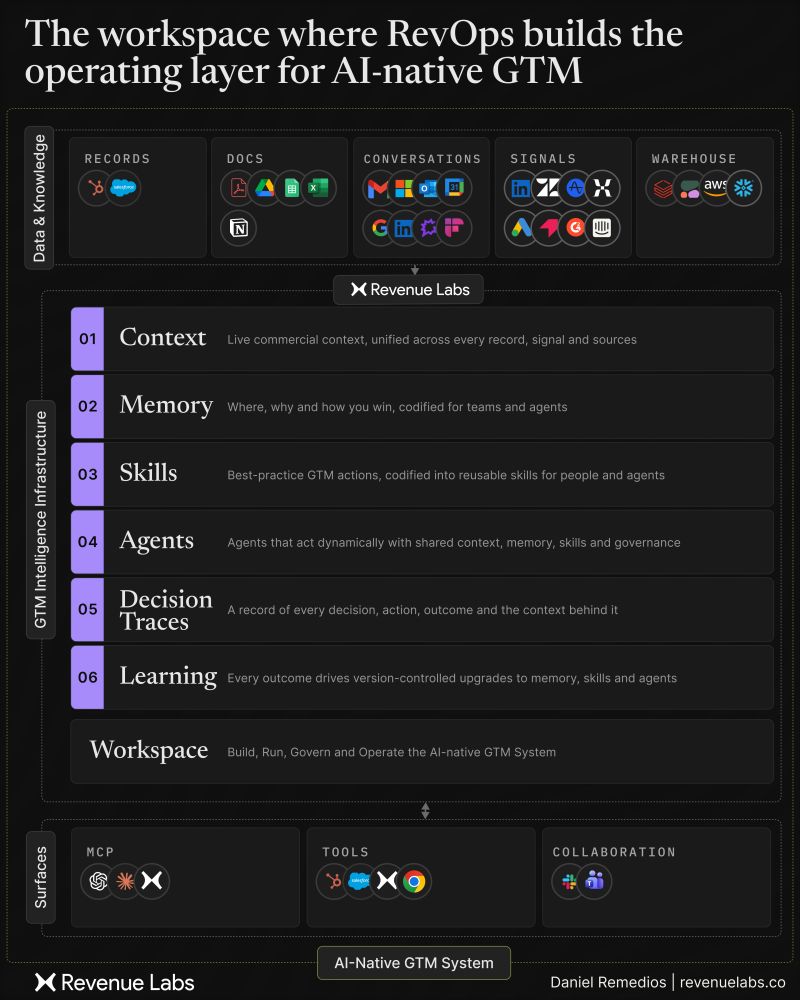
A rep receives Meeting Preparation. A manager receives Pipeline Review. A CRO receives commercial State. A CSM receives Renewal Risk. RevOps works at a different layer. It builds and governs: Memory, Skills, Agents, Tools, State, permissions, and traces.
This is why RevOps becomes the builder. The rest of the organisation increasingly consumes what it builds. That division can make AI adoption much more coherent than asking every employee to invent their own prompts, agents and workflows.
This changes the RevOps talent profile
The role therefore needs new skills. Systems thinking. Product judgement. AI literacy. Data architecture. Governance. Commercial understanding. Evaluation. Process design. Change management.
The strongest RevOps leaders will need to move comfortably between technical and commercial abstraction. They must understand how a sales manager thinks about a deal. And how that judgement should be represented inside the system.
They need to understand the company strategy. And how that strategy becomes Memory. They need to understand AI capabilities. And where those capabilities should not be trusted.
This is a harder role than SaaS administration. It is also a much more leveraged one.
The operating layer gives RevOps leverage
There is an economic consequence too. A RevOps team today often scales by absorbing more operational work as the company grows. More users. More workflows. More reports. More systems. More requests.
AI-native architecture allows some of that work to become reusable infrastructure. Create a Skill once. Improve it once. Propagate it across multiple capabilities. Maintain State centrally. Reuse Memory. Observe outcomes.
The RevOps function can increasingly improve the system rather than repeatedly supporting each individual instance of work. That changes its leverage. A small, highly capable RevOps team may be able to influence a much larger amount of commercial activity. The function becomes less linear.
The final shift is from operating the stack to improving the organisation
This is the part that matters most. RevOps began as the function responsible for making the commercial stack work. AI-native systems create a larger opportunity. RevOps can become the function responsible for making the commercial operating model improve.
It can help answer: What should the company understand? What should it remember? What should it be capable of doing? Where should humans judge? Where should machines act? How should decisions be observed? What should the organisation learn from outcomes?
These are not software-administration questions. They are questions about how the company itself should operate. That is why I think RevOps becomes one of the most important roles in the AI-native organisation. Not because it owns more tools. Because it starts designing the system through which commercial judgement becomes action.
The SaaS era made RevOps the operator of the stack.
The AI-native era makes RevOps the architect of the commercial system.
This essay is versioned. Where our thinking develops materially, we will update the version and explain why - the revision history is preserved, not polished away.