
Essay
v1.0
Management After the Operating Layer
When the system maintains state, managers stop being information collectors.

A note from the author
I became interested in this question while thinking about how much management time is actually spent establishing state. Pipeline reviews. Forecast calls. Account reviews. One-to-ones. Status updates. Some of that time is genuine management. A surprising amount is the organisation reconstructing enough context for management to begin. If the operating layer can maintain more of that state continuously, the interesting question is not whether managers disappear. It is what remains when managers no longer need to spend as much time discovering what is happening. My view is that management moves upward: toward judgement, coaching, exceptions, resource allocation and improving the system itself.
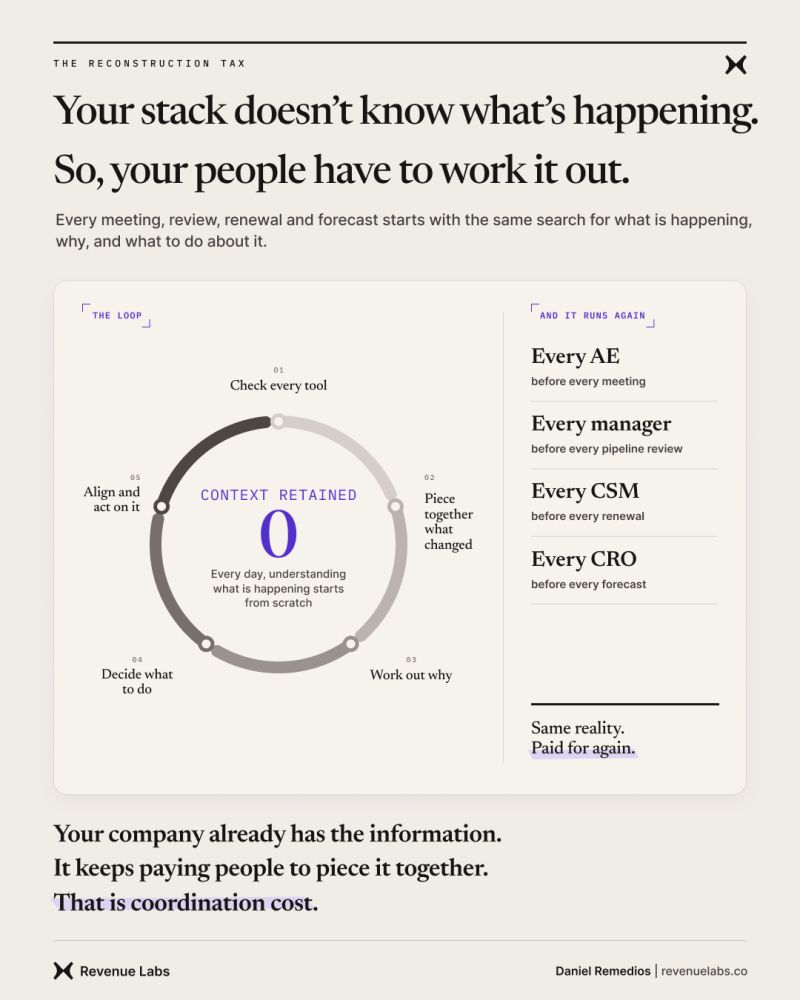
A sales manager starts Monday by asking for updates. Which deals changed? Which ones slipped? Where is the forecast exposed? Which reps need help? Which customer commitments are outstanding?
Some of these questions require judgement. Many require information. The manager spends time gathering that information because the organisation does not maintain it reliably elsewhere.
They ask reps. Inspect CRM. Review calls. Read Slack. Compare numbers. Reconstruct the situation. Only then can the deeper work begin.
Where should I intervene? What does this rep need? Which deal deserves attention? What trade-off should we make? Which behaviour should change?
This distinction matters because a significant part of modern management is not judgement itself. It is the work required to create the context in which judgement becomes possible.
AI-native systems begin changing that layer. If Live State continuously maintains more of what is happening, capabilities assess routine situations, and meaningful changes are surfaced automatically, managers no longer need to spend the same proportion of their time discovering the state of the organisation.
They can begin from it. That does not reduce the importance of management. It exposes what management was uniquely valuable for all along.
Management has always been partly an information system
Organisations need to coordinate many specialised people around shared objectives. Management hierarchy is one of the mechanisms companies developed to make that possible.
Information moves upward. A salesperson understands a group of deals. A manager creates a view across the salesperson and their peers. A director creates a view across managers. A CRO builds a view across the commercial organisation.
At each level, information is compressed. Detail becomes summary. Signals become metrics. Local context becomes organisational interpretation. Decisions then move back down. Priorities. Targets. Resource allocation. Interventions.
This is not all management is. But it is an important part of what management structures do. They act as an information and coordination network.
The reason becomes clearer when information is incomplete. A manager asks for an update because the system does not contain the current state. A forecast meeting reconciles interpretations because there is no shared representation of pipeline.
A one-to-one transfers context that otherwise remains inside one person’s head. A business review reconstructs the relationship between activity and outcome. These rituals help the organisation maintain coherence. They are partly management practices. They are also responses to information architecture.
Managers spend enormous amounts of time discovering what changed
Consider the difference between two questions. “What is happening?” and “What should we do about it?” Modern managers spend significant time answering the first before they can reach the second.
The pattern exists everywhere. A sales manager scans pipeline to find risk. A customer leader reviews accounts to discover which ones are deteriorating. A marketing leader reads reports to understand where performance changed. An executive prepares for a meeting by asking teams to assemble updates.
The manager is functioning as an observer of the system. Observation consumes attention. And because human attention is limited, companies often make observation periodic.
Weekly pipeline review. Monthly account review. Quarterly business review. The organisation cannot inspect everything continuously, so managers sample reality on a schedule.
Live State changes that constraint. The operating layer can continuously observe more of the underlying system and identify meaningful state transitions. The manager no longer needs to inspect every deal to discover which three changed. They can begin with the three.
This is a subtle change in workflow. It is a significant change in management economics.
From inspection to attention allocation
A manager’s real scarce resource is not access to information. It is attention. They cannot deeply inspect every deal. Coach every behaviour. Join every customer conversation. Investigate every exception.
The organisation therefore needs a mechanism for determining where management attention creates the highest value. Today, much of that allocation is manual. The manager scans. Asks. Listens. Notices. Prioritises.
AI-native systems can make part of that mechanism explicit. A high-value opportunity deteriorated. A rep repeatedly overrides the same recommendation. A strategic customer has entered an unusual risk state. One segment of pipeline is behaving differently from historical patterns. A new employee is consistently struggling with one part of discovery.
These are not merely alerts. They are claims about where management attention should go. The manager still decides whether the claim is important. But the operating layer can dramatically reduce the search cost.
Management begins moving from finding the exceptions toward handling the exceptions.
Exception handling becomes more central
This is a useful way to think about the future management role. Routine situations are increasingly handled by the system. Stable accounts do not require deep inspection.
Well-understood low-risk decisions can run through Skills and agents. Standard coaching observations can be surfaced automatically. Predictable process does not need continuous managerial enforcement.
What remains disproportionately valuable? Exceptions. Ambiguous situations. High-stakes decisions. Novel patterns. Conflicts between objectives. Situations where the system is uncertain. Situations where the system is confidently wrong.
These are precisely the environments in which experienced human judgement matters most. The manager therefore becomes increasingly responsible for deciding what to do where the operating model cannot simply apply itself. This is not less management. It is management concentrated at the points of highest uncertainty and consequence.
Managers become governors of judgement
As AI systems begin making recommendations and taking action, another responsibility appears. Who judges the judgement? A Deal Assessment capability decides an opportunity is high risk. The manager disagrees. Why?
Perhaps the system missed relationship context. Perhaps the Skill is weak. Perhaps the manager is overconfident. Perhaps the situation is genuinely novel. The disagreement matters.
Managers increasingly become one of the governance layers around machine judgement. They inspect edge cases. Challenge conclusions. Approve high-consequence actions. Identify where organisational Memory is incomplete. Recognise where a Skill needs to evolve.
This moves the manager beyond supervising work. They begin supervising part of the operating logic through which work is performed.
Coaching changes too
Coaching today depends heavily on observation. Managers listen to calls. Review results. Remember previous conversations. Identify patterns. Then offer feedback.
The quality of coaching depends partly on how much of the employee’s work the manager can actually see. That is a sampling problem. An AI-native operating layer expands the observable surface. It can detect recurring patterns across many interactions.
The rep asks weak discovery questions repeatedly. The same objection is mishandled across several calls. Next steps are consistently vague. The rep performs strongly with technical stakeholders but struggles to mobilise economic buyers. The system can surface these patterns before the manager has listened to twenty recordings.
This does not make the system the coach. It changes the inputs available to coaching. The manager can spend less time discovering the pattern and more time understanding why it exists, deciding which intervention matters and helping the person improve.
The coaching conversation can become more specific. Not: “You need better discovery.” But: “Across your last eight opportunities, you establish technical pain well but rarely test the economic consequence. Let’s look at the pattern and work on that.”
The operating layer provides the evidence. The manager provides judgement, empathy and development.
Managers increasingly improve the system, not just the person
There is another consequence. Suppose five reps make the same mistake. Traditional management may coach five people. That may be appropriate.
But perhaps the problem is not five individuals. Perhaps the Skill is poor. Perhaps the process is ambiguous. Perhaps onboarding teaches the wrong behaviour. Perhaps relevant Memory is missing.
An AI-native manager can begin asking a more systemic question: Is this a people problem or an operating-system problem?
That distinction is powerful. If the same failure appears repeatedly, fixing each employee individually is expensive. Fixing the underlying Skill may propagate improvement across the organisation.
The manager therefore becomes an important source of operating-system feedback. They do not only improve individual performance. They help identify where the system through which performance occurs should change.
The manager becomes a system trainer
This creates a different relationship between management and organisational learning. An experienced manager already trains the organisation indirectly. They coach people. Create process. Share lessons. Escalate recurring problems.
AI-native systems can make this contribution more durable. The manager rejects a recommendation and explains why. That creates a trace. They identify missing context. Memory can improve.
They repeatedly ask the same question in pipeline review. Perhaps the Pipeline Review Skill should include it. They notice an exception that occurs repeatedly. Perhaps the ontology needs a new concept.
Their judgement can move from a private intervention into system improvement. The manager is no longer only training employees. They are helping train the commercial operating model. That can multiply the value of exceptional management.
Great managers become more leveraged
Strong managers are scarce. They understand people. They recognise patterns. They make good decisions with incomplete evidence. They know when process should be followed and when an exception matters.
Historically, their leverage has been constrained by attention. A manager can only review so many deals, coach so many people and participate in so many decisions. Management hierarchy partially solves this by creating more managers.
AI-native systems create another form of leverage. The system can encode more of what strong managers repeatedly teach. It can surface the situations where their judgement is most valuable. It can preserve their corrections. It can distribute lessons through Memory and Skills.
A strong manager can therefore influence decisions they never directly touch. This does not commoditise good managers. It compounds them. The organisation begins turning management judgement into infrastructure.
Weak management becomes harder to hide
There is a less comfortable consequence too. Better observability makes management quality more inspectable. If Decision Traces preserve important judgements, companies can start seeing patterns in how managers intervene.
Which managers consistently identify risk earlier? Which ones override the system accurately? Which ones repeatedly maintain optimistic forecasts unsupported by evidence? Which coaching interventions produce better outcomes? Which teams operate with unusually high decision latency?
Traditional performance management often evaluates the outputs of teams. AI-native systems can begin revealing more about the quality of managerial judgement itself. This should be handled carefully. Commercial outcomes are noisy. A manager can make excellent decisions and still experience bad outcomes.
But richer decision data creates the possibility of evaluating management at a deeper level than headline results alone. That changes accountability.
Management span may increase
If managers spend less time on reconstruction, routine inspection and process enforcement, the efficient span of management may change. A manager today might support eight reps because the information burden of ten or twelve becomes difficult.
If the operating layer maintains more state and surfaces important changes, that same manager may be able to support more activity without proportionally increasing workload. This will vary enormously by role.
Some teams require intensive human development. Some commercial environments are highly complex. More reports does not automatically mean more management capacity. But the underlying economic relationship can shift.
The relevant question becomes: How much complexity can one good manager govern when the system absorbs more observation and coordination?
That is more interesting than asking how many managers AI will replace.
Fewer status rituals, better decision rituals
Management calendars also begin to change. Many recurring meetings exist partly to create shared state. Pipeline review. Forecast. Account review. Weekly team update.
Some of these will remain valuable. Human groups need discussion. Leaders need shared interpretation. Teams need social coordination. But the purpose can change. If everyone enters with a maintained view of what changed, the meeting does not need to spend half its time establishing facts.
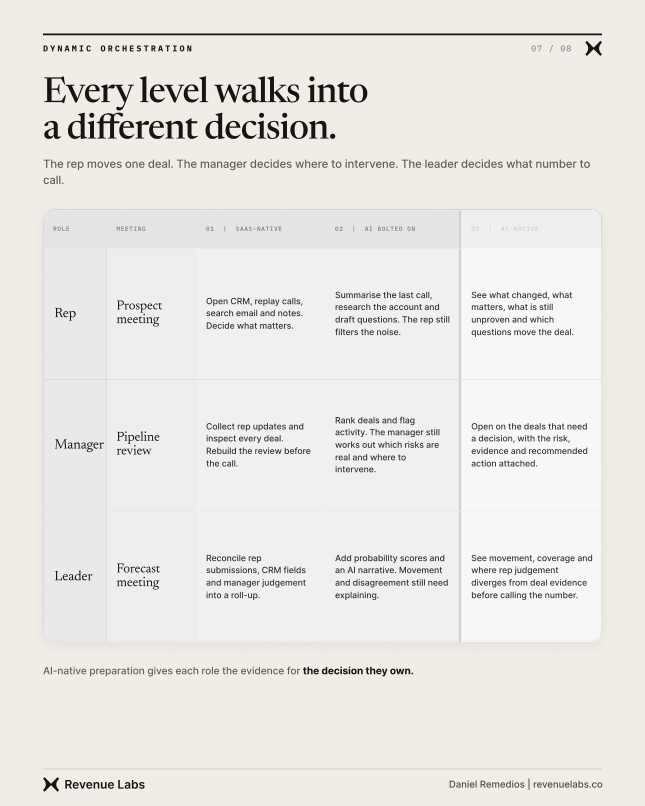
Instead of: “Can you update me on Meridian?” the conversation can start: “Meridian’s champion strength declined after the last meeting, security added another review and forecast confidence dropped from 72% to 48%. The system recommends executive intervention. Do we agree?”
The meeting moves immediately into judgement. This is a better use of synchronous human time. The operating layer handles more reconstruction asynchronously. People use live interaction for ambiguity, disagreement, creativity and decision.
That creates a useful principle: Use the system to establish state. Use people to resolve what the state does not settle.
Objectives become more important
If managers spend less time monitoring routine execution, setting objectives becomes more important. Agents need objectives. Capabilities need priorities. Humans need to know what the system is optimising for.
A prospecting system can prioritise accounts. But should it optimise for meetings? Qualified pipeline? Strategic logos? Short-term revenue? Learning in a new segment?
Those are management decisions. As execution becomes more automated, poorly defined objectives can propagate faster. This makes management upstream thinking more important. What are we actually trying to achieve? Which trade-offs are acceptable? Which constraints matter? When should short-term outcomes give way to strategic learning?
The system can optimise. Management decides what deserves optimisation.
Resource allocation becomes more dynamic
Managers also allocate scarce resources. People. Time. Executive attention. Budget. Discount flexibility. Technical support.
As State becomes more current and capabilities become more predictive, resource allocation can become more responsive. A strategic deal enters an unusual state. Executive sponsorship is deployed earlier. A segment begins producing unusually strong outcomes. More prospecting capacity shifts toward it. A customer shows early expansion signals. Specialist support is assigned.
Management moves from periodic allocation based on retrospective reporting toward more continuous allocation based on changing state. Again, the system does not eliminate the decision. It improves the timing and context around it. This matters because resource allocation is one of management’s most economically consequential responsibilities.
Managers become translators between objectives and operating logic
There is an important relationship between leaders, managers and RevOps here. Leaders define broad objectives. RevOps architects the system. Managers live close enough to the work to see how that system interacts with reality. They sit in the middle.
A leadership objective such as “move upmarket” eventually has to change operating behaviour. Which accounts matter? What does qualification look like? When should executive involvement occur? Which capabilities need to behave differently?
Managers are often where the abstract objective meets specific commercial situations. That makes their feedback important to Memory and Skills. They help translate strategy into executable judgement. And they help reveal when the formal logic fails in practice.
The human role concentrates around novelty
There is a broader pattern here. The more reliably the system can handle a situation, the less management attention that situation should require. The more novel the situation, the more valuable humans become.
A routine late-stage security review may be well understood. A geopolitical event suddenly affecting a strategic account is not. A standard pricing objection may be handled through an established Skill. A complex negotiation involving unusual legal and commercial trade-offs requires human judgement. A familiar coaching pattern may be surfaced automatically. A talented rep experiencing a crisis of confidence requires a manager.
AI does not remove the human from management. It changes the distribution of situations requiring human involvement. The human role moves toward the edges of the known system. That is where novelty, ambiguity and consequence concentrate.
Management becomes more about designing conditions
There is a useful way to describe the shift. Traditional management often focuses on controlling activity. Did the work happen? Was the process followed? Was CRM updated? Did the rep make enough calls? Did the team complete the next steps?
Some of this remains necessary. But when routine execution becomes more observable and more automated, managers can spend more time designing the conditions for good performance.
Are the objectives clear? Is the right Memory available? Are the Skills good? Are incentives aligned? Does the person have the right capability? Is the system allocating attention correctly? Where should autonomy increase? Where should it decrease?
This is closer to system design. Managers shape the environment in which people and agents perform.
The role of trust changes
Management also relies heavily on trust. Leaders cannot observe everything. Managers cannot inspect every action. Employees are given autonomy because complete supervision is impossible and undesirable.
AI-native systems increase observability. That does not mean companies should use the technology to create perfect surveillance. That would be both unhealthy and strategically shortsighted.
The more useful opportunity is to make important decisions and state transitions observable without turning every human action into a metric. This distinction matters.
Good management requires psychological safety, autonomy and room for judgement. The objective should be greater organisational understanding, not total behavioural control. The system should help answer:
Where is attention required? Where is the operating model failing? Where is consequential judgement happening? Not: How do we measure every minute of every person’s work? AI-native management should increase trust through better shared context, not replace trust with surveillance.
Managers move up the stack
There is a simple pattern underneath all of this. As the system absorbs more routine work, the manager’s role moves upward. From information gathering to interpretation. From monitoring to attention allocation. From process enforcement to exception handling. From individual correction to system improvement. From reviewing activity to evaluating judgement. From repeated coaching to codifying reusable lessons. From periodic resource allocation to more responsive intervention. From supervising execution to designing the conditions in which execution happens well.
Humans move toward the work that is hardest to formalise. Judgement. Relationships. Trade-offs. Novelty. Leadership.
This creates a different management system
Put these changes together and the management architecture begins to look different. The operating layer continuously senses the organisation. Live State maintains what is happening. Capabilities perform routine analysis and work. Decision Traces make consequential judgement observable. The system identifies material changes and allocates attention.
Managers intervene where ambiguity, consequence or human development requires them. Their interventions create new evidence. RevOps and leadership can use that evidence to improve Memory, Skills and governance. The system improves.
Management therefore becomes part of a feedback loop: State → exception → managerial judgement → action → trace → outcome → system improvement.
The manager is neither outside the system nor being replaced by it. They are one of its highest-value actors.
Management after information scarcity
Much of twentieth-century management developed in an environment where information was scarce, delayed and expensive to aggregate. Software reduced that scarcity. AI reduces it further. The question is what management becomes when access to information is no longer the primary constraint.
I think the answer moves toward judgement. Which changes matter? Which objectives matter most? Where should scarce attention go? When should the system be trusted? When should it be challenged? Which exceptions reveal a deeper operating problem? Which lessons deserve to become part of how the whole organisation works?
These questions are harder than collecting status. They are also much closer to what great managers already do. The AI-native operating layer does not eliminate management.
It removes some of the work that accumulated around management because the system could not maintain itself. What remains is the part we should probably have been designing the role around all along.
The manager as judge. Coach. Allocator. Governor. And increasingly, improver of the system itself.
This essay is versioned. Where our thinking develops materially, we will update the version and explain why - the revision history is preserved, not polished away.