
Essay
v1.0
The Company as a Learning System
A company that becomes better at operating because it operated.

A note from the author
This essay is where the Revenue Labs thesis started becoming a broader question about companies. GTM gave us the initial environment: accounts, deals, customers, decisions and outcomes. But the architecture we kept discovering felt increasingly general. Companies sense their environment. Build representations of reality. Apply accumulated judgement. Decide. Act. Observe outcomes. Learn. For most of the software era, much of that loop remained human. AI allows more of it to become persistent, executable and observable inside software. I do not think the destination is the autonomous company. I think the more interesting idea is the adaptive company: an organisation that becomes better at operating because it operated.
Companies are often described through their functions. Sales. Marketing. Product. Finance. Operations. Customer Success. Each function has people, software, processes and objectives.
This is useful organisationally. But it can hide something more fundamental. A company is also a system that continuously tries to understand and respond to its environment.
Customers change. Competitors move. Markets shift. Products are used. Signals arrive. People act. The organisation needs to notice those changes, interpret what they mean, decide what matters, coordinate action and learn from the result.
Seen this way, the company is not simply a collection of workflows. It is a feedback system. And for most of the software era, large parts of that feedback loop remained human.
The company as a loop
At a high level, every organisation performs some version of the same sequence. It observes the world. Builds a representation of what is happening. Applies accumulated knowledge and judgement. Chooses what to do.
Acts. Observes the outcome. Then updates how it thinks.
The details differ by function. In GTM, the signal may be a new buyer, a changed conversation, a slipped deal or a customer risk. In Product, it may be user behaviour. In Finance, a change in cash flow. In Operations, a supply constraint.
The underlying loop remains recognisable: Sense → Represent → Interpret → Decide → Act → Learn.
Companies already do this constantly. The interesting question is where each part of the loop lives.
Historically, software participated heavily at the edges. It captured events. Stored records. Executed predetermined workflows. Produced reports.
Humans performed much of the interpretation in the middle. They reconstructed context. Applied judgement. Handled ambiguity. Resolved contradictions. Coordinated across systems. Learned lessons and attempted to propagate them through management, process and culture.
That division of labour made sense. The technology could not do much else. AI changes that constraint.
Software once recorded the company
The first generations of enterprise software made organisations more legible. A transaction became a record. A customer became an object in CRM. An employee became an entry in HR software. A support request became a ticket. A sale became an opportunity. A campaign became a measurable sequence of events.
This was an extraordinary transformation. Before these systems, much of organisational reality lived in paper, conversation and individual memory. Software created durable records.
That made coordination easier. It made reporting possible. It created systems of record. But the software mostly recorded the outputs of organisational understanding.
A salesperson decided a deal was qualified and updated the opportunity. A manager decided the forecast should change and moved the category. A CSM decided a customer was at risk and updated the health score.
The system stored the conclusion. The reasoning usually remained human.
Then software coordinated workflow
The next major step was workflow. Software did not only store the record. It began coordinating what should happen around it.
Create a task. Send an email. Assign an owner. Move the record. Escalate the ticket. Trigger the campaign. The system could execute process consistently. This created enormous operational leverage.
But deterministic workflow depends on something important. The organisation needs to know the rules in advance. When X happens, do Y. That works well for structured process.
It works less well when the decision depends on ambiguous evidence, incomplete context or judgement. So the human remained central.
The software coordinated the known path. The person handled everything that required interpretation.
AI enters the middle of the loop
This is why the current AI transition is different. Models can increasingly operate on the kinds of information previously reserved for humans.
Language. Conversations. Unstructured evidence. Incomplete information. Contextual judgement. They can retrieve information, compare weak signals, use tools and act.
That allows software to move further into the organisational loop. Not merely: record what happened, or execute a rule, but increasingly: interpret what is happening.
That is the discontinuity. The obvious consequence is automation. More work can be performed by machines.
But the deeper consequence is architectural. If software can participate in interpretation and judgement, the company can begin storing more of its operating model inside the system.
Representation comes before intelligence
This is where many AI discussions begin too late. A powerful model is not enough. Before intelligence can make a useful decision, it needs some representation of the environment.
What is true? What changed? Which evidence matters? Which relationships exist? What remains uncertain? Humans maintain these representations naturally. We call them mental models. Organisations maintain them collectively through people, software, meetings and process.
AI-native systems need a version too. This is Live State. A maintained representation of the environment against which the system can reason.
In GTM, State may represent: accounts, people, opportunities, customers, relationships, commercial signals, commitments, risk, and uncertainty.
The same principle applies elsewhere. An intelligent operating system cannot act reliably from raw information alone. It needs a model of reality.
The company also needs a model of itself
Representation of the external world is only half the problem. The organisation needs to know how it wants to interpret that world.
What matters? Which objectives take priority? Which trade-offs are acceptable? What constitutes a good customer? What does quality look like? Which risks matter? How should recurring decisions be made?
This is the accumulated judgement of the company. Historically, it has lived across: strategy, documents, culture, process, training, management, and individual experience.
AI-native systems allow more of this judgement to become explicit. Memory represents what the organisation knows and believes. Skills represent methods for applying that judgement. Capabilities compose those methods into recognisable organisational work.
The company begins to encode not only its information. It begins to encode how it operates on information.
That is a much deeper form of digitisation.
The company becomes more persistent
One of the most important properties of this architecture is persistence. Traditional organisations forget constantly. People leave. Context decays. Decisions lose their rationale. Lessons remain local. Processes drift. Teams repeat work that another team has already done.
This is partly a consequence of human memory and partly a consequence of fragmented software. AI-native systems can make more of the operating model persistent.
State persists. Organisational Memory persists. Skills persist. Decision history persists. Outcomes remain connected to the logic that produced them.
The company starts each decision with more accumulated context. It does not need to reconstruct everything from scratch. That changes the economics of knowledge.
Capabilities become the executable organisation
Once State, Memory and Skills exist, the system can do more than answer questions. It can possess capabilities. Research an account. Assess a deal. Prepare a meeting. Plan a renewal. Forecast. Coach.
These are not merely software features. They are parts of what the organisation itself knows how to do. This distinction matters.
A company has always been partly defined by its capabilities. Can it sell enterprise? Can it onboard customers well? Can it launch products? Can it manage complexity?
Historically, capabilities lived primarily in people and process. AI-native systems allow more of them to become executable infrastructure. The organisation’s capability map begins to exist in software.
Agents become actors in the company
This is where agents fit. Agents are actors that can observe State, use Memory, invoke Skills, use tools and perform actions.
They matter. But they are not the company. A useful analogy is employees. People are critical actors inside an organisation. The organisation is more than its employees.
It contains: roles, objectives, processes, knowledge, authority, coordination, and history.
Agents need an equivalent environment. Otherwise we are simply creating autonomous actors and hoping they behave coherently.
The company as a learning system therefore requires architecture around the agents. Shared State. Shared organisational logic. Governed Skills. Clear objectives. Decision Traces. Outcome feedback.
The agent participates in the loop. The operating model gives the agent meaning.
Decisions become part of the system
As more judgement moves into software, decisions themselves become important objects. What did the system know? What did it believe? Why did it choose this action? What uncertainty existed? What happened afterwards?
Decision Traces preserve this chain. That has several consequences. Governance improves. Managers can inspect judgement. Human overrides become evidence. Capabilities can be evaluated. Operating changes can be tested.
The company accumulates a history of how it decided. That history creates a new dataset. Not merely what the company did. How the company thought.
This is the raw material for learning.
Learning closes the loop
A system becomes genuinely adaptive when outcomes affect future behaviour. A prospect responds. A deal slips. A customer renews. A forecast proves wrong. A manager overrides the system.
Each outcome creates evidence. The organisation can ask: Was the State complete? Was the Memory correct? Was the Skill effective? Did the capability behave appropriately? Was the right objective being optimised?
The system begins to diagnose its own deficiencies. That moves us beyond automation. The operating model becomes improvable.
Learning exists at multiple levels
There is a useful distinction here. A company can learn inside an existing model. For example, it becomes better at predicting which deals will close.
That is one level. It can also learn that the model itself is incomplete. Perhaps the organisation’s definition of a champion is wrong. Perhaps the ICP needs to change. Perhaps a missing concept should be added to the ontology. Perhaps the Deal Assessment Skill is weak.
This is second-order learning. The company does not only improve its decisions. It improves the system through which it makes decisions.
That is where the operating model becomes genuinely adaptive.
A learning system needs stability too
Continuous learning sounds universally desirable. It is not. A system that reacts to every new outcome becomes unstable.
Companies need both adaptation and coherence. Some things should change rapidly. Current State. Low-risk execution methods.
Other things should move more slowly. Qualification methodology. ICP. Strategy. Organisational principles.
A learning company therefore needs different update rates at different layers. It needs evidence thresholds. Versioning. Governance. Experiments. Rollbacks. The ability to distinguish noise from a genuine change in the environment.
Adaptation without stability produces thrashing. Stability without adaptation produces obsolescence. The operating model needs both.
Objectives become part of the architecture
Learning also requires direction. A system cannot improve meaningfully without some idea of what “better” means. Revenue? Margin? Customer retention? Strategic account penetration? Learning in a new market? Forecast accuracy?
These objectives can conflict. A prospecting capability optimised purely for response rate may produce lower-quality pipeline. A renewal capability optimised purely for retention may discount too aggressively. A support system optimised for ticket closure may damage customer experience.
This is a fundamental organisational problem, not an AI problem. Companies always operate against multiple objectives. AI makes those objectives more important because optimisation becomes cheaper and faster.
Leaders therefore become increasingly responsible for defining the objective hierarchy under which the system operates. Machines can optimise. The organisation still needs to decide what deserves optimisation.
Management becomes part of the learning architecture
This changes management. Managers have historically been important carriers of organisational learning. They observe work. Recognise patterns. Correct behaviour. Translate strategy. Escalate recurring problems.
AI-native systems make those interventions more persistent. A manager rejects a recommendation. The disagreement creates a trace.
They identify missing context. State improves. They repeatedly apply a judgement the system does not understand. Memory can improve.
They spot a flawed method. A Skill changes. The manager is no longer only improving an employee. They are helping improve the system through which many employees and agents operate. Strong management becomes more leveraged because its judgement can propagate.
RevOps becomes institutional infrastructure
RevOps plays a similar role at another level. It becomes the architect and governor of the commercial system. State. Ontology. Memory. Skills. Capabilities. Agents. Governance. Decision Traces. Learning loops.
This means RevOps increasingly manages not merely the technology through which GTM happens, but the structure through which commercial learning becomes executable. That is why the role becomes so strategically important. It sits close to the mechanism through which organisational experience becomes future capability.
The rate of learning becomes competitive
This leads to a strategic consequence. Imagine two companies with access to similar models. Similar data. Similar software. Similar people.
One uses AI primarily to produce work faster. The other builds a system in which actions produce traces, outcomes improve Skills, Memory evolves and repeated operating gaps become new capabilities.
The first organisation becomes more productive. The second can become more capable. That difference compounds. Each decision becomes evidence. Each outcome becomes a potential upgrade. Each upgrade improves future work.
The competitive advantage shifts from simply possessing intelligence to learning faster through operation. This is where AI-native systems become strategically interesting.
Experience becomes infrastructure
Most companies already learn from experience. But that learning is difficult to retain. An experienced salesperson sees hundreds of patterns. An experienced manager develops intuition. A founder understands the market differently after a decade.
This knowledge can be extraordinarily valuable. It is also fragile. People leave. Teams reorganise. Markets change.
AI-native systems allow portions of that experience to become infrastructure. Not by pretending all tacit knowledge can be encoded. It cannot.
But by progressively capturing: relevant State, organisational judgement, methods, decisions, outcomes, and improvements. The system becomes a durable layer through which experience can influence future work.
Experience stops being only something people possess. More of it becomes something the organisation can retain.
This changes the boundary of the firm
There is an even broader implication. Economists have long thought about firms partly through coordination. Why does work happen inside a company rather than through markets?
One reason is that coordinating people, information and resources through hierarchy can be more efficient than repeatedly negotiating every interaction externally. If AI materially changes the cost of coordination, it may eventually change the efficient shape of companies.
Smaller teams may coordinate more complexity. Experts may influence more work. Capabilities may be assembled dynamically. Some organisational functions may become thinner. External Skills and specialised agents may integrate more naturally into internal systems.
The boundary between employee, software and external capability becomes more fluid. This will not happen uniformly. Trust, incentives, regulation, culture and relationships all matter.
But the underlying economic constraint is moving. When coordination cost changes, organisational design can change with it.
The operating model becomes programmable
There is a phrase worth approaching carefully. The company becomes more programmable. Not because every human decision becomes code. Not because organisations become deterministic.
But because parts of the operating model that previously existed only through human habit can become explicit, executable and versioned. Definitions. Methods. Permissions. Decision criteria. Escalation rules. Objectives. Capabilities. Learning loops.
The company gains a new ability: to inspect and deliberately modify more of the machinery through which it operates.
This makes the operating model increasingly tangible. A process can be upgraded. A Skill can be tested. Memory can be versioned. A capability can be evaluated. A decision can be traced.
This is different from merely configuring software. It is closer to configuring the behaviour of the organisation itself.
But companies are not machines
This metaphor has limits. Companies contain people. People have motives. Politics. Identity. Trust. Creativity. Relationships. Interpretations. Culture.
The most important decisions often involve ambiguity that cannot be reduced cleanly to optimisation. An AI-native operating model should not treat the company as a deterministic machine.
The goal is not to eliminate these human qualities. It is to distinguish where they create unique value from where people are compensating for information and coordination constraints that software can increasingly handle.
The system should absorb more reconstruction. More routine observation. More repeated transfer of known information. More low-risk process.
Humans should remain disproportionately involved where human capability is genuinely scarce. Leadership. Novelty. Relationships. Ethics. Negotiation. Creative judgement. Responsibility.
The learning company is not less human. It can become more deliberate about where humans matter.
Intelligence changes the operating boundary
This may be the deeper pattern underneath the entire transition. Every technology changes the boundary between what people do and what systems do.
Databases moved memory. Workflow software moved process. Cloud systems moved infrastructure. AI moves interpretation and judgement.
The boundary will keep moving as model capability improves. A task considered deeply human today may become routine software tomorrow. Another may remain human because trust or accountability matters more than technical capability.
The important property of an AI-native organisation is not that it automates everything possible. It is that it can move this boundary deliberately.
It understands which capabilities exist. Which parts remain human. Which parts are machine. Why. And when the architecture should change.
That makes adaptability itself part of the operating model.
The company starts to observe itself
At the frontier, something unusual happens. The system does not only observe customers and markets. It observes the company.
Which decisions are slow? Where does judgement vary? Which capabilities fail? Where are humans repeatedly intervening? Which Memory is contradicted by outcomes? Which Skills produce weak results? Which manual activities repeat?
The organisation becomes an object of observation inside its own operating system. That creates a recursive loop. The company operates. The system observes the operation. The observations reveal something about the company. The company changes how it operates. Then it observes again.
This is what makes self-upgrading systems different from ordinary automation. The system acts on the environment. And increasingly, on the organisation’s own operating model.
A different kind of company
Put the pieces together. An AI-native company maintains more persistent State. Its judgement becomes more explicit through Memory. Its methods become executable through Skills. Its work becomes composable through capabilities.
Agents act across tools and systems. Decision Traces preserve consequential reasoning. Outcomes feed back into evaluation.
Weaknesses become visible. The operating model improves. This creates a very different relationship between company and software.
Software is no longer merely where the company stores records or performs workflows. It becomes one of the places where the company remembers how to operate. That may be the defining transition.
From software company to learning company
For decades, the goal of enterprise software was to digitise more of the company. Digitise the customer record. Digitise the workflow. Digitise the transaction. Digitise communication.
AI extends that trajectory into something less tangible. Digitise more of the understanding. The judgement. The method. The decision. The learning.
Not all of it. Not perfectly. And not without governance.
But enough to change the architecture. The company begins to look less like a collection of people coordinating through applications and more like a shared learning system in which people and machines operate together.
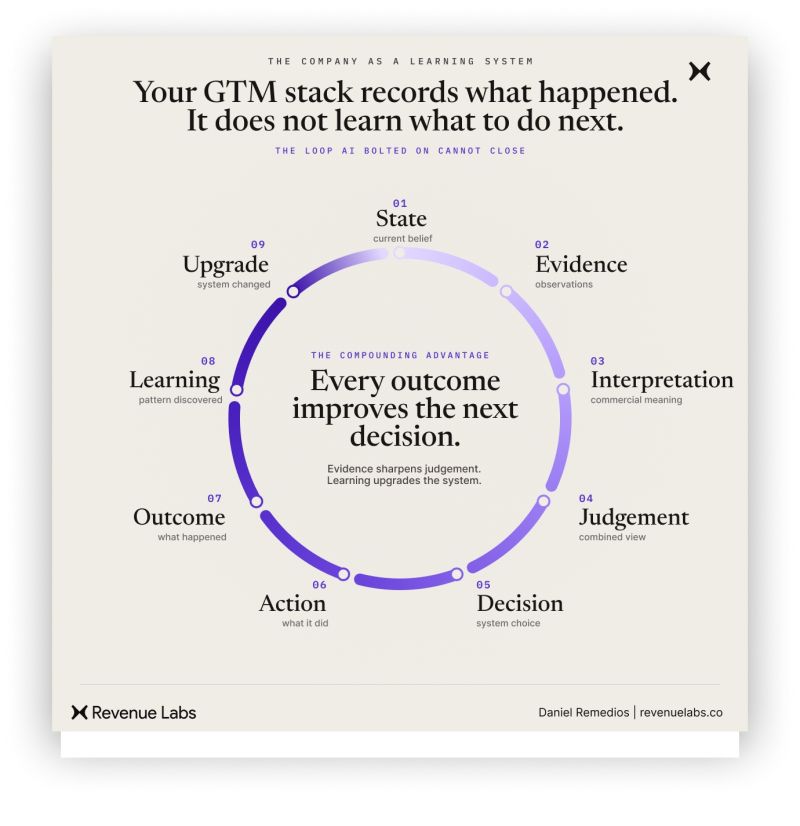
The operating loop becomes: Sense → State → Judgement → Capability → Action → Trace → Outcome → Learning → Upgrade.
Then reality changes. And the loop begins again.
The important question for the next generation of companies may therefore not be how much AI they use. It may be how quickly their experience becomes better judgement, how quickly that judgement becomes better capability, and how coherently those capabilities propagate through the organisation.
We spent the software era making companies increasingly digital. The next era may be about making them increasingly adaptive. Not because the software knows everything. Because the organisation can finally begin remembering, inspecting and improving more of how it learns.
This essay is versioned. Where our thinking develops materially, we will update the version and explain why - the revision history is preserved, not polished away.