
Essay
v1.0
The AI-Native GTM Maturity Curve
SaaS-native → AI-assisted → AI-native → self-upgrading. Where organisations actually are.

A note from the author
I wanted a way of describing AI maturity that did not reduce to how many copilots or agents a company had deployed. A company can use AI everywhere and still rely on people to reconstruct context, reconcile systems and maintain the connective tissue of the organisation. That led us to a different maturity model. SaaS-native. AI-assisted. AI-native. Self-upgrading. The distinction is not the quantity of AI. It is where understanding, judgement, coordination and learning live. I think that gives leaders a much more useful way to assess where they actually are, and more importantly, what architectural transition needs to happen next.
Most companies are currently asking a version of the same question. How much AI are we using? The answer usually takes the form of a feature inventory.
AI in CRM. AI in call analysis. AI in prospecting. AI in content. AI in customer success. More copilots. More agents. More automation.
This is understandable, but I think it measures the wrong thing. An organisation can use AI everywhere and still operate through the same underlying architecture it used before.
People reconstruct context. Managers gather state. RevOps reconciles systems. Knowledge remains distributed. Decisions happen through meetings and individual judgement. AI makes many of those activities faster. That does not necessarily make the operating model AI-native.
The more useful question is: Where does understanding, judgement, coordination and learning live?
That gives us a different maturity curve. Not: little AI → lots of AI. But: SaaS-native → AI-assisted → AI-native → self-upgrading.
Each stage represents a different division of labour between people and software.
Stage 1: SaaS-native
The SaaS-native organisation uses software extensively. CRM. Marketing automation. Sales engagement. Conversation intelligence. Customer success. Analytics. Support.
The stack may be sophisticated. The organisation may be highly digital. But people still provide much of the operating layer.
They interpret fragmented evidence. Reconstruct current state. Apply company judgement. Coordinate across systems. Decide what changed. Escalate exceptions. Teach each other how work should be done.
Software stores evidence and executes workflows. Humans maintain coherence. This is the dominant operating model of the SaaS era.
It works well because people are flexible. They bridge gaps between systems. Handle exceptions. Interpret ambiguity. Remember context.
The weakness is that much of the organisation’s intelligence remains distributed and ephemeral. The system knows what happened. The people know what it means.
Stage 2: AI-assisted
The next stage adds intelligence to the existing architecture. Research gets faster. Emails get generated. Calls get summarised. CRM updates automatically. Forecast narratives are produced. Dashboards become conversational. Agents perform isolated tasks.
This can create significant productivity gains. But the organisation may still rely on people to assemble context before the AI can be useful.
A salesperson asks an assistant to summarise a deal. The assistant retrieves fragments and reconstructs an answer. A manager asks for pipeline analysis. The system interprets records that were still assembled through human process.
A prospecting agent produces personalised outreach. Someone still decides which accounts matter and why. AI accelerates pieces of the operating model. It does not necessarily change where the operating model lives.
That is why AI-assisted is a useful distinction. The work becomes faster. The architecture remains recognisable.
The trap of AI-assisted maturity
This stage can look more advanced than it is. The company has many AI features. Employees use copilots every day. Agents perform meaningful work. Leadership sees measurable time savings.
It feels like an AI transformation. But underneath, the same coordination problem may remain. Different tools use different context. Different employees create different prompts. Agents reconstruct state independently. Company knowledge is embedded inconsistently across instructions.
Outputs multiply. Managers still need to reconcile what is trustworthy. AI can therefore increase local intelligence while leaving organisational intelligence fragmented.
This is one of the reasons the transition from Stage 2 to Stage 3 is not simply incremental. It requires a different architecture.
Stage 3: AI-native
The AI-native organisation begins moving parts of the operating layer into the system. It maintains Live State. It encodes organisational Memory. It turns methods into Skills. It composes capabilities. Agents operate within shared context and governance. Decision Traces preserve important judgement. Outcomes feed back into improvement.
The distinction is not that the organisation uses more AI. It is that software assumes more responsibility for maintaining the conditions under which intelligent work can happen.
A Deal Assessment capability does not begin by asking a human to assemble the deal. It begins from maintained state. A prospecting capability does not treat ICP as a document that must be copied into every prompt. It reasons from shared Memory.
A manager does not manually inspect every opportunity to discover which ones changed. The system allocates attention toward meaningful state transitions. This is a different operating model.
The key shift is persistence
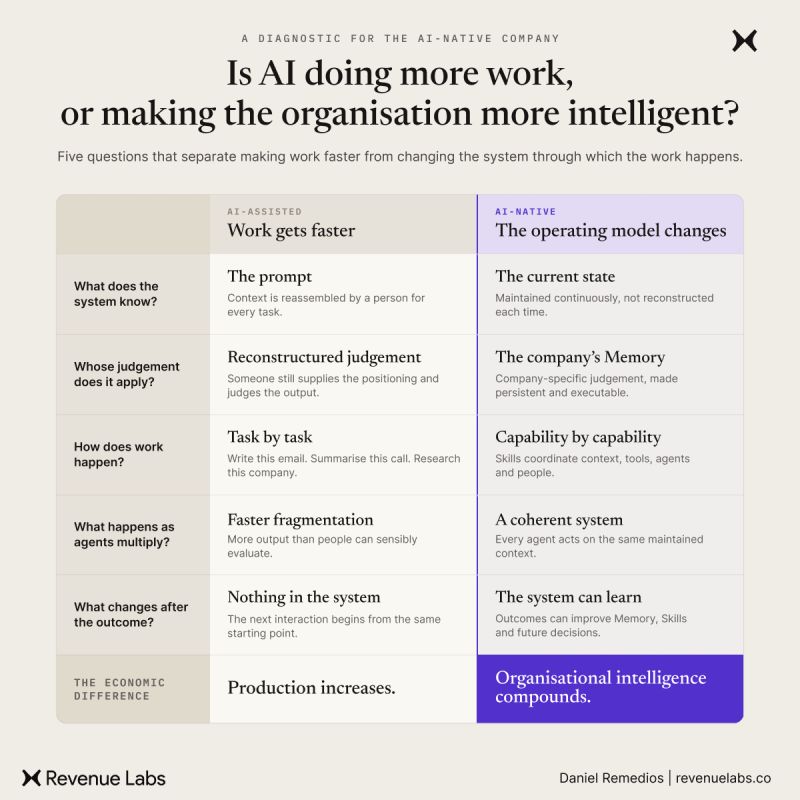
One of the cleanest ways to distinguish AI-assisted from AI-native systems is persistence. AI-assisted systems often create intelligence at the moment of use. Retrieve the information. Build the context. Generate the answer. Then do it again next time.
AI-native systems preserve more of the organisation’s understanding. State persists. Memory persists. Skills persist. Decision history persists. The organisation does not start from zero on every interaction.
That persistence creates reuse. The same State can serve multiple capabilities. The same Memory can guide multiple decisions. The same Skill can be used by multiple agents. The same Decision Trace can improve future judgement.
The operating model becomes an asset rather than a series of isolated interactions.
The second shift is from tasks to capabilities
AI-assisted organisations often automate tasks. Write this email. Summarise this call. Research this account. Classify this opportunity.
AI-native organisations begin designing around capabilities. Meeting Preparation. Deal Assessment. Pipeline Review. Account Prioritisation. Renewal Planning.
The distinction matters. A task describes an action. A capability describes something the organisation can reliably do. Capabilities combine State, Memory, Skills, tools, orchestration and governance.
They can span applications. They can be evaluated against outcomes. They can improve. This is where AI starts moving from productivity software toward operating infrastructure.
The third shift is from workflow to judgement
Traditional SaaS automates known process. When X happens, do Y. AI-assisted systems add generation and interpretation inside those workflows. AI-native systems begin making more of the judgement itself executable.
Is this account worth attention? Is this deal genuinely healthy? Does this customer require intervention? Which opportunity deserves management time? Those are not fixed workflow questions. They depend on context.
An AI-native system can increasingly apply company-specific judgement to them. This is why Memory and Skills matter. Without them, intelligence remains generic. With them, the system can operate from the way the organisation itself thinks.
The fourth shift is from reporting to attention
SaaS-native organisations report what happened. AI-assisted organisations summarise and explain those reports faster. AI-native organisations can increasingly decide which changes matter enough to warrant attention.
This changes the management rhythm. Instead of inspecting everything to find exceptions, managers begin with the exceptions. Instead of periodically searching a territory for opportunity, the system can surface meaningful account changes. Instead of waiting for a QBR to discover risk, the system can recognise changes in customer state as they occur.
The output is not just information. It is prioritised attention. That is a deeper form of intelligence.
The fifth shift is from output to trace
AI-assisted systems are often evaluated on outputs. Was the email good? Was the summary correct? Was the recommendation useful?
AI-native systems need to preserve something richer. What did the system know? What did it believe? Which Memory did it apply? Which Skill did it use? Why did it act? What happened next?
This is the Decision Trace. Once judgement becomes part of the operating model, the organisation needs to observe not only what the AI produced but how organisational decisions were formed.
This enables governance. It also creates the raw material for learning.
The sixth shift is from automation to learning
This is where the curve becomes more interesting. Traditional SaaS executes workflows. AI-assisted systems execute them faster. AI-native systems can begin observing whether the underlying operating logic works.
A capability runs. A decision is made. An outcome occurs. The system can compare the outcome with the State, Memory and Skill that produced it.
That creates the possibility of improvement. The organisation can ask: Was relevant context missing? Was Memory wrong? Was the Skill weak? Did a human override improve the result? Was the right capability invoked?
The operating model becomes inspectable. And once it is inspectable, it can become improvable.
Stage 4: self-upgrading
This is the frontier. The system does not merely execute the operating model. It increasingly identifies where the operating model itself is deficient.
Imagine a Deal Assessment capability repeatedly underestimates risk in a particular class of enterprise opportunity. The system can detect the pattern. It can inspect Decision Traces. It can identify that the current Skill gives too little weight to a particular form of stakeholder behaviour. It can propose a change.
A human reviews it. A new Skill version is approved. Future assessments improve. Now imagine the same mechanism across: ICP. Messaging. Qualification. Customer health. Account prioritisation. Coaching. Forecasting.
The system starts identifying: missing State, Memory gaps, weak Skills, missing tools, ontology deficiencies, repeated human overrides, and capabilities the organisation performs manually but has never encoded.
It becomes capable of recommending upgrades to itself. That is a qualitatively different stage of maturity.
Self-upgrading does not mean self-governing
This distinction is essential. A system capable of proposing improvements should not necessarily be free to make every change autonomously. Some upgrades are low risk. A minor research method can be adjusted automatically.
Others are strategic. Changing ICP. Pricing logic. Qualification. Customer-risk policy. These may require leadership approval.
The frontier is therefore not a company surrendering control to an autonomous system. It is a company where the operating system can increasingly observe its own deficiencies and participate in improving them. Governance becomes part of the learning loop.
The system learns. Humans decide which learning should become operating logic. Over time, some boundaries may move. But autonomy should remain proportional to consequence.
The maturity curve changes the role of RevOps
RevOps looks different at each stage. In the SaaS-native organisation, RevOps administers the stack. Integrations. Data. CRM. Reporting. Workflow.
In the AI-assisted organisation, RevOps adds copilots, AI features and automations. It becomes responsible for more tools and more AI workflows.
In the AI-native organisation, RevOps becomes the architect of State, Memory, Skills, capabilities, governance and Decision Traces. It designs the commercial operating system.
In the self-upgrading organisation, RevOps increasingly becomes the governor of system improvement. Which recommendations should be adopted? Which operating changes require approval? Where is the system learning the wrong lesson? How quickly should capability upgrades propagate?
The role moves from configuration to architecture to governance of learning.
The maturity curve changes management too
Managers follow the same progression. SaaS-native managers gather information and coordinate people. AI-assisted managers use AI to do this faster. AI-native managers begin from maintained State and spend more time on exceptions, coaching and judgement.
Self-upgrading systems add another responsibility. Managers become one of the most valuable sources of corrective evidence. Their overrides reveal missing context. Their repeated questions reveal Skill gaps. Their interventions reveal where organisational judgement remains tacit.
They help train the system. Management moves from supervising work toward improving the operating model through which work happens.
The maturity curve changes the user experience
The interface changes too. At Stage 1, users operate applications. Open CRM. Open Gong. Open Outreach.
At Stage 2, each application increasingly contains an AI assistant. The user still moves between applications. At Stage 3, capabilities can increasingly come to the user.
A manager receives the deals that changed. An AE receives Meeting Preparation. A CRO receives Commercial State. A CSM receives Customer Risk. The underlying applications remain, but the user does not need to operate each one directly for every task.
At Stage 4, the system increasingly surfaces not only work and recommendations but improvements to how the organisation itself operates.
The experience moves from: use software to: consume capability to: govern the system.
Different roles occupy different points in that experience.
The economics change at each stage
The economic progression is also distinct. SaaS-native software creates leverage through digitisation and workflow. AI-assisted software lowers production cost.
AI-native systems begin lowering coordination cost and decision latency. They increase management leverage. Reduce unnecessary variance. Make company judgement more reusable.
Self-upgrading systems add another property: learning rate. The system improves because it operates. That creates a compounding effect.
This is why Stage 4 matters. The gain is not only cheaper execution. It is improving execution. The distinction between productivity and compounding becomes central.
The maturity curve is not linear
Companies will not progress neatly from one stage to the next. An organisation may have AI-native prospecting and SaaS-native customer success. One capability may have excellent shared State while another relies on manual reconstruction. Some workflows may be self-improving while others remain static.
The stages are therefore better understood as operating characteristics than company labels. Ask of a particular capability: Where does State live? Where does judgement live? Who reconstructs context? How is the work performed? How is it traced? Does the outcome improve the method?
That tells us more than asking whether the company “uses AI”.
AI-native is not an end state
There is another reason to treat maturity carefully. The models will keep improving. New capabilities will become possible. Organisations will change.
What counts as appropriate machine judgement today may look conservative in several years. What counts as advanced autonomy today may become normal infrastructure.
The operating model therefore cannot be static. An AI-native company is not one that reaches a final architecture. It is one increasingly capable of moving the human-machine boundary deliberately as capability improves.
That is a more durable definition. The organisation understands which work remains human because of current constraints, not because “that is how the process has always worked”. As those constraints change, the architecture can change with them.
The real maturity test
This gives us a more demanding set of questions for any organisation claiming to be AI-native.
Does the system maintain a shared representation of commercial State? Does organisational judgement exist outside individual prompts and people? Are methods reusable as Skills? Are agents operating through shared capabilities or isolated workflows? Can consequential decisions be traced? Can the organisation connect those decisions to outcomes? Can repeated outcomes improve State, Memory or Skills? Can the system identify gaps in its own operating model? And can those improvements propagate safely across the organisation?
If the answer is no, the company may still be doing excellent work with AI. But it is probably still operating an AI-assisted version of the SaaS model. That distinction matters because the two systems compound differently.
From AI adoption to operating-model design
The maturity curve changes how companies should approach AI transformation. The usual starting point is application-by-application. Where can Salesforce use AI? Where can Marketing use AI? Which team needs a copilot? Which process should get an agent?
That creates useful local improvements. But it can also produce another fragmented layer. A more ambitious transformation starts with the operating model.
What does the organisation need to understand continuously? Which judgement should become shared? What capabilities should exist? Where should autonomy sit? Which decisions matter enough to trace? What outcomes should improve the system?
Then technology follows. The question stops being: Where should we add AI? It becomes: Which parts of how this organisation understands, decides, acts and learns can now move into the system?
That is the AI-native maturity question.
The frontier keeps moving
The SaaS-native organisation relies on people to make software coherent. The AI-assisted organisation gives those people increasingly powerful intelligence. The AI-native organisation begins making the coherence itself part of the system.
The self-upgrading organisation starts learning how to improve that system through operation. That is the progression:
Software supports human coordination. AI accelerates human coordination. The operating layer assumes more coordination. The operating layer begins improving itself.
The most important transition is therefore not from less AI to more AI. It is from intelligence being something people access inside software to intelligence becoming part of how the organisation itself operates.
And once that happens, maturity is no longer measured by how many agents a company has. It is measured by how much of its ability to understand, decide, act and learn has become coherent, persistent and improvable.
This essay is versioned. Where our thinking develops materially, we will update the version and explain why - the revision history is preserved, not polished away.