

A note from the author
Agents are exciting. We are building them too. But the more we have worked with agents, the more convinced I have become that the agent itself is not the most important architectural question. An agent without good State can confidently act on an incomplete picture. Without shared Memory, different agents can apply different versions of company judgement. Without Skills and governance, autonomy can simply create faster inconsistency. The interesting problem is therefore not how many agents an organisation has. It is the system in which those agents operate. This essay is an attempt to separate the actor from the architecture and explain why the infrastructure around agents may ultimately matter more than the agent abstraction itself.
The current AI market is fascinated by agents. Agents research accounts. Agents write emails. Agents update CRM. Agents prepare forecasts. Agents analyse customers. Agents coordinate other agents.
The underlying idea is intuitive. If models can reason, use tools and act, then perhaps companies can replace more workflows with autonomous software. That is clearly directionally important. But I think the agent is being asked to carry too much conceptual weight.
An agent can be capable and still operate inside a weak system. It can have excellent reasoning and poor context. It can use tools without understanding the company’s operating logic. It can act autonomously without knowing whether its decisions were good. It can optimise locally while the organisation becomes less coherent globally.
This matters because enterprise software problems are rarely isolated task problems. They are state, judgement, coordination and learning problems.
An agent is an actor inside that environment.
It is not the environment itself.
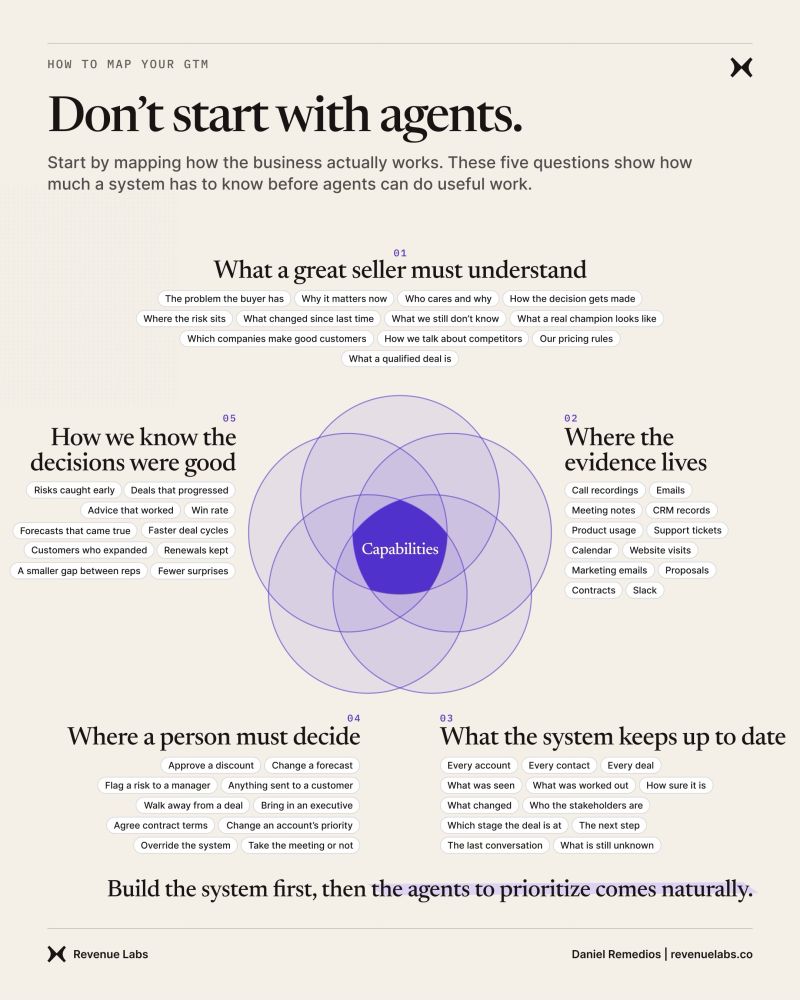
The agent is only one part of the system
Consider a Deal Risk agent. What does it need to work well? It needs the current state of the opportunity. It needs access to the company’s qualification logic. It needs to know which signals matter. It needs a method for assessing risk.
It may need data from CRM, conversations, email and product usage. It may need to distinguish observed evidence from inference. It needs to know when confidence is too low for autonomous action. It needs to explain why it reached a conclusion. And eventually, the organisation needs to know whether the conclusion proved useful.
The agent participates in this process. But most of the intelligence of the system is not contained in the fact that an agent exists. It sits in the surrounding architecture.
State. Memory. Skills. Tools. Permissions. Decision Traces. Outcomes. Feedback.
If any of those are weak, a more capable agent can simply fail faster.
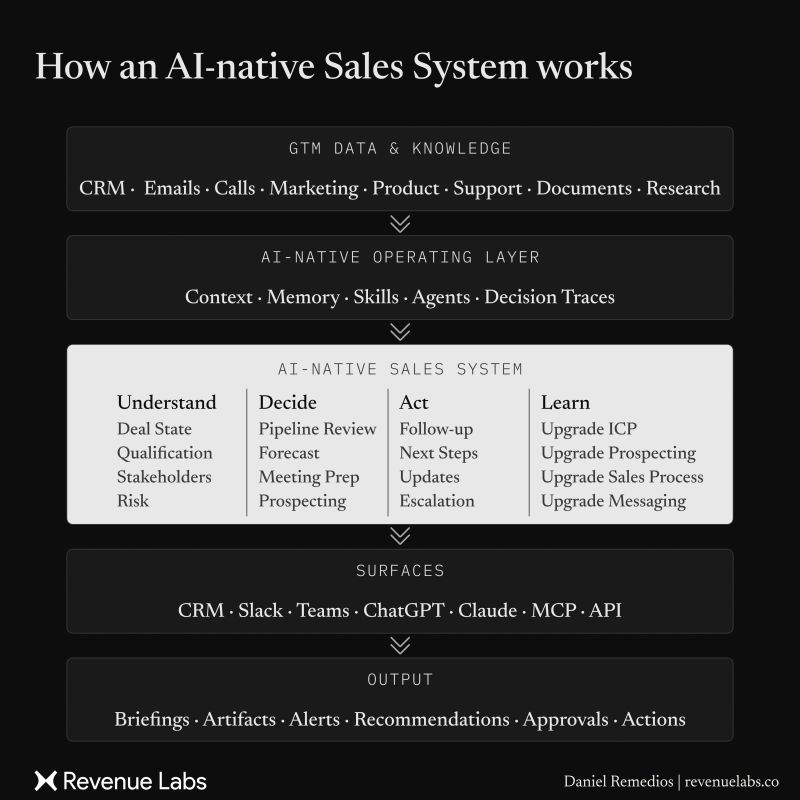
More autonomy can amplify fragmentation
This is the deeper risk. The SaaS era fragmented commercial work across applications. Humans compensated by carrying context between them. Now imagine replacing some of that human coordination with many autonomous agents.
One agent researches accounts. Another prioritises them. Another writes outreach. Another assesses deals. Another forecasts. Another manages customers.
If each reconstructs its own context independently, reasons from different assumptions and has no persistent relationship with the others, the architecture has not become more coherent. It has become more autonomous. That is not the same thing. In fact, autonomy increases the cost of inconsistency.
A human who lacks context may stop and ask a colleague. An agent can proceed. A human may notice that two systems disagree. Two agents may each act on a different version of the truth. A human may remember that the company changed its qualification logic last week. An isolated agent may not.
The more machine action a company introduces, the more important shared context becomes. This is why I think the real enterprise AI challenge is not simply building better agents. It is building the system in which agents operate.
Agents need shared state
A useful operating model starts with a common representation of reality. If a Prospecting Agent believes an account is high priority, while a Sales Agent operates from stale information and a Customer Agent knows something about the same company that neither of them can see, then the agents are not coordinating around a shared world.
They are each constructing one. That creates a familiar problem. The organisation has multiple partial representations of reality. Only now the representations belong to machines as well as people. Live State changes that. Instead of every agent beginning by reconstructing context, agents can operate against a maintained commercial state.
A new executive joins. The account state changes. A prospecting capability may respond. A customer conversation happens. The deal state changes. A sales capability may respond. A support issue escalates. The customer state changes. A renewal capability may respond.
The agents are specialised. The state is shared. This distinction matters. Distributed intelligence works better when it operates against a coherent representation of reality.
Agents need organisational judgement
State alone is not enough. Two companies can observe the same event and interpret it differently.
A new CRO joining a target account may be highly relevant to one company and irrelevant to another. A particular support pattern may signal churn risk in one business and normal behaviour in another. A strong champion may mean something different in enterprise software than in a transactional sale.
Agents therefore need access to the organisation’s judgement. This is Memory.
Without it, the agent relies on generic model intelligence. That may produce plausible work. It does not necessarily produce company-specific work.
The distinction becomes more important as the task becomes more consequential. A generic model can draft an email.
A company-specific system should know why this account matters, what this organisation believes about the persona, what previous engagement occurred, what positioning is relevant and what outcome the company is trying to create. The agent does not need to reinvent that logic. It should inherit it.
Agents need methods
The same applies to Skills. An objective is not a method. “Assess this deal” is an objective.
How should the assessment be performed? Which evidence should matter? What constitutes missing evidence? How should uncertainty be handled? When should a contradiction trigger escalation? What should the resulting assessment contain?
This is where Skills matter. An agent can use intelligence inside a method rather than treating every task as an unconstrained reasoning problem.
That gives the organisation a better balance between adaptability and control. The agent remains capable of handling changing situations. The organisation still defines how important work should be done.
This is especially important in enterprise environments, where the goal is rarely maximum autonomy. It is reliable autonomy inside appropriate boundaries.
Agents need tools, but tools are not context
There is another common confusion. Giving an agent more tools does not necessarily make it understand the organisation better. Tools increase what the agent can do.
Search CRM. Read email. Query a warehouse. Send a message. Update a record. Create a task. These capabilities matter. But tool access and contextual understanding are different things.
An agent can be connected to every application in the stack and still lack a coherent representation of the account. It can retrieve every call and still misunderstand the deal. It can access the company’s documents and still fail to apply the right judgement.
Tool abundance can actually increase complexity. The system now has more possible actions and more possible sources. It still needs a way to determine which evidence matters, which actions are appropriate and how they relate to the current state.
The agent needs tools. The operating model gives those tools meaning.
Agents need boundaries
The most credible AI-native organisations will probably not be those with the highest possible level of autonomy. They will be the ones that understand where autonomy belongs.
Companies already operate this way with people. A salesperson has discretion, but cannot approve any discount they want. A manager has authority, but within budget and policy. A CSM can make decisions, but some commercial changes require approval. Autonomy is bounded.
AI systems should be designed similarly. An agent might autonomously enrich an account. It might recommend moving a forecast category. It may require manager approval before changing a strategic deal. It might draft a renewal plan but not commit commercial terms.
The boundary can depend on: confidence, economic consequence, reversibility, risk, customer impact, and organisational policy.
This is much more sophisticated than asking whether an agent is autonomous. The useful question is: Autonomous to do what, under which conditions, with which evidence, and accountable to whom?
Agents need observability
As machine autonomy rises, invisible decision-making becomes more dangerous. If an agent prioritises an account, the organisation should know why. If it downgrades a deal, the manager should be able to inspect the evidence. If it chooses not to act, that may matter too.
A log saying “agent executed successfully” is not enough. The organisation needs to understand the decision itself.
What State did the agent see? Which Memory did it use? Which Skill did it apply? What judgement did it make? Which action followed? What happened afterwards?
This is the role of Decision Traces. They turn agent activity into something the organisation can inspect, govern and eventually learn from.
Without traces, greater autonomy can create less organisational understanding. That is the wrong direction.
The organisation should observe outcomes, not only outputs
Most AI systems are still evaluated at the level of outputs. Was the answer good? Was the email relevant? Was the summary accurate? This matters.
But organisations care about what happened next. Did the account respond? Did the opportunity progress? Did the forecast improve? Did the customer renew? Did the manager accept the recommendation? Did the human override the system?
An agent that produces consistently impressive outputs but poor outcomes is not useful.
An agent that makes simple decisions but improves organisational performance may be extremely useful.
The system therefore needs to connect agent behaviour to outcomes. This is where isolated agents become particularly weak. Without shared traces and outcome data, each agent learns very little about whether its actions contributed to the organisation’s objectives. The operating layer provides the loop.
The agent should not own the company’s logic
There is a practical architectural consequence here. Do not bury critical company logic inside individual agents.
If the company’s ICP exists only inside the Prospecting Agent prompt, then another capability will recreate it. If qualification logic exists only inside the Deal Agent, Pipeline Review may interpret deals differently. If customer risk logic exists separately across several agents, changes need to be made repeatedly.
The organisation’s logic should exist independently of the agents that use it. Memory should be shared. Skills should be reusable. State should be persistent.
This creates a cleaner separation. Agents can change. Models can change. Orchestration can change. The underlying organisational logic remains durable.
That is especially important in a market where agent frameworks and models will evolve quickly. The company should not have to rebuild its operating model every time the technical implementation changes.
Agents are increasingly interchangeable
This leads to a strategic point. Model capability will continue to improve. Agent frameworks will continue to mature. Tool use will become more reliable.
Many forms of agent behaviour that look differentiated today may become standard infrastructure. If that happens, where does durable value sit? Probably not simply in having an agent.
It sits in: the quality of the State, the depth of organisational Memory, the methods encoded in Skills, the capability graph, the traces, the outcome history, the governance, and the system’s ability to improve.
Two companies may use the same models and similar agent infrastructure while achieving very different organisational performance. The difference is the system around the agents.
That system is company-specific. It accumulates. It learns. And it becomes harder to reproduce because it reflects how the organisation itself has learned to operate.
Multi-agent systems make architecture more important, not less
This becomes even clearer as companies begin using many agents. A single agent can sometimes carry a surprising amount of context inside its prompt and working memory. Ten agents create coordination problems. A hundred agents create architecture problems.
Who owns the state? How do agents communicate? Which conclusions persist? How are conflicts resolved? Which Memory is authoritative? Which Skills can be reused? How are permissions inherited? Which actions require approval? How does the organisation observe the combined system? How do outcomes propagate back into improvement?
The more distributed the execution becomes, the more valuable shared primitives become. This is familiar in software engineering. Distributed systems require stronger mechanisms for state, coordination and observability than simple local applications. Enterprise agent systems will likely follow a similar pattern.
The interesting challenge moves from: “Can this agent perform the task?” to: “Can many intelligent actors operate coherently inside one organisational system?”
That is a much harder question.
It is also a much more important one.
The user should consume capabilities, not agent complexity
There is another practical reason not to organise the operating model around agents. Most users do not care.
A CRO needs an accurate forecast. A manager needs to know which deals require attention. An AE needs to prepare for a customer conversation. An SDR needs to know which accounts matter. They should not need to understand whether one agent, five agents or no autonomous agent produced the result.
The capability is the user-facing abstraction. Behind it, the system can decide which combination of State, Memory, Skills, tools and agents is required. This also gives the architecture freedom to evolve.
A capability might initially rely heavily on a human. Later, the agent becomes capable enough to perform more of the Skill. The user still receives the same capability. The internal human-machine boundary changes without requiring the organisation to redesign the entire experience. That feels like a more durable way to build.
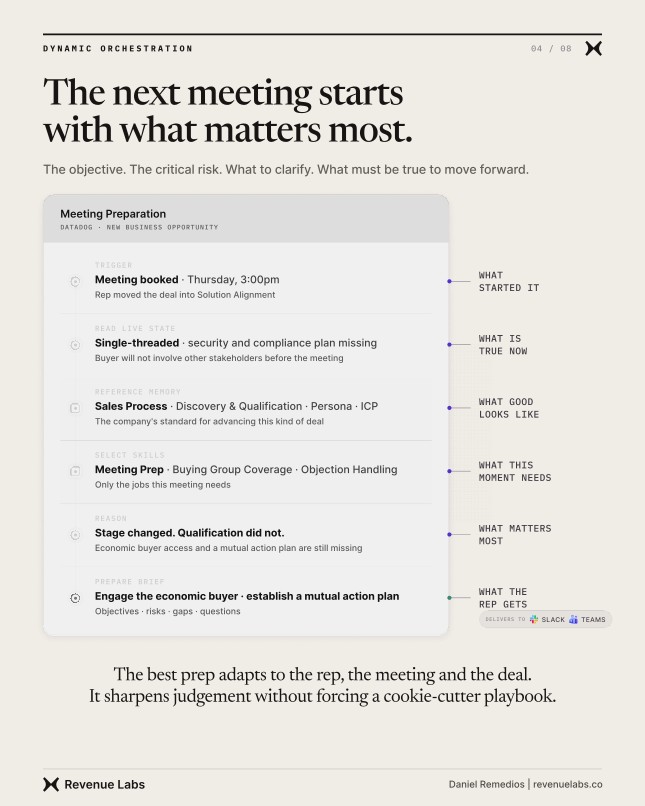
Humans are part of the agent system too
One mistake in AI architecture is to treat humans as external exceptions. They are not. Humans are actors in the operating model.
A manager may provide judgement when confidence is low. A rep may contribute relationship context unavailable elsewhere. A leader may change an objective. RevOps may approve a Memory upgrade. A subject-matter expert may improve a Skill. The system should be designed around those interactions.
Sometimes the agent acts. Sometimes the human acts. Sometimes the agent prepares the decision and the human makes it. Sometimes a human correction becomes feedback that improves future machine behaviour.
The important question is not whether humans remain “in the loop”. It is which loop they should be in.
That depends on the nature of the capability. Routine observation may become largely machine-driven. High-stakes judgement may remain deeply human. System improvement may involve both.
AI-native architecture is not about replacing one actor with another. It is about redesigning the coordination between them.
From agentic automation to organisational capability
This returns us to the original question. What should an enterprise build around? If the answer is agents, the natural roadmap becomes:
build more agents, give them more tools, increase their autonomy, and connect them together.
There is value in each of those steps. But they do not guarantee a better operating model. A more complete roadmap looks different.
Maintain better State. Encode organisational Memory. Develop reusable Skills. Compose capabilities. Use agents where autonomous reasoning and action add value. Preserve Decision Traces. Connect actions to outcomes. Improve the system.
This changes the role of the agent. It becomes an important execution primitive inside a broader architecture.
That is not a smaller vision for agents. It is a more consequential one.
Because the objective is not to create autonomous software for its own sake. It is to create an organisation that can understand more continuously, decide more consistently, act with lower latency and learn from what happens.
Agents help make that possible.
They are simply not the architecture.
The frontier is coordinated intelligence
The early enterprise AI question was whether models could perform useful tasks. The current question is increasingly whether agents can perform useful work. The next question will be whether large numbers of intelligent actors can participate in operating a company without recreating the fragmentation we spent the SaaS era trying to manage.
That requires a different level of architecture. Shared State. Shared organisational Memory. Reusable Skills. Capabilities. Governed autonomy. Decision Traces. Learning loops.
The models will continue to improve. Agents will become more capable. That makes these surrounding systems more important, not less.
The future company may contain thousands of machine actions and many specialised agents. But if each operates from a different understanding of reality, the company will not become intelligent. It will become noisy.
The frontier is not autonomous agents everywhere.
It is coordinated intelligence operating from a shared model of the organisation.
This essay is versioned. Where our thinking develops materially, we will update the version and explain why - the revision history is preserved, not polished away.