
Article
Most GTM Teams Don't Learn From Deals
GTM teams review deals constantly. They rarely learn from them. Here's what changes when every deal teaches the system.

They review deals. They don't learn from them.
Most GTM teams don't really learn from deals. They review them.
- A deal slips
- The manager asks what happened
- The rep explains the context
- RevOps checks the fields
- Someone pulls up the call recording
- A note gets added to the CRM
- The lesson gets mentioned in the forecast call
Then everyone moves on. The same mistake happens again two weeks later.
This is one of the biggest hidden failures in GTM. Not lack of activity. Not lack of tools. Not lack of dashboards. Lack of organisational learning.
A system fragmented by design
The current system is fragmented by design.
- CRM stores fields
- The call recorder stores transcripts
- The sales tool stores activity
- The manager stores judgement
- The rep stores deal context
- The playbook stores last quarter's assumptions
So when something important happens, the company does not really learn.
A rep discovers that engineering-led deals need the CTO involved before proposal. Another rep learns that single-threaded champions create late-stage risk. Another manager notices that procurement objections are often a symptom of a weak business case, not price sensitivity. Another team sees that certain signals only matter when paired with a leadership change.
But those lessons remain isolated.
Why isolated lessons don't compound
This is why:
- Rep variation stays high
- Playbooks decay
- Managers end up inspecting deals manually
- RevOps spends so much time reconstructing what already happened
- Most AI in GTM feels underwhelming
Build the system with the right primitives
The breakthrough comes when you build the system with the right primitives.
- Context
- Memory
- Skills
- Agents
- Decision traces
Now every deal can teach the system.
- What was the state of the deal?
- What did the rep do?
- What did the agent recommend?
- Why was that action taken?
- What outcome was expected?
- What actually happened?
That trace becomes the foundation for learning.
When every deal teaches the system
The system can start to spot patterns:
- Single-threaded deals slip 2.4x more often after Demo.
- CTO engagement increases win rate in engineering-led accounts.
- Proposal-stage deals without a live economic buyer decay faster.
- Competitor mentions in late-stage calls predict discount pressure unless the business case is already anchored.
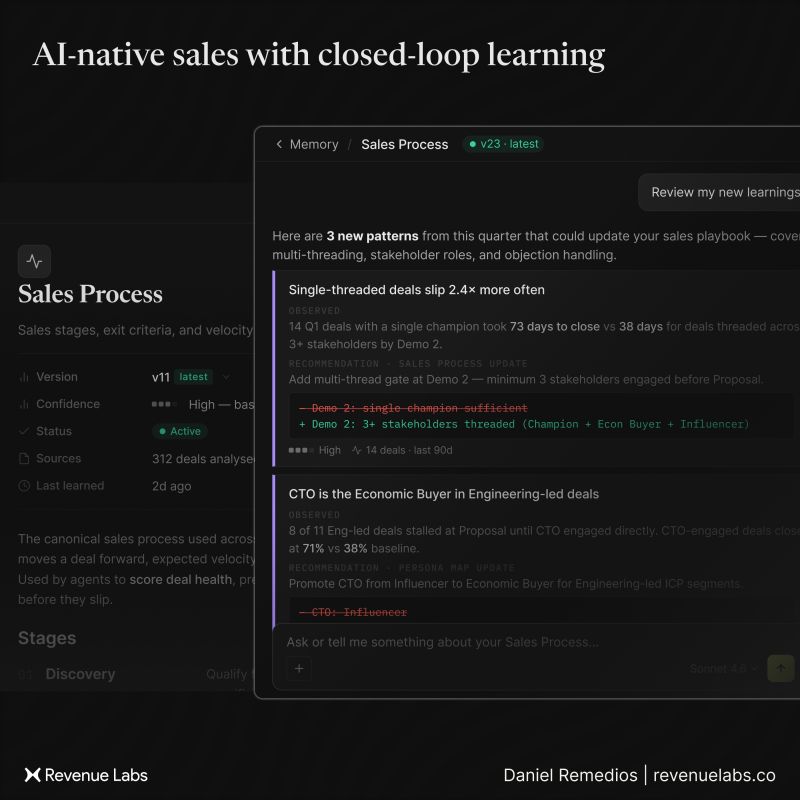
This is where GTM changes.
- Sales process updates from evidence, not opinion
- Persona maps improve from actual buying behaviour, not workshop assumptions
- Deal models learn which risks matter
- Agents improve their recommendations
- Managers move from chasing every deal to governing the system
- CROs move from inspecting pipeline to improving the machine that creates it
- RevOps move from reporting on activity to designing the feedback loops that improve decision quality
Every outcome can improve the operating model.
Old GTM records what happened. AI-native GTM learns what works. And in a market where execution is getting cheaper, learning velocity becomes the advantage.