
Article
AI Has Exposed the Fragile GTM Operation
Most executives think AI is changing GTM. It isn't. It's exposing how fragile the existing operating model already was.

AI isn't changing GTM. It's exposing it.
Most executives I speak to think AI is changing GTM. It isn't. GTM changed first. AI is just making the fact that the operating model failed to keep up impossible to ignore.
For 20 years, the GTM stack was built for a slower world, where signals were limited, markets moved more predictably, buying committees were smaller, and execution was constrained by human capacity. So the model made sense:
- CRM stored the records
- Marketing automation ran campaigns
- Sales tools executed workflows
- Dashboards reported what happened
- Humans connected everything together
That model just about worked. Then several things changed.
Signals exploded. Markets accelerated.
Every account, opportunity and customer now produces a continuous stream of data across calls, email, product usage, meetings, activity, hiring, news and the wider market. The problem is no longer access to data. It's knowing what it means and what should happen next.
Commercial reality changes continuously, but most companies still run through QBRs, pipeline meetings, win-loss reviews and ad hoc analysis. The market is continuous. The operating model is periodic.
Execution became a commodity
AI can research accounts, write emails, prepare meetings, update records and automate workflows at almost no marginal cost. But cheaper execution does not guarantee better outcomes. When context is fragmented, AI simply executes poor decisions faster.
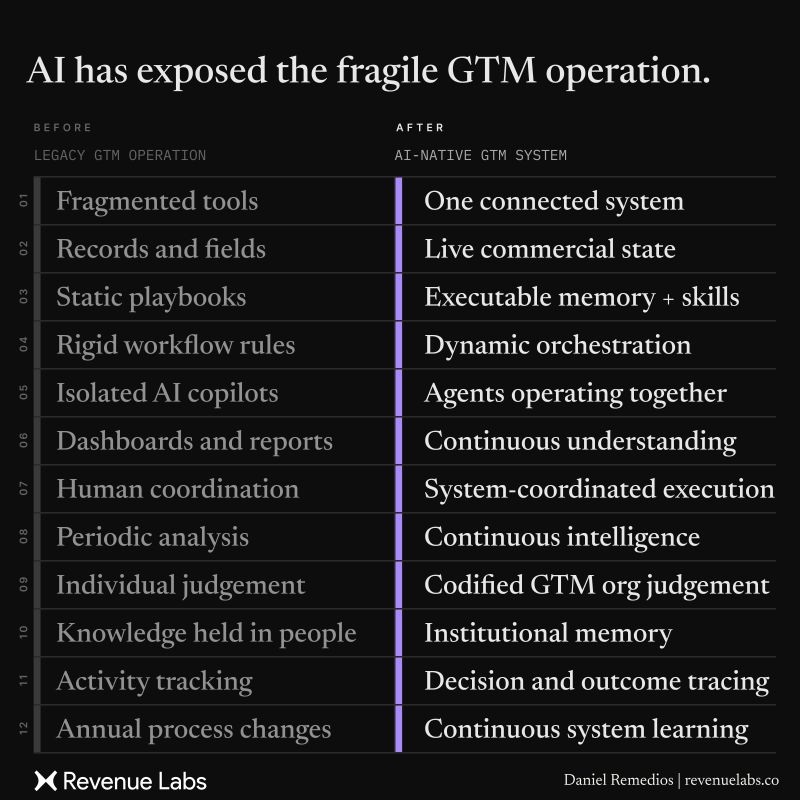
A different operating model
Agents need more than access to tools. They need shared context, codified skills, memory and feedback from a shared understanding of reality. Without that, every agent operates from a different prompt and a different interpretation of reality.
The fragmented GTM operation was built to store, automate and report, so humans became the hidden integration layer, reconstructing the CRM, reviewing calls, inspecting dashboards and preparing meetings. AI removed the need for every rep to reconstruct the market from scratch. The result is broader coverage, better timing, more consistent judgement and higher conversion. Execution scales linearly. Systems compound.