
Article
The Four New Primitives Behind AI-Native GTM
After hundreds of conversations with GTM leaders racing to integrate AI, four primitives keep surfacing: state, memory, orchestration and learning.

Adding AI to a fragmented operation
After hundreds of conversations with GTM leaders racing to integrate AI into their operation, one thing has become increasingly clear.
AI is helping teams do more. Emails. Research. Documents. Proposals. But the more it does, the faster the system beneath it strains, and burnout, confusion and anxiety increase.
Most GTM teams are struggling because they were built around records and workflows rather than continuous understanding.
So humans compensate
Humans became the integration layer, at multiple levels: managers, reps, RevOps. The company functions because people continuously map the gaps. The pressure has been building for years. More ops. More dashboards. More documents. More spreadsheets.
I think it's time a set of primitives starts to become necessary.
The four primitives
1. State (the Context Graph) is a continuous representation of GTM reality for every account, contact and deal: what's happening, what changed, why it changed, how confidence is shifting, what should happen next.
2. Codified GTM (Memory and Skills) is persistent, evaluable GTM memory and skills: ICPs, personas, scoring, messaging, the deal execution standard, lessons from wins and losses, and decision logic.
3. Orchestration (the Agent Studio) coordinates agentic workflows and actions from shared state and codified GTM: meeting prep, deal risk, pipeline review, coaching, prospecting, lead routing, and many more.
4. Learning is decision traces, outcomes, feedback loops, evolving judgement and accumulated contextual understanding.
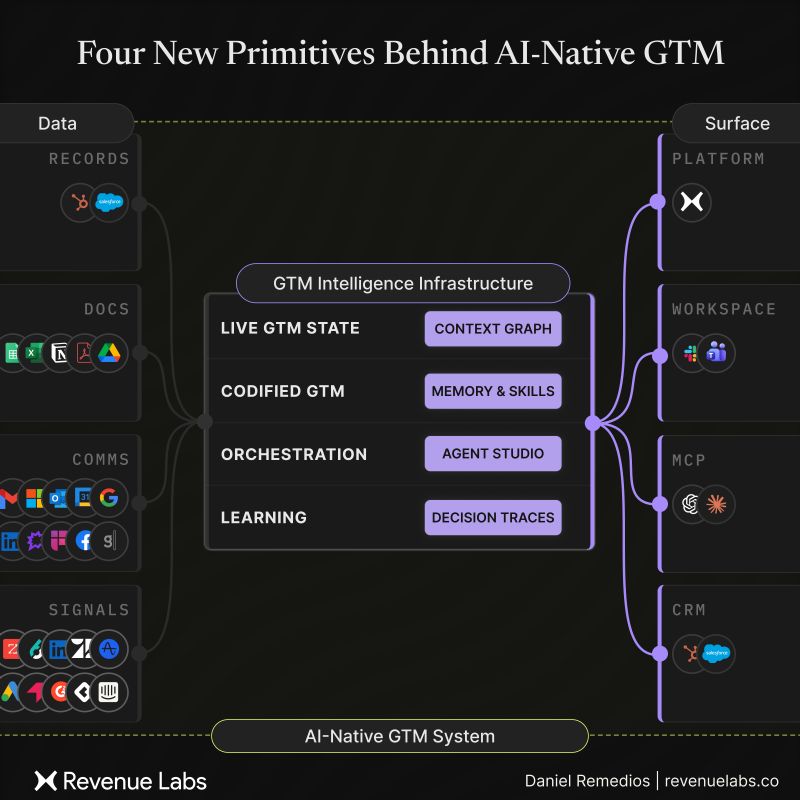
Together they give the system the ability to upgrade and improve itself. That's the foundation AI-native GTM companies can build on for their teams and agents. We're building the infrastructure to make this possible at Revenue Labs.