
Article
AI Is Changing GTM's Architecture, Not Just the Work
It isn't just that AI does the work. The deeper shift is the architecture beneath it, from records to state, memory, agents and learning.

It's the architecture, not the work
AI is not just changing GTM. It's exposing that most GTM stacks were built for a different era.
For the last 20 years, companies built GTM around:
- records
- workflows
- departments
- dashboards
- human coordination
Humans then reconstructed reality. That worked when markets moved slower and execution was expensive and constrained. But AI is changing the physics, and execution is becoming abundant.
The bottleneck shifts
The constraint is no longer execution. It's understanding, judgement, coordination and learning. And this is where many operations are about to hit a wall, because AI doesn't magically fix operational architecture. In many cases it exposes how fragmented the existing architecture is.
- CRM stores one thing
- Call logs store another
- Reps interpret risk and opportunity in different ways
- Managers override the formal records
Teams are working harder than ever to keep up, reconstructing reality across tools, dashboards, spreadsheets, Slack messages and meetings. Operationally, it's primitive. That's why we've observed many AI efforts failing to fulfil their potential.
An architecture built to learn
Most companies are trying to bolt AI onto an architecture designed for human middleware, static workflows, siloed functions and retrospective reporting. But AI increases the cost of fragmentation. The faster execution becomes, the more expensive misalignment becomes.
It's forcing a shift to a new company architecture, an AI-native GTM system:
- from records to state
- from workflows to orchestration
- from playbooks to executable memory
- from reporting to continuous learning
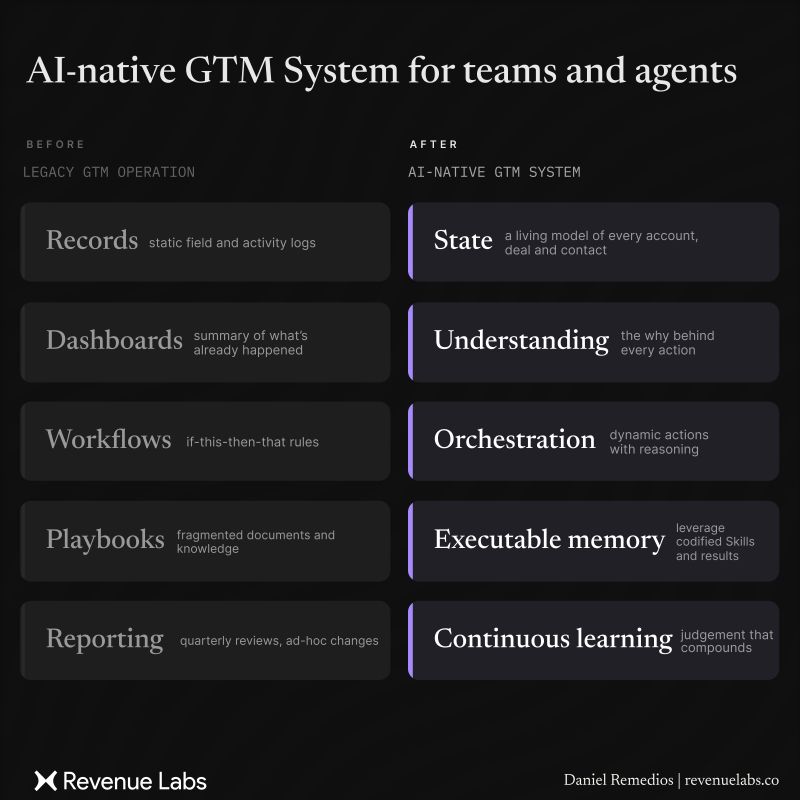
The next generation of GTM systems don't just store work, automate workflows and report on what happened. They operate on what's happening, and they run on four primitives: state, codified GTM, agents and learning. We're building that at Revenue Labs.