
Article
v1.0
When the system watches the market continuously
AI-native prospecting shifts from periodically working finite lists to maintaining market-wide State and bringing people in when their attention matters.

An SDR gets 1,000 accounts at the start of the quarter.
They tier them. Research the best ones. Find contacts. Add them to sequences. Work through 5–10 touches.
Some reply. Most don’t.
Eventually attention moves elsewhere.
Three months later, one of those companies hires a new CRO.
Their old champion joins another target account.
They start hiring five RevOps roles.
Someone returns to the pricing page.
But nobody is really watching anymore.
That’s not bad prospecting.
It’s a consequence of the operating model. A human can only meaningfully pay attention to so many accounts.
AI is already changing the economics of this work.
An SDR can use Claude to research an account. AI can identify contacts, personalise outreach, summarise previous conversations and execute sequences.
The cost of working an account falls significantly.
That’s AI-assisted GTM.
An AI-native GTM system introduces a different model.
What if the system was already watching?
Imagine it continuously monitoring 100,000 accounts against how your company sells.
Your ICP. Personas. Products. Messaging. Previous engagement. What drives propensity. What buying looks like. What tends to create timing.
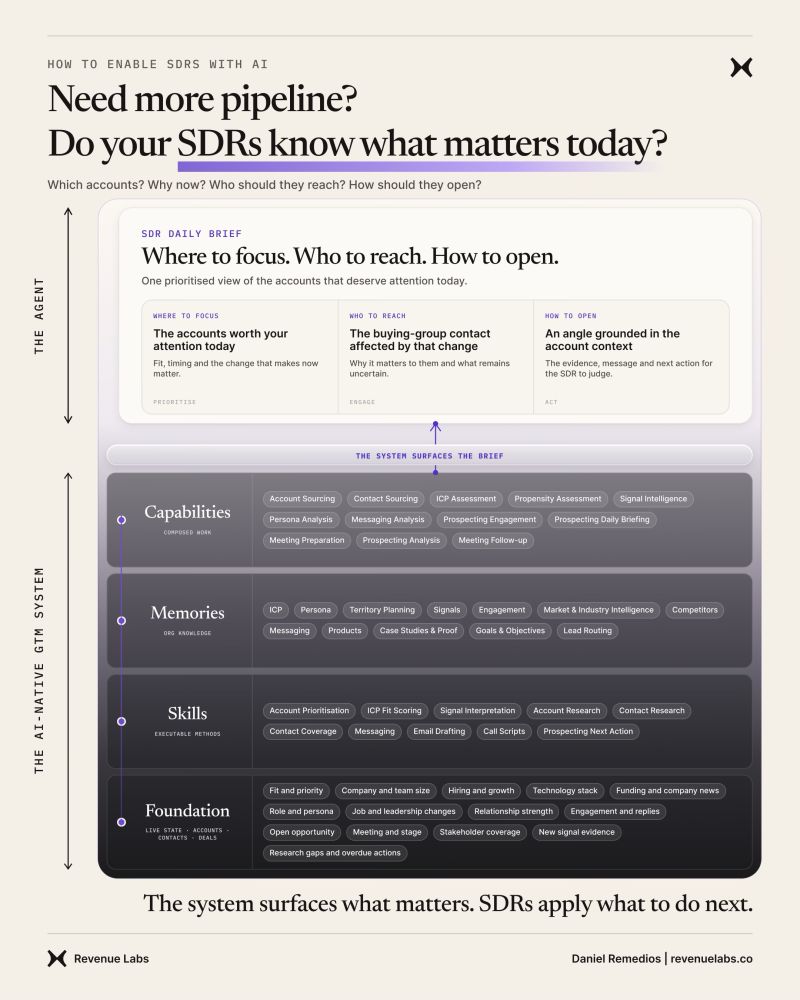
Every morning, the SDR gets a briefing:
→ Prioritise Acme. New CRO + RevOps hiring + previous opportunity lost on timing.
→ Re-engage Sarah. Previous champion just joined another Tier 1 account.
→ Hold Octopus. Strong signals, but an AE is already engaged with the buying group.
The SDR can meaningfully work 10–20.
The system can watch 100,000.
This is where the primitives of an AI-native GTM system matter.
Live State maintains what is commercially true now, rather than repeatedly reconstructing it from static records.
Memory gives the system your GTM knowledge and judgement.
Skills give it the methods to reason about that State, recommend and perform the work.
So a new CRO isn’t automatically a signal.
The system understands what changed, why it matters to your business and whether it warrants attention now.
And if it doesn’t?
It keeps watching.
The account doesn’t become “done” because the sequence ended.
Timing changes → State changes → attention changes.
The economics are fundamentally different.
Old GTM: humans periodically work a finite list.
AI-assisted GTM: humans work that list much faster.
AI-native GTM: the system continuously understands a much larger market and brings humans in when their attention matters.
This is what we’re building into Revenue Labs.
And prospecting is only one expression of it.
The same State, Memory and Skills can prepare the meeting, manage the deal, review the pipeline and recommend the next action.
Every judgement and outcome can then make the system better.
The list existed because continuously understanding the market was too expensive.
That is no longer necessarily true.
This essay is versioned. Where our thinking develops materially, we will update the version and explain why - the revision history is preserved, not polished away.