
Article
v1.0
The operating layer that makes GTM AI-native
Start with what the work must understand, maintain and learn, then design State, Memory, Skills, Agents and human judgement around it.

When I speak to sales and RevOps leaders about AI, the starting point is often existing work.
Where could we add AI?
Which workflows could we automate?
Which agents should we build?
Meeting Prep. Follow-up. Deal Risk. Pipeline Review. Prospecting. Win/Loss. CRM updates.
It’s a logical starting point. But it often produces an AI-assisted version of the GTM stack we already have.
I think the more interesting starting point is the work itself.
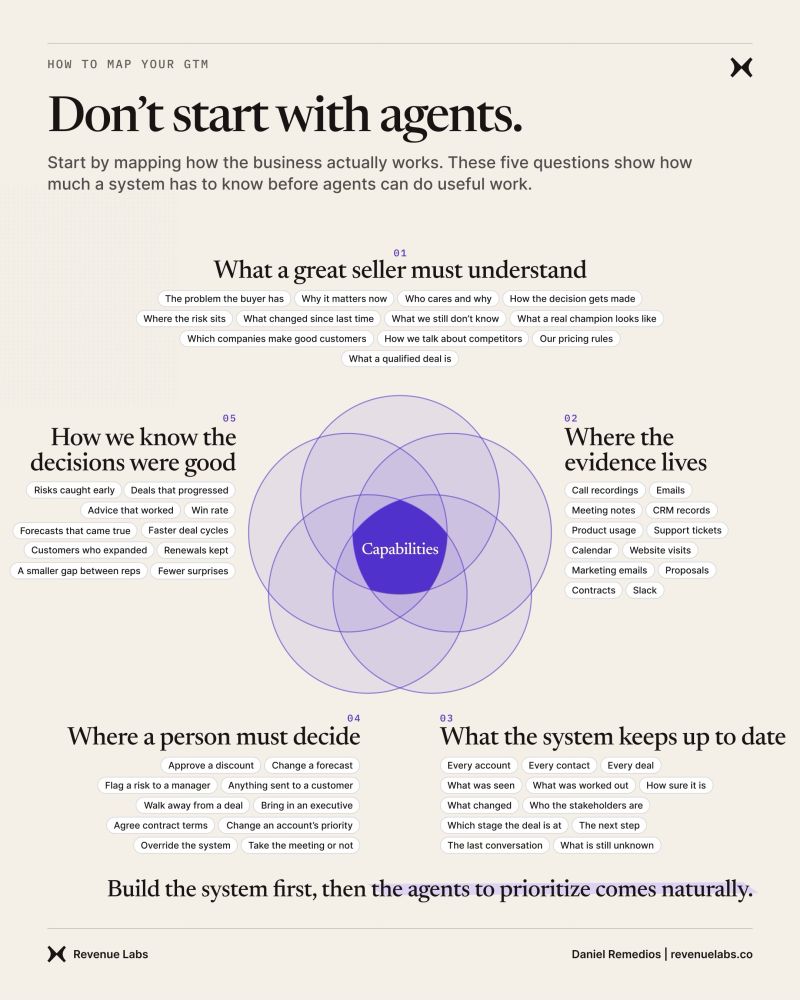
Take progressing a deal. What does a great seller need to understand?
→ Why the buyer needs to act
→ Who cares and why
→ Whether there is a real champion
→ How the decision will get made
→ Where the risk sits
→ What has changed
Then work backwards.
What does the system need to know about how your business sells?
What evidence exists across CRM, calls, email and meetings?
What should it continuously maintain as State?
Where can the system decide and act, and where does human judgement matter?
What outcomes tell us whether those decisions were good?
These questions lead to a very different architecture.
You start to need new primitives: State, Memory, Skills, Agents, Decision Traces, human judgement and learning.
And capabilities, the “jobs to be done”, stop being isolated.
Meeting Prep operates from what the system already understands. The meeting creates new evidence and changes State. Deal Assessment sees that change. Pipeline Review knows where intervention is required. Win/Loss connects the eventual outcome back to the decisions that produced it.
The next capability doesn’t start from zero.
This is where the distinction between AI-assisted and AI-native becomes much clearer.
AI-assisted makes the existing workflow more intelligent.
AI-native creates a system that continuously understands how the business is operating, applies its commercial logic, involves humans where their judgement matters, and learns from what happens next.
That changes the leverage too.
A great manager can only personally inspect so many deals. The system can apply their commercial logic across every deal, continuously, and bring them in where their judgement has the greatest impact.
Human judgement becomes part of the feedback loop, improving how the system operates over time.
Agents are part of this. But they’re an expression of the system, not the starting point.
Even familiar GTM building blocks take on a different role:
Documents → Memory
Playbooks → Skills
Workflows → Agents
Activity Logs → Decision Traces
Data → State
The bigger opportunity isn’t adding intelligence to every application and workflow.
It’s building the new Operating Layer that your people, agents and capabilities can all run on.
One that understands the business, maintains reality as it changes, applies its commercial logic and learns from the outcomes.
That’s the shift from AI-assisted to AI-native GTM.
This essay is versioned. Where our thinking develops materially, we will update the version and explain why - the revision history is preserved, not polished away.