
Article
v1.0
The Reconstruction Tax on GTM attention
How repeatedly piecing together account and deal context limits informed coverage, and how maintained State can redirect attention to change.

Your GTM team can only act on the business it has time to understand.
That’s a constraint we’ve built entire operating models around.
A rep has six meetings today. A manager has forty deals to inspect. A CSM has eighty customers. An SDR has a territory they’ll never have time to research properly.
Before deciding what deserves attention, each has to establish what’s happening.
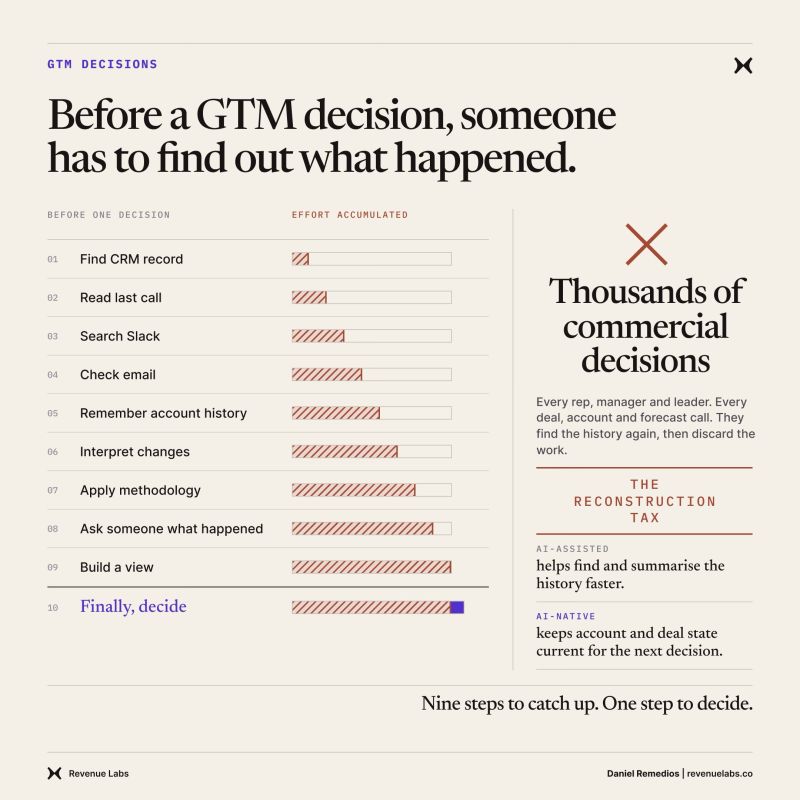
Open the record. Read the conversation. Check the history. Ask someone. Resolve the contradictions. Apply what the company knows.
Nine steps to catch up. One step to decide.
We call this the Reconstruction Tax.
It’s easy to see the time being spent. Harder to see what never happens because of it.
→ The account that becomes relevant but stays unresearched
→ The deal that deteriorates between pipeline reviews
→ The customer whose risk only becomes clear at renewal
→ The manager who spends the meeting collecting updates instead of helping
The tax limits how much of the business receives informed attention.
AI-assisted GTM reduces the cost of those steps. Better summaries. Faster research. Instant briefings.
But if understanding is still assembled separately for each task, someone still has to decide where to look. Faster answers don’t help with the questions nobody had time to ask.
This is where the operating model needs to change.
An AI-native system continuously maintains commercial State. It interprets new evidence against the account’s history, the company’s knowledge and what it previously understood.
A missed buyer commitment means something different in a healthy deal than in one where the champion is losing influence and the economic buyer remains absent.
That combination can change the risk assessment, the next meeting’s objective and whether a manager should intervene.
The system brings the change, evidence and recommended response to the person whose judgement matters.
Attention follows commercial change, rather than waiting for the next scheduled review.
And the response creates a learning opportunity. Was the risk real? Did the intervention help? Was important context missing? The answers can improve the system’s knowledge and methods for future decisions.
That changes the economics of GTM.
More accounts understood. Earlier intervention. Decisions shaped by the situation. Learning that carries into the next piece of work.
The same team can cover more of the business with greater depth.
Because its capacity to act is no longer constrained in the same way by its capacity to catch up.
This essay is versioned. Where our thinking develops materially, we will update the version and explain why - the revision history is preserved, not polished away.