
Article
v1.0
Why your GTM tech stack is not an operating system
Smarter applications still leave commercial understanding, decisions and learning fragmented across the organisation.

Your GTM tech stack isn’t your operating system.
And bolting AI to every application won’t make it one.
I think this is one of the most important distinctions we’re missing in the conversation about AI-native GTM.
Look at where the market has been heading:
→ CRMs are adding agents
→ Sales platforms adding more intelligence
→ Customer success tools predicting risk
→ Marketing tools automating execution
We’re making every part of the operation more intelligent.
But are we making the operation itself more intelligent?
Consider what happens when a customer starts to show signs of risk:
Product usage declines.
Support tickets increase.
A key stakeholder stops engaging.
Three signals. Three different applications.
Potentially three different AI agents interpreting them.
Who understands what they mean together?
Who determines whether the account is genuinely at risk?
Who decides what should happen next?
And critically, who learns whether that decision was right?
This is the problem with building intelligence around an operating model that was never designed to be intelligent.
The information is fragmented.
Understanding is fragmented.
Decisions are fragmented.
And the responsibility for connecting everything still falls on people.
We’re investing billions in making individual applications smarter, while preserving the architecture that created the fragmentation in the first place.
I think there’s a much bigger opportunity.
What happens when we design the GTM operation around AI from the outset?
A system that continuously:
→ Interprets evidence and signals across the business
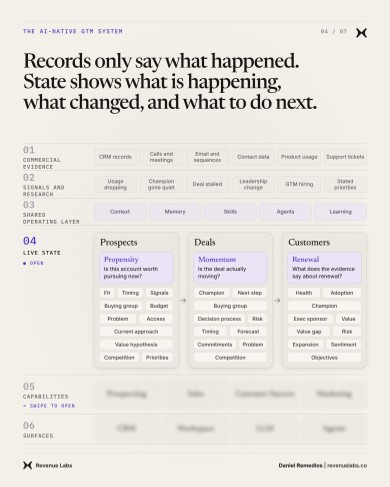
→ Maintains a live understanding of prospects, deals and customers
→ Identifies what has changed and where attention is needed
Coordinates decisions and actions across functions
→ Learns from outcomes, improving the next cycle
With people providing judgement, direction and governance throughout.
Now the architecture starts to look very different.
Your existing applications become sources of evidence and places where work happens.
The intelligence, memory, State and capabilities are shared across the operation.
And every outcome contributes to what the system understands next.
The advantage isn’t having more agents, better context or faster workflows.
It’s building an operation that becomes more intelligent through use.
At Revenue Labs, we’ve built the Operating Layer for AI-native GTM from that very principle.
I’ve mapped out the six layers of an AI-native GTM system in the carousel 👇
💬 I’m curious how others are approaching this.
Are we making our existing GTM stack smarter, or are we ready to rethink the operating model itself?
🔔 Follow for more on the new operating model for AI-native GTM
✉️ Reimagining your GTM with AI first? DM me




This essay is versioned. Where our thinking develops materially, we will update the version and explain why - the revision history is preserved, not polished away.