
Article
v1.0
Capabilities encode expertise that workflows cannot anticipate
RevOps can define how the business should operate while the system reasons continuously across changing evidence, without pre-programming every possible scenario.

A lot of RevOps automation starts with the same question:
“What should trigger this workflow?”
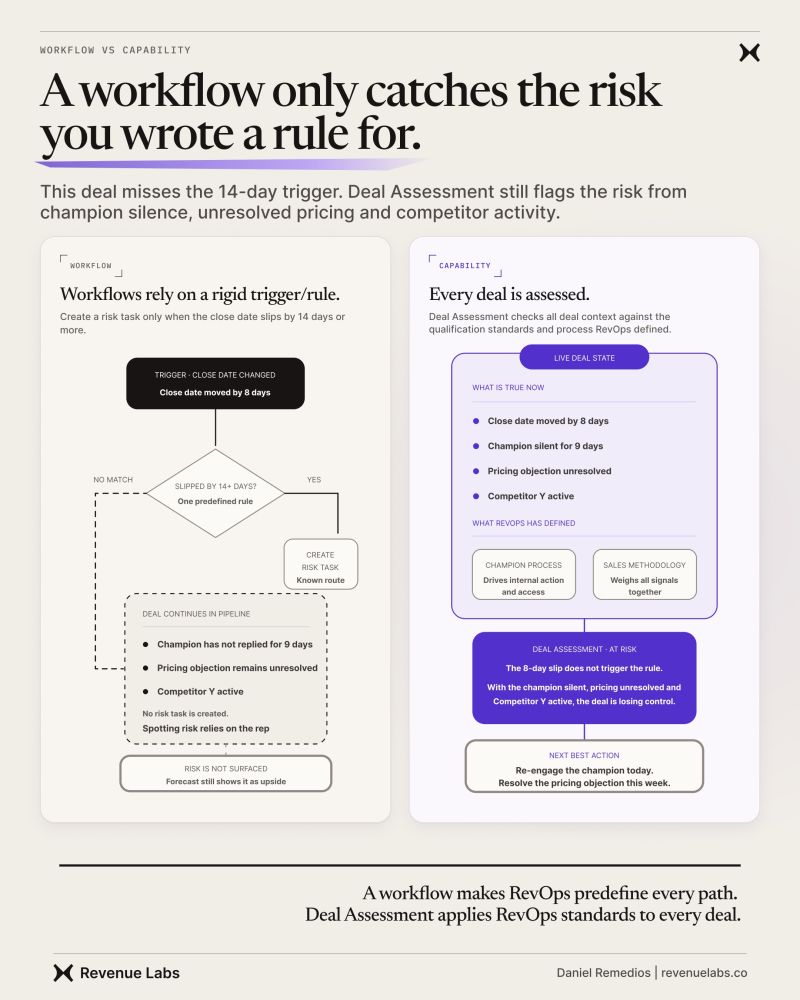
If the close date slips by 14 days → create a risk task.
So RevOps defines the condition, builds the workflow and decides what should happen when it fires.
The problem is what happens at 13 days.
Or 8.
The rule doesn’t fire.
Even if the champion has gone silent, pricing is unresolved and a competitor has entered the deal.
The individual signals are there.
The risk is there.
The workflow just wasn’t designed to see it.
This is an important distinction between workflows and capabilities.
A workflow asks:
Did the predefined condition happen?
A capability asks:
Given everything we know about this deal, what is true now?
That changes the job RevOps has to do.
Today, a lot of RevOps expertise gets translated into increasingly complex trees of triggers, conditions, branches and automations.
RevOps has to anticipate the scenarios.
Then encode the paths.
Then maintain them as the business changes.
In an AI-native system, I think the abstraction moves up a level.
RevOps defines how the business should operate:
→ What makes a qualified opportunity
→ How champions should behave
→ What good deal progression looks like
→ Which risks matter
→ How the sales methodology should be applied
→ Where human judgement is required
The system applies those standards to every deal, continuously.
So an 8-day slip doesn’t need its own rule.
The system can reason across the slip, nine days of champion silence, an unresolved pricing objection and active competition.
And conclude:
This deal is losing control.
Then determine what deserves attention and what should happen next.
That’s a very different operating model.
It doesn’t remove RevOps from the system.
It stops requiring RevOps to pre-program every possible version of reality.
And I think that’s one of the more consequential shifts in AI-native GTM.
The scarce skill moves from building increasingly elaborate workflows to designing the commercial system itself.
What should the business know?
What standards should it apply?
Where should it exercise judgement?
What should happen when reality changes?
Workflows encode paths.
Capabilities encode expertise.
And that changes what RevOps can build.
This essay is versioned. Where our thinking develops materially, we will update the version and explain why - the revision history is preserved, not polished away.