
Article
v1.0
Where commercial understanding lives in AI-native GTM
Maintaining a shared interpretation of accounts, deals, and customers changes how capabilities operate and where people contribute their judgement.

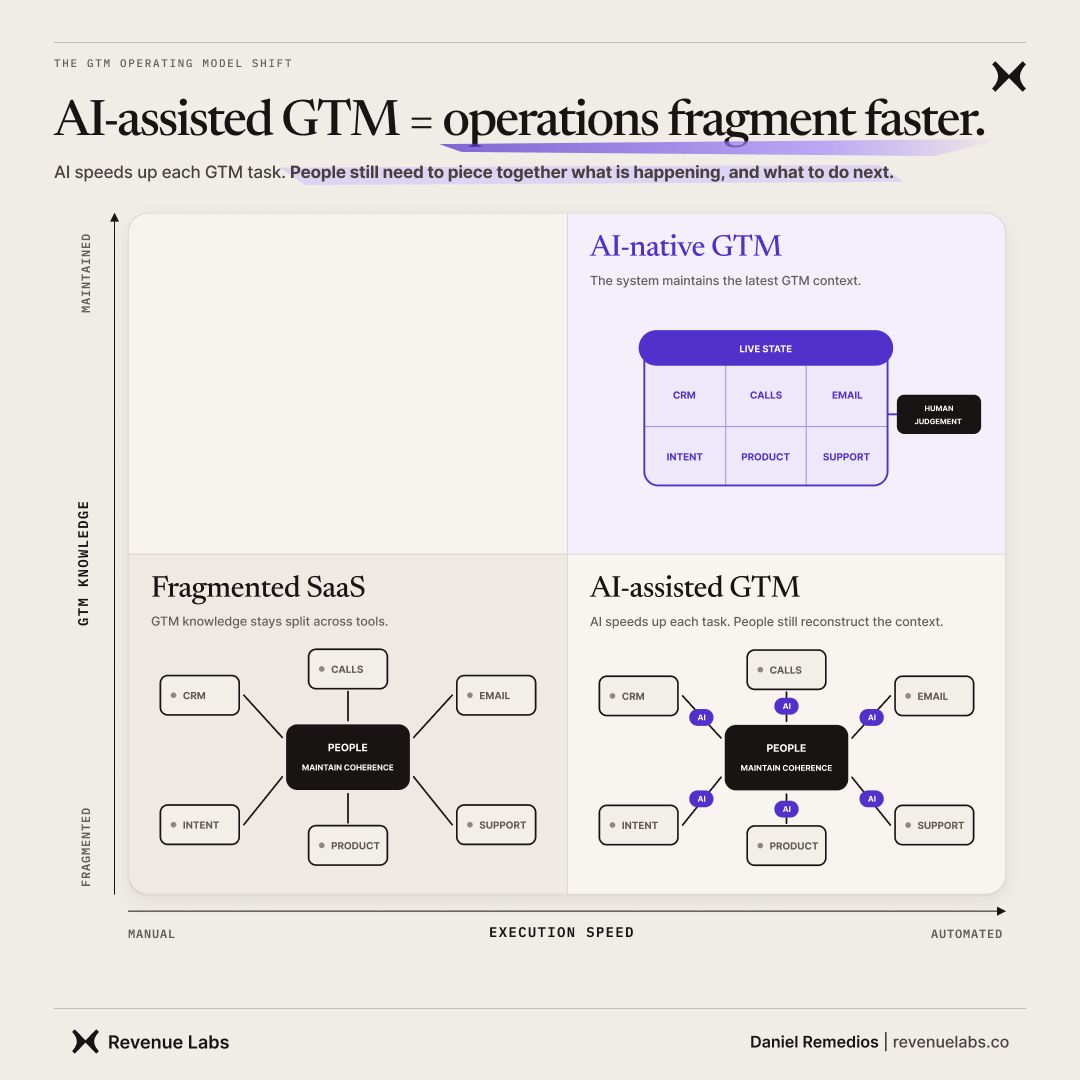
AI-assisted GTM can make a fragmented operating model run much faster.
I think that’s an important distinction as more AI gets added across the GTM stack.
Most companies already have their commercial knowledge distributed across Salesforce, Gong, email, Slack, product, support and dozens of other systems. The operating model that emerged around this was largely human: people continuously piece together what is happening, work out what matters, and decide what to do next.
We’re now making each part of that process much faster with AI.
Research an account. Summarise a call. Draft an email. Update the CRM. Prepare for a meeting. Assess a deal.
But if each of those operations starts by finding and reconstructing the relevant context again, the underlying operating model hasn’t really changed.
We’ve made the fragmentation faster.
This is one of the differences I see between AI-assisted and AI-native GTM.
AI-native starts with the system maintaining an understanding of the commercial environment itself.
It continuously observes the evidence across CRM, conversations, email, product, support and external signals. It maintains what is currently understood about an account, deal or customer, what has changed, what that means, and what should happen next.
That maintained understanding can then be used across prospecting, meeting preparation, deal management, forecasting, customer success and every other capability.
You’re no longer asking every AI interaction to reconstruct the business before it can help.
And humans don’t disappear from the operating model. Their role changes.
Instead of continuously assembling context for the system, they provide judgement where the system actually needs it.
I think this is a much bigger shift than adding AI to every GTM workflow.
It changes where the understanding of the business lives.
I wrote more about this idea, and what I think the missing operating layer looks like, in The Lab ↓
This essay is versioned. Where our thinking develops materially, we will update the version and explain why - the revision history is preserved, not polished away.