
Article
v1.0
Turning everyday GTM decisions into organisational learning
Decision Traces connect what a team knew, why it acted, and what happened next, giving the organisation evidence for future commercial judgements.

Most GTM organisations make 10,000s of consequential decisions every month.
→ Which accounts should we pursue?
→ Is this deal actually at risk?
→ Should we discount?
→ When should we intervene with a customer?
The strange thing is how little of that judgement becomes an organisational asset.
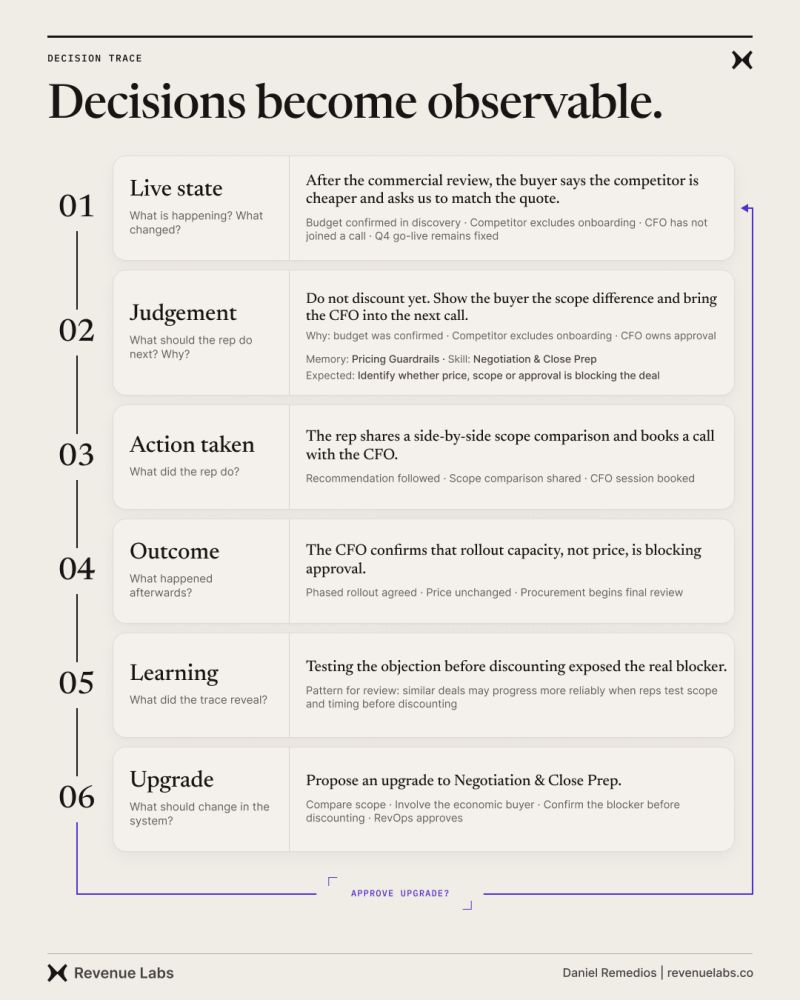
Take a fairly ordinary sales situation. A buyer says a competitor is cheaper and asks you to match the quote.
The rep decides what to do. Perhaps they ask their manager or follow the playbook. Eventually they discount, or they don’t.
A few weeks later the deal closes, slips or disappears.
CRM records the outcome. But the useful part is usually lost: what did we know, why did we make that decision, what did we do, and did it work?
So next time, we largely do the work again.
Another rep makes another judgement. Another manager inspects another deal.
This is where AI-assisted GTM stops too early.
We give the rep AI research. The manager an AI deal summary. RevOps an AI dashboard.
The work gets faster, but the operating model hasn’t really changed. Humans still interpret the information, decide what matters and apply the judgement.
AI-native GTM should work differently.
Imagine the system maintains the live State of the deal. It knows budget was confirmed, the competitor excludes onboarding and the economic buyer hasn’t been involved.
Rather than immediately discounting, it recommends testing whether price is actually the blocker.
The rep does. Rollout capacity turns out to be the real issue, and the deal progresses without the discount.
Now the organisation has evidence about whether its judgement worked.
Repeat that across thousands of GTM decisions and the system can start to learn:
→ Which signals identify accounts worth pursuing?
→ Which deal risks predict slippage?
→ Which interventions reduce churn?
→ Which actions create expansion?
That learning can change how the next account, deal or customer is handled.
This is why Decision Traces are much more important than an AI explainability feature.
They create the connection:
State → judgement → action → outcome → evaluation → learning → upgrade
And that changes the economics.
Today we repeatedly pay people to research, inspect, prioritise, diagnose and make many of the same classes of decision.
AI-assisted makes those tasks cheaper and faster.
AI-native creates the possibility of the system performing more of that work, learning from what happens and improving the next time.
The value isn’t only hours removed.
It’s better accounts pursued. Fewer unnecessary discounts. Earlier deal intervention. Less missed churn. Better allocation of management attention.
And, over time, better judgement.
The system doesn’t just help the organisation operate. It gets better because it operated.
That’s a very different idea of what AI in GTM is for.
This essay is versioned. Where our thinking develops materially, we will update the version and explain why - the revision history is preserved, not polished away.