
Article
v1.0
Three operating models for understanding the GTM business
From software that stores evidence to AI that speeds up reviews, the next shift is a system that continuously maintains shared understanding and coordinates capabilities.

It’s Monday morning.
Every AE, Manager, Executive and RevOps leader starts the week trying to answer the same three questions.
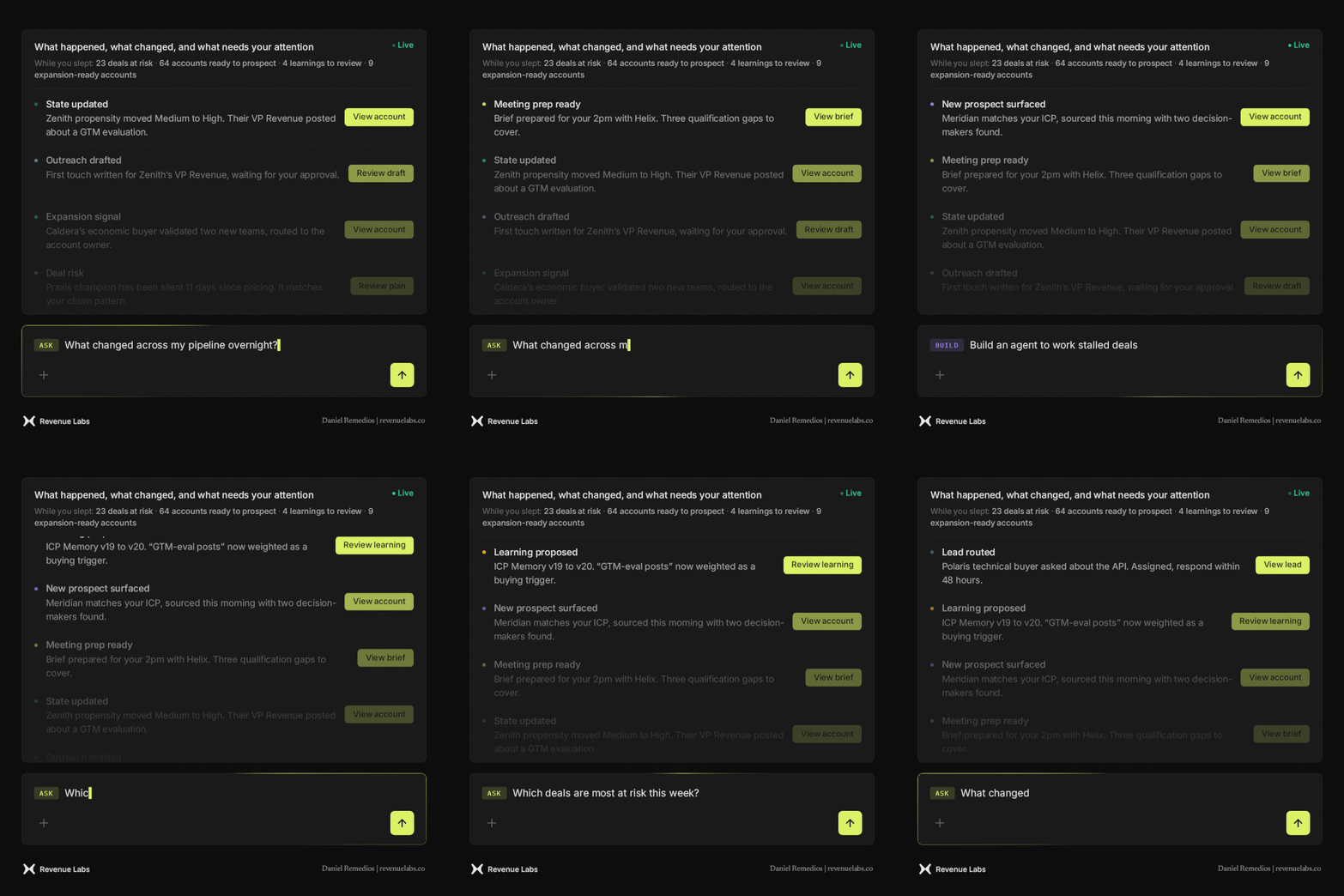
→ what’s happening?
→ what’s changed?
→ what needs my attention?
The work looks different.
→ AEs prepare for meetings across Salesforce, Gong, Gmail and Slack
→ Managers reviews opportunities before the forecast call
→ RevOps analyse dashboards and pipeline movement before the weekly business review
→ Leadership wants to understand whether forecast confidence has changed since last week
Different work.
The same underlying job.
Every team is reconstructing the business before deciding what to do next.
1️⃣ Software supports human coordination
This is the operating model we all know.
Salesforce stores records.
Gong stores conversations.
Gmail stores communication.
Dashboards aggregate metrics.
The software provides the evidence.
People create the understanding, apply judgement and coordinate execution.
Understanding lives with people.
Adding AI changes that experience dramatically.
Meeting preparation takes seconds.
Pipeline reviews immediately surface what’s changed.
Deal Risk explains why confidence has shifted.
Forecast summaries write themselves.
The work becomes faster.
The operating model stays the same.
2️⃣ AI accelerates human coordination
AI is still reasoning from fragmented records spread across Salesforce, Gong, Gmail, Slack and dozens of other systems.
It still has to infer company judgement from prompts, documentation and isolated workflows.
That creates familiar constraints:
→ fragmented context
→ inconsistent interpretation
→ disconnected workflows
→ isolated outputs
→ limited organisational learning
AI accelerates human coordination.
It doesn’t fundamentally change it.
I think AI-native GTM starts from a different assumption.
Instead of asking people (or AI) to repeatedly reconstruct the business, the system continuously maintains an understanding of it.
AI no longer has to infer the organisation from disconnected evidence because it operates within the organisation itself.
This is the missing AI-native GTM Operating Layer.
3️⃣ The AI-native system coordinates capabilities
That AI-native GTM Operating Layer is built from shared primitives:
→ Live State
→ Memory
→ Skills
→ Agents
→ Decision Traces
Together they give both people and AI something today’s GTM stack cannot: a continuously maintained understanding of the business.
Work becomes a system capability:
Meeting Prep. Deal Management. Prospecting. Handovers. Win-Loss Analysis.
Everything starts from the same shared foundation instead of rebuilding context from scratch.
I think that’s the real shift.
Adding AI reduces the cost of existing work.
AI-native systems change how the GTM teams and agents continuously understands, decides, acts and learns.
This essay is versioned. Where our thinking develops materially, we will update the version and explain why - the revision history is preserved, not polished away.