
Article
v1.0
The cost of reconstructing the same commercial reality
Reps, managers, and customer success teams repeatedly assemble context the company already holds. Maintained State lets multiple capabilities use that understanding.

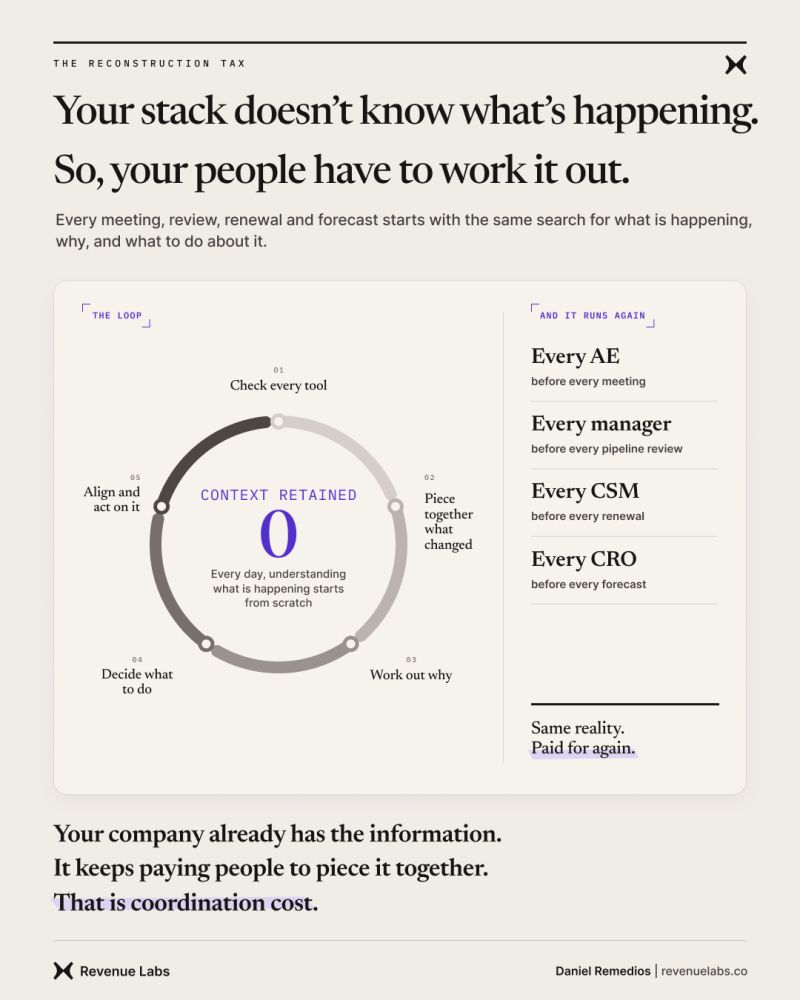
A surprising amount of GTM work is paying people to reconstruct things the company already knows.
Before a meeting, an AE checks Salesforce, Gong, email and Slack to understand the account. Before pipeline review, a manager reconstructs the same reality across 20 deals. Before a renewal, a CSM pieces together usage, support, conversations and commercial history.
The information exists. What doesn’t exist is a maintained understanding of what it means.
So the organisation keeps paying to reconstruct it.
AI-assisted GTM makes that considerably faster:
→ summarise the calls
→ research the account
→ analyse the deal
→ prepare the briefing
→ generate the report
The work gets faster, but the architecture remains fragmented. Each person, copilot or agent can still assemble its own context, reach its own interpretation and discard much of that understanding.
Faster reconstruction is still reconstruction.
This is why I think State is a defining primitive of an AI-native GTM system.
State is the system’s maintained understanding of commercial reality: what has happened, what changed, what the organisation believes it means, the evidence behind that judgement and its confidence.
For a prospect, that might mean understanding Fit, Problem, Timing and Access: not just that a CRO was hired or sales headcount increased, but why those signals change the account’s propensity and what deserves attention.
For a deal, it might mean understanding that the champion is weakening, the economic buyer remains unengaged, security has entered the process and the implementation date is becoming less credible.
Once that understanding persists, capabilities can operate on it.
If Prospect State changes:
→ Prioritisation can reassess the account
→ Research can investigate why now
→ Prospecting can determine the next best action
→ Meeting Prep can inherit what is already understood
If Deal State changes:
→ Deal Assessment can reassess risk
→ Pipeline Review can surface the exception
→ Forecasting can update its judgement
→ Coaching can recommend an intervention
This is where the economics change.
AI-assisted makes thousands of individual tasks faster.
AI-native turns maintained understanding into shared infrastructure.
One change in State can inform multiple capabilities. Those capabilities can apply the same codified organisational Memory and Skills rather than independently reconstructing how the company thinks.
And the loop continues.
The system observes what happened, evaluates its previous judgement and can learn how its State, Memory, Skills and capabilities should improve.
State → understand → decide → act → observe → learn.
This is one of the ideas we’ve been exploring in The Lab.
The question isn’t only how much faster AI can make existing work.
It’s what changes when an organisation can maintain its understanding once, use it everywhere, and continuously improve how it acts.
This essay is versioned. Where our thinking develops materially, we will update the version and explain why - the revision history is preserved, not polished away.