
Article
v1.0
Making commercial judgement executable across GTM
Shared Memory lets a company’s beliefs shape sourcing, research, prioritisation, and engagement, then change as outcomes reveal what those beliefs got right.

Most companies are giving AI access to their data before they’ve worked out how to give it access to their judgement.
Consider something as simple as deciding which accounts to prioritise.
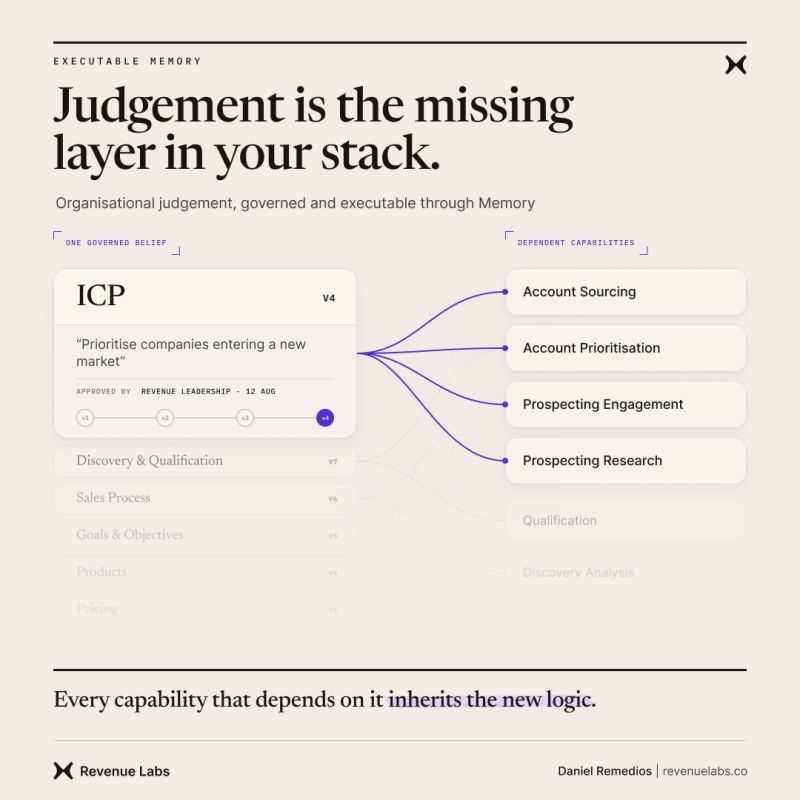
Revenue leadership might believe that companies entering a new market are particularly valuable. That judgement should influence which accounts are sourced, how they’re assessed, what research is performed, how they’re engaged and how performance is analysed.
But where does that judgement live today?
Some of it is encoded in CRM fields and scoring models. Some sits in playbooks, prompts and workflows. Much of it exists implicitly in the heads of the people who understand the market best.
Adding AI to each part of the stack doesn’t solve this. It can actually create more places for the organisation’s judgement to diverge.
A research agent gets one set of instructions. A scoring model contains another. An engagement agent has its own prompt. RevOps updates a workflow. Sales leadership changes its view of the market.
Each component can become more intelligent while the system remains fragmented.
This is one of the differences I see between AI-assisted and AI-native GTM.
AI-assisted systems make individual workflows more intelligent. AI-native systems need a shared layer of organisational judgement that every relevant capability can inherit.
We think of this as executable Memory.
A belief can be governed, versioned and connected to every capability that depends on it. Change the belief once and the logic used across sourcing, prioritisation, research, engagement and analysis can change with it.
The more interesting part comes next.
The system can observe what happened after that judgement was applied. Which accounts engaged, progressed, became opportunities or won becomes evidence about whether the original belief was actually right.
Now experience can change Memory, and Memory can change the next decision.
What we knew → What we decided → What we did → What happened → What we learned
This changes more than the amount of work AI can automate.
Organisations have always accumulated judgement through experience. What’s been difficult is capturing it, distributing it and consistently applying it to the next decision.
If AI-native systems make that judgement executable, the economics start to change:
Learn once → encode once → improve everywhere.
The real leverage from AI may not just be cheaper execution.
It may be making better organisational judgement compound.
This essay is versioned. Where our thinking develops materially, we will update the version and explain why - the revision history is preserved, not polished away.