
Article
v1.0
Live State gives AI a maintained model of the business
Connected evidence updates the system’s understanding of what is true, what changed, and what remains uncertain, creating context that GTM capabilities can reuse.

I increasingly think State is one of the defining breakthroughs required for AI-native GTM.
Not better prompts. Not more Skills. Not even more autonomous agents.
Because AI can only make good commercial decisions if it has an accurate model of the world it is acting on.
And GTM doesn’t really have one today.
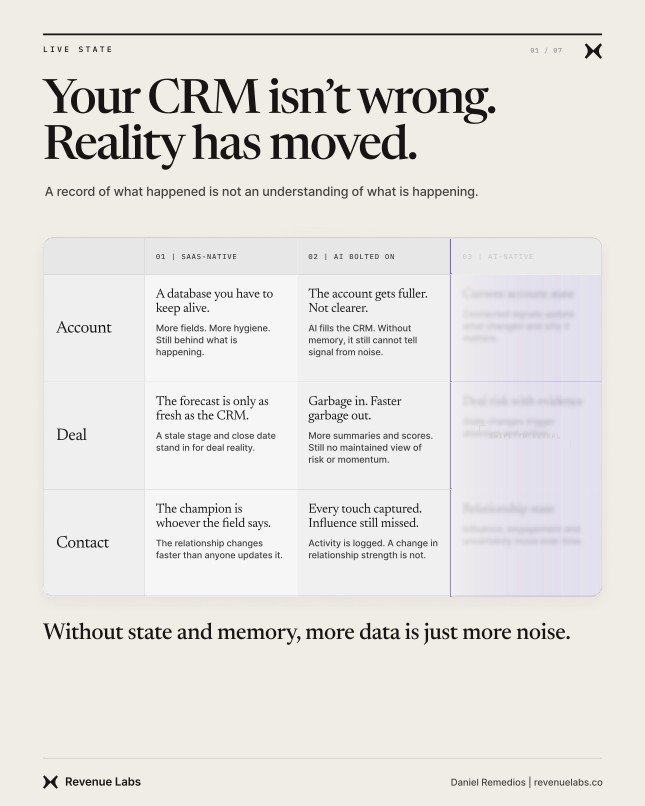
It has records, activities, conversations, signals, documents and metrics across many systems. Each is evidence about commercial reality. None, independently, is commercial reality.
People have always filled the gap.
They reconstruct what is happening, reconcile evidence, apply company-specific judgement and decide what should happen next.
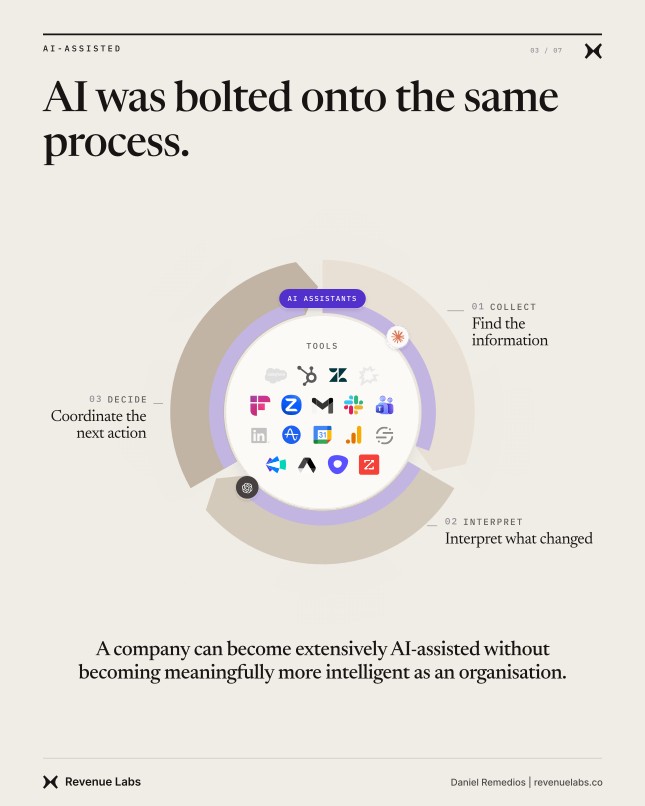
Adding AI to legacy SaaS makes that process dramatically faster.
It doesn’t remove the underlying problem.
AI can retrieve more information, summarise calls and generate analysis while still reconstructing reality each time it acts.
Multiple agents operating from fragments of context can create multiple interpretations of the same business.
More intelligence without shared State can mean faster fragmentation.
AI-native systems require a different architecture.
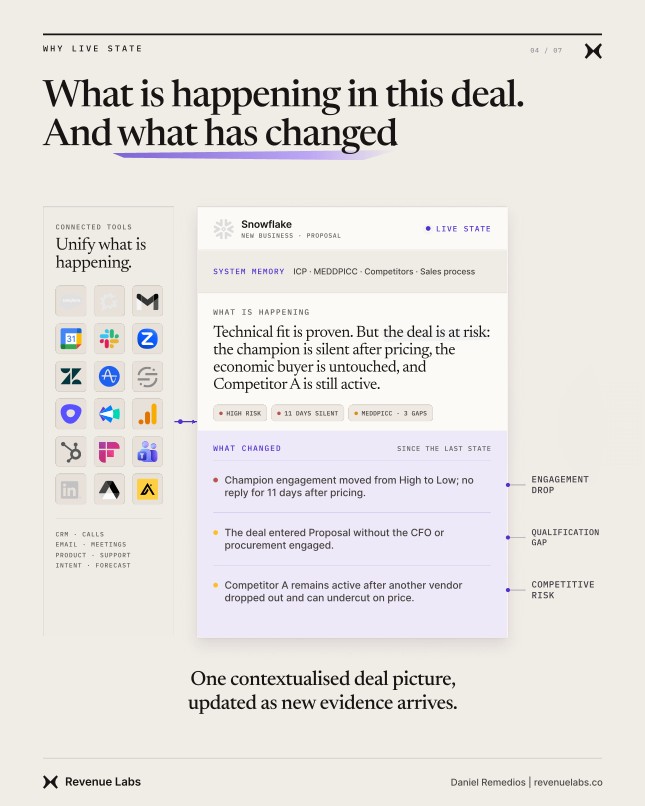
Raw GTM data becomes evidence. Evidence from accounts, contacts, conversations, engagement, product usage, meetings and market signals is connected over time.
That evidence updates a maintained representation of what is currently true, what has changed, what remains uncertain and what requires attention.
That is Live State.
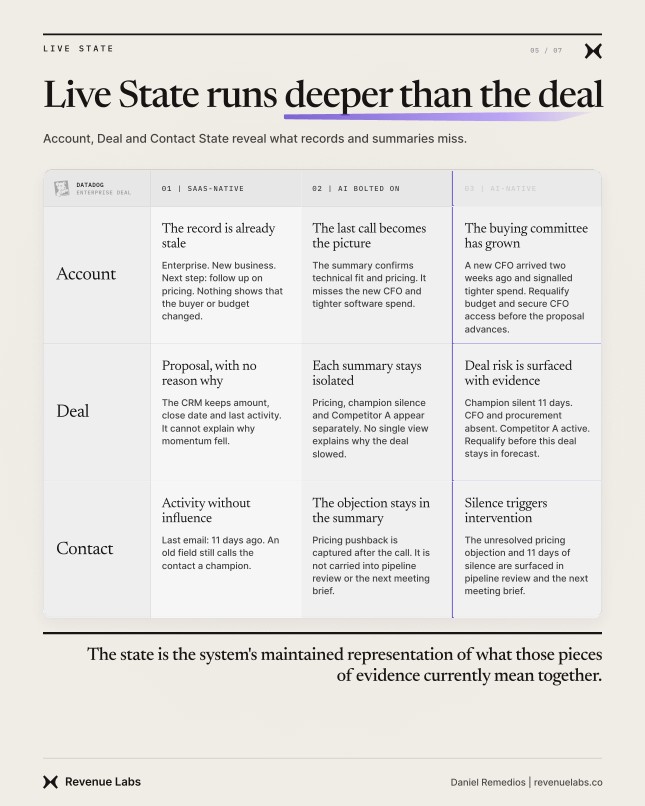
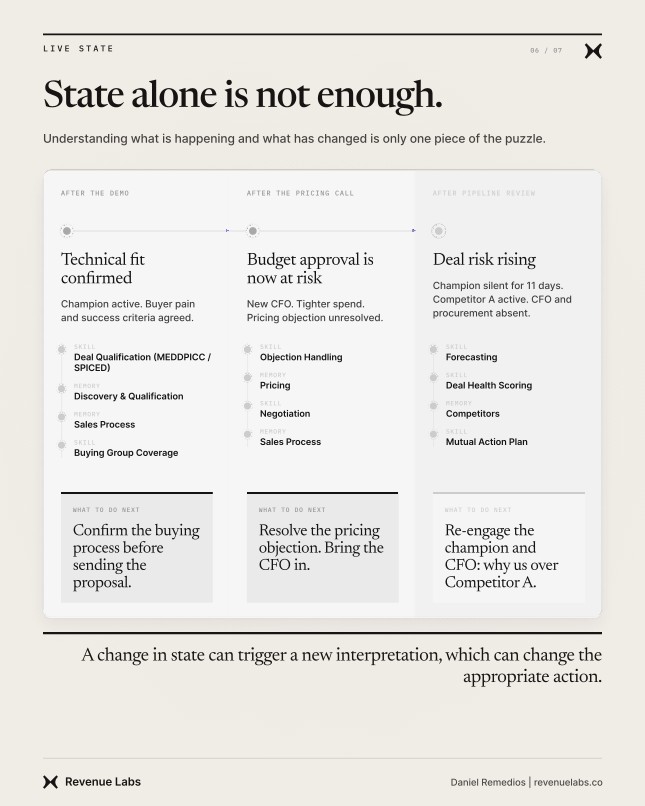
A record might tell you a contact is the champion. State can recognise their influence has weakened.
A CRM might tell you a deal is in Proposal. State can recognise that budget conditions changed, the economic buyer is absent and competitive risk has increased.
Memory and Skills then provide the organisation’s judgement for interpreting that reality and deciding what should happen next.
This changes more than the quality of an AI output.
It changes the economics of GTM.
Today, enormous commercial effort is spent reconstructing context: reps preparing, managers inspecting, RevOps reconciling and leaders establishing which reality to trust.
If the system maintains that understanding continuously, it can be reused across prospecting, meeting preparation, deal assessment, pipeline review, forecasting, coaching and every commercial capability above it.
Understand once.
Use everywhere.
Update continuously.
That is why I don’t think AI-native GTM emerges by adding enough AI features to the existing SaaS stack.
SaaS was designed to store and coordinate the evidence of work.
AI-native systems need to maintain an evolving model of the business itself.
Once that exists:
State → judgement → action → outcome → learning
The system can understand before it acts, explain why, observe what happened and improve the logic used next time.
Not software with more intelligence added to it.
A commercial system capable of maintaining and improving its understanding of reality.


This essay is versioned. Where our thinking develops materially, we will update the version and explain why - the revision history is preserved, not polished away.