
Article
v1.0
From more AI output to a more intelligent organisation
Maintained State, executable company judgement, coordinated capabilities, and traced outcomes can change how the company learns from the work it performs.

Most companies are using AI to do more work.
I think the bigger opportunity is to make the company itself more intelligent.
There’s an important difference.
Think about how most GTM organisations operate today.
→ Salesforce stores the opportunity
→ Gong stores the conversation
→ Slack contains fragments of discussion
A playbook describes how the team should sell:
Then people provide the connective tissue.
They reconstruct what is happening.
They decide which context matters.
They apply judgement.
They coordinate the next action.
They learn from what happened, then hopefully remember that learning the next time.
AI makes a lot of this faster.
→ Summarise the call
→ Research the account
→ Write the email
→ Assess the deal
→ Recommend the next action
It feels productive.
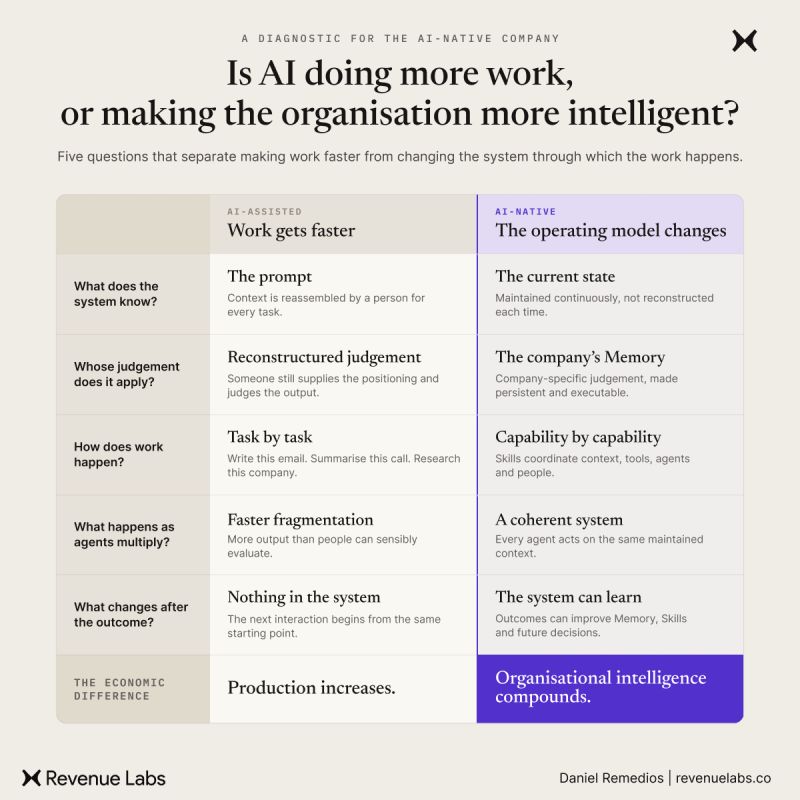
But the underlying operating model hasn’t necessarily changed.
→ Context can still be reconstructed for every task
→ Company judgement can still live primarily inside people
→ Agents can still operate from different assumptions
And after the outcome, very little about the system itself has changed.
More intelligence in the workflow does not necessarily create a more intelligent organisation.
I think AI-native GTM starts when we change the system underneath the work.
→ State is maintained, rather than continually reconstructed
→ Company knowledge and judgement become persistent and executable
→ Skills coordinate context, tools, agents and people around capabilities
→ Important decisions can be traced to outcomes
→ Outcomes can improve how the system operates next time
The distinction matters economically too.
→ AI-assisted increases production
→ AI-native has the potential to compound organisational intelligence
This is the idea I’ve been trying to make much more explicit while building Revenue Labs.
And the further we’ve followed it, the more it has taken us beyond individual AI use cases into questions about State, Memory, Skills, Agents, decision-making, RevOps, management and how the company itself learns.
I’ve written the first version of that thinking down.
It starts with The AI-Native Operating Model.
Link in the comments.
This essay is versioned. Where our thinking develops materially, we will update the version and explain why - the revision history is preserved, not polished away.