
Article
v1.0
Why accurate CRM data isn’t enough to understand a deal
Sales teams repeatedly piece together what has changed across calls, emails and CRM records. AI-native systems maintain that understanding continuously.

Every CRM field can be correct.
And your understanding of the deal can still be wrong.
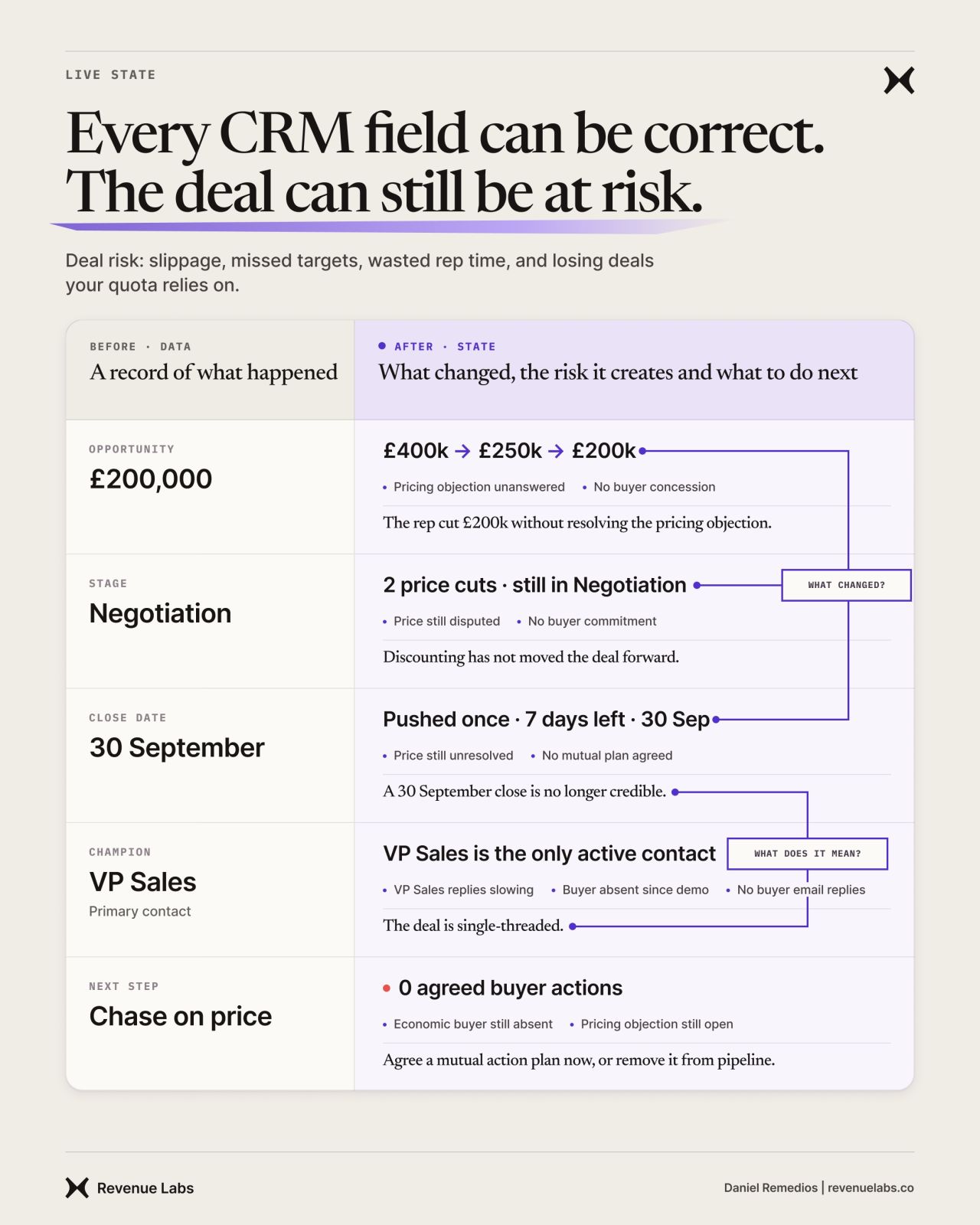
Take a £200k opportunity.
Stage: Negotiation.
Close date: 30 September.
Champion: VP Sales.
Next step: Chase on price.
Every field might be accurate.
But now look at what has happened.
→ £400k became £250k, then £200k
→ Neither concession produced buyer commitment
→ The close date has already moved
→ The economic buyer is absent
→ Engagement is slowing
→ There are no agreed buyer actions
The interesting thing isn’t that the CRM needs more fields.
It’s that the meaning of the existing fields has changed.
£200k isn’t simply the opportunity value. It’s the result of two unsuccessful price cuts.
Negotiation isn’t simply the stage. It’s a negotiation where the seller has conceded twice and the buyer hasn’t moved.
30 September isn’t simply the close date. It’s a date that has already slipped, with no mutual plan and seven days remaining.
VP Sales isn’t simply the champion. They’re now the only active contact.
A good sales manager will work this out.
But think about the work required to do it.
They reconstruct the deal from the CRM, call transcripts, email, meetings, rep knowledge and everything that has happened since the last review.
Then they reason across it:
Discounting hasn’t moved the deal forward.
The deal is single-threaded.
The close date is no longer credible.
Get a mutual action plan agreed now, or remove it from pipeline.
That reconstruction happens constantly across GTM.
Before pipeline reviews.
Before meetings.
Before forecasts.
Before account reviews.
Before deciding what to do next.
And I think this is where the distinction between AI-assisted and AI-native GTM becomes much clearer.
AI-assisted helps humans reconstruct the answer faster.
AI-native removes the need to reconstruct it in the first place.
The system continuously observes the evidence, understands what changed, maintains its current understanding, and determines what deserves attention.
Research → Evidence → State → Attention → Next Best Action
We call that maintained understanding State.
Without it, managers spend pipeline reviews discovering what is happening instead of deciding what to do about it.
Reps repeatedly explain context the organisation already possesses.
Forecasts inherit stale assumptions.
And bad deals consume time because the record still looks healthy after the underlying reality has changed.
The next generation of GTM systems won’t just help us record and retrieve commercial data.
They’ll maintain an understanding of the business as it changes.
That’s the shift from a system of record to an AI-native operating system.
This essay is versioned. Where our thinking develops materially, we will update the version and explain why - the revision history is preserved, not polished away.