
Article
v1.0
Designing GTM to learn from every commercial decision
Connecting evidence, judgement, action, and outcomes can turn individual lessons into improvements across the company. RevOps has a role in designing that loop.

I think AI changes something much more important than the productivity of a GTM team.
It changes the possible learning rate of the company itself.
We’re already seeing the first-order effect.
AI can research more accounts, write more messages, analyse more calls, assess more deals and recommend more actions.
The work gets faster.
But if the operating model underneath it stays the same, something important doesn’t change.
An account is prioritised. A message is chosen. A rep takes an action. A deal progresses or stalls. Eventually, there is an outcome.
The evidence is usually captured somewhere.
But the judgement that connected the evidence to the decision rarely is.
And even when somebody learns from the outcome, that learning usually remains with the person.
The rep gets better. Managers develop intuition. RevOps changes a process. Enablement updates a playbook.
The organisation learns slowly and unevenly.
The system itself hasn’t really learned.
This becomes more consequential as AI makes more decisions and actions possible.
Because faster work without a learning loop can simply mean making more decisions while forgetting why they worked.
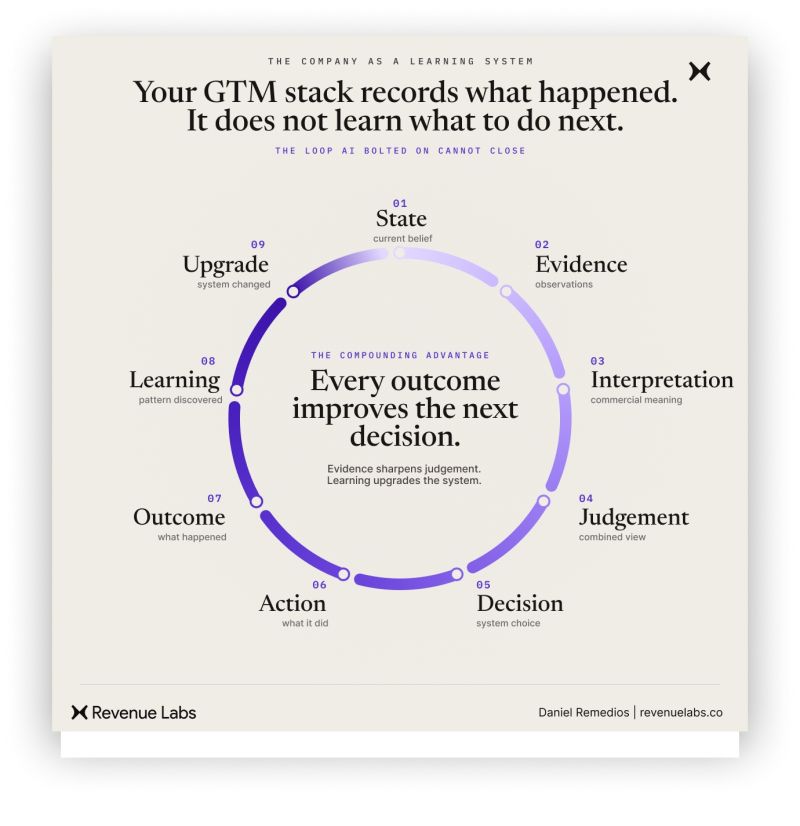
I think AI-native GTM requires a different operating model:
State → Evidence → Interpretation → Judgement → Decision → Action → Outcome → Learning → Upgrade
Now a lost deal can improve how future deals are qualified.
A prospect that converts can change how the next account is prioritised.
An objection can improve messaging.
A forecast miss can improve how risk is interpreted.
Learning no longer depends entirely on humans noticing a pattern, remembering it and distributing it across the organisation.
The operating system can learn too.
And I think this becomes an increasingly important responsibility for RevOps.
Not simply administering the GTM stack or deploying AI tools, but designing the commercial learning system itself.
What should the organisation observe?
What judgement should be codified?
What did we learn from the outcome?
What should change because of it?
That creates a very different kind of compounding advantage.
Not simply more work per person.
But better judgement per decision, because of every decision that came before it.
The companies that close this loop will compound their commercial judgement.
The companies that don’t may simply do the same work faster.
This essay is versioned. Where our thinking develops materially, we will update the version and explain why - the revision history is preserved, not polished away.