
Article
v1.0
Decision Debt: the learning lost when judgement goes unrecorded
Decision Traces preserve context, reasoning, and outcomes as evidence for future work. Without them, commercial experience can disappear even as AI accelerates execution.

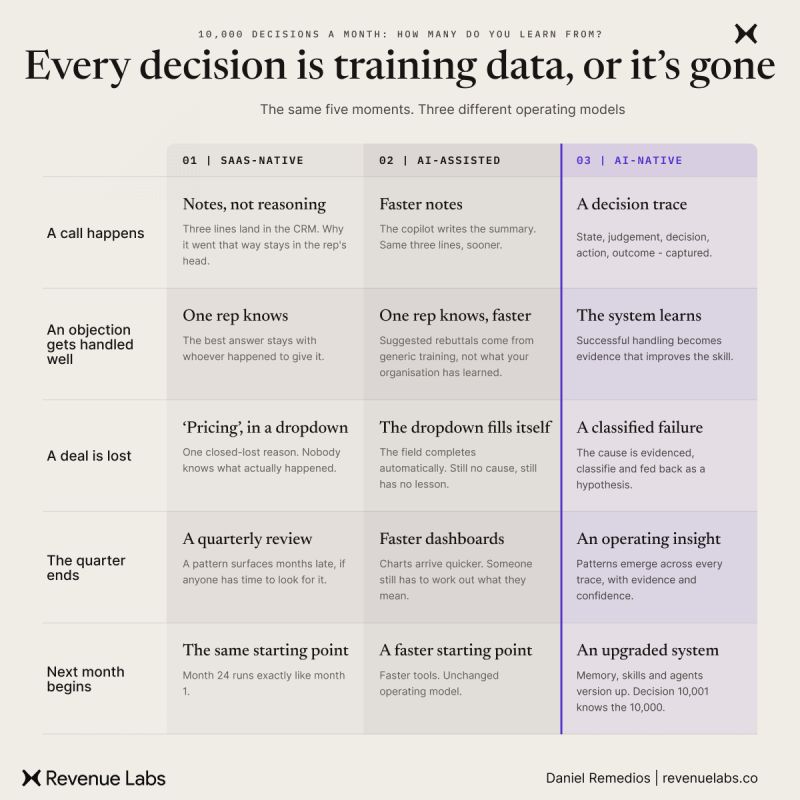
Your GTM organisation might make 10,000 decisions this month.
How many will decision 10,001 learn from?
Think about how much judgement passes through a GTM organisation every day.
→ Which account should we pursue?
→ Who should we contact?
→ What should we say?
→ Is this deal healthy?
→ Why did it slip?
→ Should a manager intervene?
→ Why did we lose?
In most companies, very little survives:
→ CRM captures the outcome
→ Gong captures the conversation
→ Slack captures fragments
The reasoning sits between them, reconstructed by people when they need it again.
AI makes this faster.
→ Calls get summarised
→ CRM updates itself
→ Deals get assessed
→ Next actions get recommended
But there’s a deeper problem.
More decisions are being made, faster, across disconnected systems, while context, judgement and outcomes still disappear into human coordination.
AI-native GTM requires us to treat the decision differently.
Imagine every important decision represented as:
State → judgement → decision → action → outcome
→ What did we know?
→ What did we believe?
→ Which company logic was applied?
→ What did the person or agent decide?
→ What happened next?
That creates a Decision Trace.
Once the logic going into decisions is codified in Memory and Skills, you can close the loop:
Codified judgement → decision → trace → outcome → learning → upgraded judgement
An objection handled brilliantly doesn’t disappear with the call. It becomes evidence that can improve the skill.
A lost deal doesn’t become “pricing” in a dropdown. The system can compare similar decisions and form a hypothesis about what should change.
A manager’s judgement can inform how the system assesses the next opportunity.
This is where AI-native becomes much more important than automation:
Imagine two companies make 10,000 commercial decisions this month.
Company A does the work and starts next month with faster tools.
Company B turns those decisions into evidence for improving its ICP, messaging, qualification, discovery, objection handling, deal assessment, coaching and agents.
Both did the work. Only one turned it into an asset.
That asset compounds.
Month 1 improves Month 2.
One rep’s experience can improve every rep.
Every interaction can improve the system that handles the next one.
The organisation doesn’t just accumulate more data.
It accumulates better judgement.
I think this becomes one of the most important assets in the AI-native era: proprietary training data representing not just what happened, but how the company thinks, decides and learns.
And there is another consequence.
Every month a company operates without capturing this creates decision debt.
You can adopt the same models later. You can buy the same tools.
But you cannot reconstruct the context, reasoning and outcomes of 100,000 decisions you never traced.
The cost of waiting isn’t only the productivity you miss today.
It’s the learning you won’t have tomorrow.
This essay is versioned. Where our thinking develops materially, we will update the version and explain why - the revision history is preserved, not polished away.