
Article
v1.0
Building a sales system around shared understanding
Live context, Memory, Skills, Agents, and Decision Traces let sales capabilities coordinate their work and deliver decisions where teams already operate.

Most Sales teams are adding AI to the work they already do. But the AI-native operators think differently👇
→ Meeting prep
→ Follow-up
→ Forecasting
→ Pipeline reviews
→ Coaching
→ Win-Loss analysis
Simply connect Claude to your favourite GTM tool.
Or use their in-built Agents.
The work gets faster.
But the Sales system underneath it often stays the same.
Context is still fragmented across CRM, calls, emails and documents.
Process still depends on people knowing what to look for, what to do next and how the company expects the work to be done.
Execution still varies by rep, manager, tool and moment.
And almost none of what happens improves the system for next time.
Because everything continues to work in isolation. And it’s missing everything AI needs to operate effectively within a system.
That is the difference between adding AI to Sales and building an AI-native Sales System.
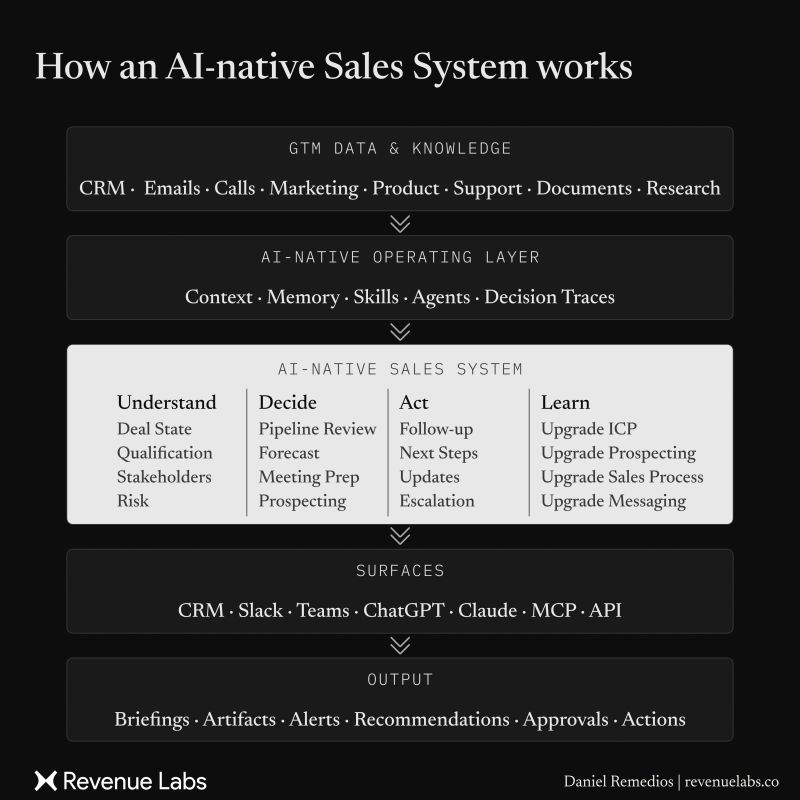
An AI-native system runs on a different architecture; supporting teams and agents with a new operating layer:
→ Live context continuously maintains the state of every deal, account, stakeholder and pipeline
→ Memory codifies what the company believes: ICP, qualification criteria, messaging, competitors, deal patterns and customer evidence
→ Skills codify how the work should be done: research, meeting prep, deal inspection, CRM updates, pipeline review, forecasting, follow-up, coaching and escalation
→ Agents use that shared context, memory and skill to run the work proactively and consistently
→ Decision traces capture what the system understood, why it acted and what happened next, so the system can improve
This creates new capabilities across the Sales operation.
The system can understand deal state, identify risk, prepare the next meeting, recommend the next action, update the forecast and escalate what matters.
It can do that continuously.
And it can deliver the output where people already work:
→ A briefing in Slack before a meeting
→ A recommendation inside the CRM
→ An approval for a manager
→ An action executed by an agent
→ An updated artefact for the pipeline review
Less software for people to operate.
More of the revenue operation operating itself, with people in the loop where judgement matters.
Here’s the takeaway:
The opportunity is not faster fragmented work.
It is a Sales System that shares understanding, coordinates execution and continuously upgrades how the company sells.
This essay is versioned. Where our thinking develops materially, we will update the version and explain why - the revision history is preserved, not polished away.