
Article
v1.0
A shared operating layer for AI-native GTM
Live State, Memory, and Skills give people and agents a common foundation for coordinating work and improving the capabilities that operate on it.

Most GTM teams think AI-native means adding AI.
I think it means changing the operating model.
Today, AI is making almost every GTM activity faster:
→ Research accounts
→ Summarise calls
→ Draft emails
→ Update CRM
→ Review pipeline
→ Forecast opportunities
→ Personalise prospecting
The work gets dramatically faster.
But underneath, the operating model is largely unchanged.
→ AE still has to understand what’s happening before deciding what to do next
→ Manager still has to inspect the pipeline before deciding where to coach
→ RevOps still has to reconcile systems, context and process before recommending action
→ Leadership still waits for the organisation to explain what changed
Different work.
The same hidden job.
Continuously maintaining a shared understanding of the business.
That’s the layer I think most AI discussions miss.
AI accelerates execution.
It doesn’t fundamentally change coordination.
Every new AI creates more recommendations, more outputs and more decisions, but someone still has to connect them together, apply company judgement and decide what happens next.
That’s why I think AI-native GTM starts from a different assumption.
Instead of asking people to continuously reconstruct the business…
…the system continuously maintains it.
Live State gives every person and every agent the same understanding of prospect, opportunity and customer:
→ what's happening
→ what's changed
→ what needs your attention
Every task changes from an isolated AI workflow to a buildable capability within a system that runs on that shared foundation:
→ Sourcing accounts
→ ICP and propensity scoring
→ Prospecting
→ Meeting prep
→ Deal risk
→ Pipeline reviews
Memory captures how the company thinks.
Skills capture how the company operates.
Agents execute consistently from the same context and logic.
The work stops depending on every individual reconstructing the business from scratch.
And because every decision is observable, the system can learn.
It identifies where context is missing.
Where judgement should improve.
Which skills should evolve.
Which capabilities should exist next.
The operating model continuously upgrades itself.
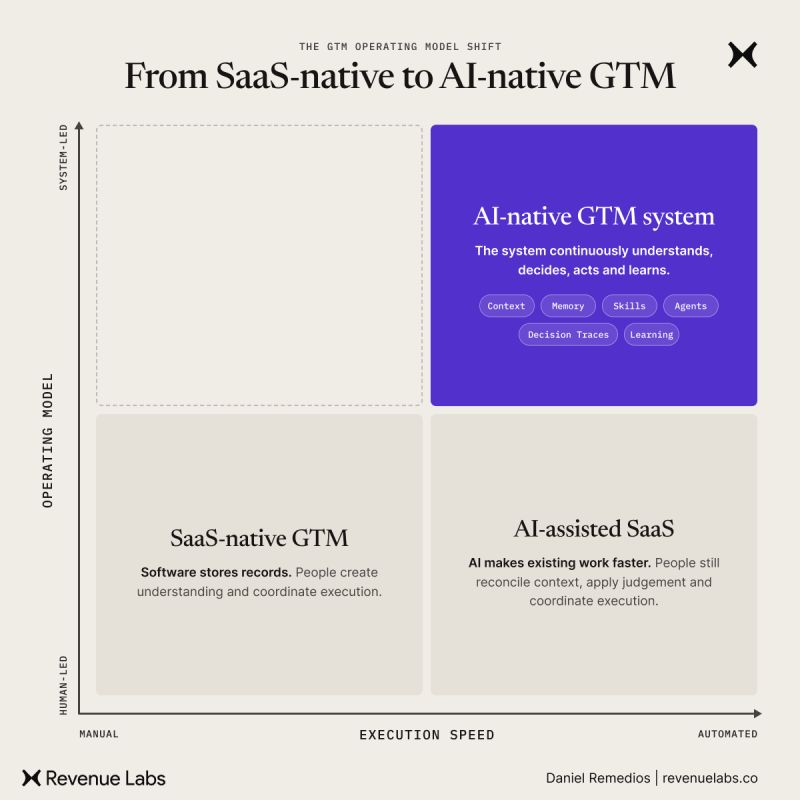
That’s the difference I see between AI-assisted GTM and AI-native GTM.
→ AI-assisted achieves faster work, but exposes an operating model dependent on manual reconstruction, coordination and learning
→ AI-native introduces an operating layer that continuously understands, coordinates, learns and improves
I think that’s the architectural shift we’re beginning to see.
This essay is versioned. Where our thinking develops materially, we will update the version and explain why - the revision history is preserved, not polished away.